* 1 "Ikugyo" is the nickname for childcare leave in Tokyo. This article will use this term consistently.
Last time, we asked three male employees about the circumstances, duration, and timing of their child-rearing. This time, we will continue to ask them in detail about how they have been working since returning to work after child-rearing, and how they balance their work and child-rearing responsibilities on a daily basis.
<Participants>
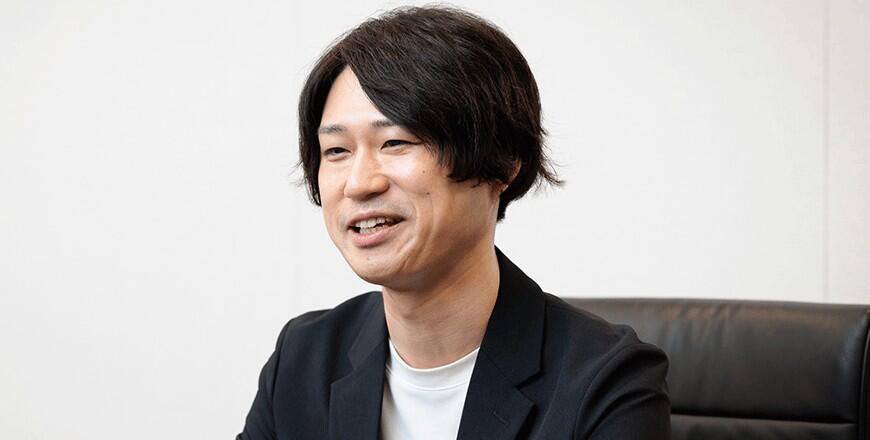
Product Business Division: Mr. Machida (left in photo)
Father of a 4-year-old daughter. Worked for 4 months when their first child was born in August 2020. Responsible for mcframe implementation support, partner support, video production, etc. His wife also works in the IT industry, making them a dual-income family.
Mr. Fujimoto (center of photo) from the Solutions Business Division
He is the father of two children, an eldest son in sixth grade and a second son who is two and a half years old. He did not work for his first child, but worked for two months when his second child was born. He is in charge of IoT implementation and maintenance.
Mr. Nishimura (right in the photo) from the Product Business Division
Father of a 3-year-old son. Received 5 months of parental leave when his first child was born in May 2021. Responsible for product planning for mcframe X, the SaaS version of the mcframe series. Goes to the pool with his son about once every two weeks.
*The departments and children's ages are as of the time of the interview.
Managing childcare after returning to work
Division of responsibilities at home (Mr. Fujimoto)

Fujimoto has a family of four, and his eldest son, a sixth-grader, has extracurricular activities, so he often goes out on weekends for those activities. "My wife takes care of all the housework and childcare, so I'm able to concentrate on my work during the week. I'm really grateful that I'm able to balance my work and family life thanks to her support in this way of working. On weekends, my wife often goes out with our eldest son, so I spend the day with our youngest child. I get up at 7:30 in the morning, prepare breakfast, and take him to the park or shopping. My youngest son is still young, so if he's crying at night, I sometimes sleep with him."
Tips for a dual-income household (Mr. Machida)

In Machida's household, where both partners work, the couple cooperates in raising the children. Particularly impressive is the way they use the smart speaker Alexa to manage their time.
"Alexa manages everything. The alarm goes off at 6:30 in the morning, and I set minute-by-minute reminders for the schedule leading up to dropping off my child at daycare at 8:00. I set things like, 'Let's brush our teeth,' 'It's time for dinner,' 'Let's write a message for daycare,' and 'Put on our socks.' The whole family follows Alexa's instructions. My child knows what to do and when it's time, so we can get ready smoothly."
Regarding the division of responsibilities between the couple, she says, "On days when I work from home, I'm usually in charge of taking the kids to and from nursery school, and after they get home from nursery school, I'm in charge of meals, baths, and preparing for the next day.We don't have any particular rules for other household chores, and we just try to be considerate and help each other out if we're tired."
Practicing flexible working styles (Mr. Nishimura)

Nishimura balances her work life with taking her children to and from nursery school and taking care of most of the housework. "My child wakes up around 7am, so I get up with him, make breakfast and eat it together. I leave the house around 8:30 am, drop him off at the nursery school in front of the station, and then I'm in the office around 10am."
Since returning to work, she says she has learned to control her work pace. "I try to schedule meetings between 10am and 5pm whenever possible. Daycare starts charging after 6pm, so I leave work around 5pm and pick my child up by 6pm. Sometimes I have to change meeting times depending on my child's schedule, so I feel bad for my colleagues, but I try to accept it."
After returning home with her children, Nishimura is in charge of everything from dinner to bath time, playing with them a little, and then putting them to bed. "I can't do this every day, so sometimes I just let my children play on their own. When I do that, time passes and before I know it, it's past their scheduled bedtime."
Changes in life caused by children's growth and personal growth
As children grow, their lifestyles change dramatically. Fujimoto talks about the changes that occurred when her eldest child started elementary school. "After he started elementary school, he took a variety of extracurricular activities, such as swimming, gymnastics, and cram school, but he gradually began to show more of his own will, and now he is concentrating on the extracurricular activities he chose. I feel that my child has grown as he is now able to make his own choices."
Machida and Nishimura, whose children are close in age, feel that their children's health problems and troubles have decreased since they were about three years old.
Machida says about her four-year-old daughter, "When she was between 0 and 1 year old, I needed some kind of care for about half the month, but as she grew, she got sick less often. However, I still feel like I'm being able to cut back on my work, and I think I'm still being helped out in some ways by my fellow members. The daily mishaps other than illness were also more severe when she was between 0 and 1 year old. At first, any kind of trouble would make me want to cry, but with more experience I've gotten used to it, and now I feel a lot better."
Nishimura-san agreed, "Until he was about two years old, he was quite sick, but this year he has hardly ever been sick, which is a relief. As a result, we have had fewer sudden problems and had to deal with them, so I think his daily routine has not been disrupted as much. I think that getting used to dealing with problems that used to be difficult is also a part of his growth. When preparing to go out, I can now use my experience, thinking, 'This is how it was done before, so I'll do this.'"
From the stories of these three people, we could see that children's growth leads to the growth of parents, and that as children grow, it becomes easier to balance work and family life.
Conclusion: Creating an environment that supports balancing work and childcare
This time, we introduced B-EN-G members' work styles after returning to work and how they balance work and childcare on a daily basis. Whether it's a stay-at-home mom household or a dual-income household, the couples share responsibilities in a way that suits them and work together to raise their children.
On the other hand, support and understanding from the workplace are important when it comes to work. B-EN-G has created a forum where working parents can exchange information through its internal social media, and actively exchanges various information on balancing work and childcare.This environment fosters an atmosphere of support for childcare throughout the workplace.
In the next (and final) installment, we will share some advice for those who are planning to start raising children.