*"Ikugyo" is the nickname for childcare leave in Tokyo. This article will use this term consistently.
At B-EN-G, we encourage employees to take advantage of our childcare leave system so that they can balance work and childcare, regardless of gender.
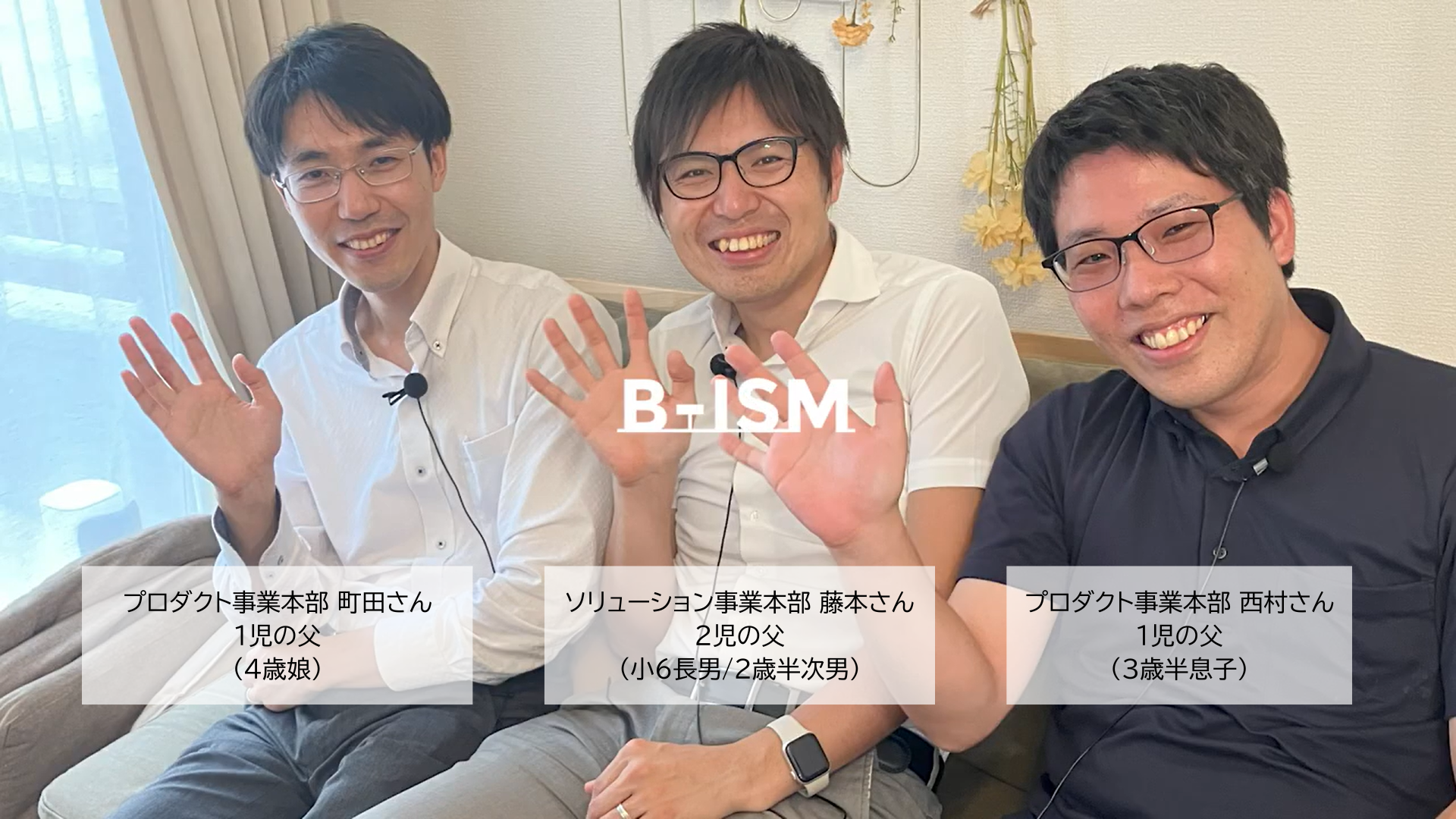
This time, we asked three male employees who are currently raising children to talk about the reality of raising children and how they balance work and family life.
<Participants>
Product Business Division: Mr. Machida (left in photo)
Father of a 4-year-old daughter. Worked for 4 months when their first child was born in August 2020. Responsible for mcframe implementation support, partner support, video production, etc. His wife also works in the IT industry, making them a dual-income family.
Mr. Fujimoto (center of photo) from the Solutions Business Division
He is the father of two children, an eldest son in sixth grade and a second son who is two and a half years old. He did not work when his first child was born, but worked for two months when his second child was born. He is in charge of IoT implementation and maintenance.
Mr. Nishimura (right in the photo) from the Product Business Division
Father of a 3-year-old son. Worked for 5 months when his first child was born in May 2021. In charge of product planning for mcframe X, the SaaS version of the mcframe series. Goes to the pool with his son about once every two weeks.
*The divisions and children's ages are as of the time of the interview.
Each parenting experience
Planned preparations and nursery school preparations (Mr. Nishimura)

When Nishimura's child was born in May 2021, she worked at the childcare center for five months. "I told my manager about my plans to work at the childcare center about six months in advance. Although there were only two months left until the end of the project I was involved in, I was able to start working at the childcare center after handing over my responsibilities to a colleague. Taking into account the availability of nursery schools and the impact of working at the childcare center on the household finances, I consulted with my family and decided to return to work in October," she says.
Nishimura also says that she moved in anticipation of enrolling her child in nursery school after returning to work. "It would be difficult to return to work without putting my child in nursery school, so I looked up the municipality with the fewest children on waiting lists while I was still working and moved there. I checked the number of children on waiting lists each month and enrolled my child in nursery school when he was four and a half months old. The first nursery school was about a 30-minute bus ride from our home, but in April of the following year I was able to transfer him to one closer to home, which gave me a little more free time than I had immediately after returning to work."
After returning to work from childcare, Nishimura was assigned to the mcframe X product planning team, where she is able to work flexibly, responding to her children's schedules and sudden illnesses.
Smooth transition and return to work (Machida)

When Machida's child was born in August 2020, she took childcare leave for four months. At the time, she was working on a large-scale project. She says that having three or four members on her team allowed her to divide up the work and hand it over to the next person, which was a major factor in her being able to take childcare leave.
"As soon as I found out I was having a child, I told my manager about my desire to raise the child, and he gladly accepted," Machida recalls.
Regarding raising a child, Machida says, "The first two months were especially difficult. There was night crying, and my wife wasn't able to move around much, so it was pretty tough. However, over the last two months, I got used to it and started to enjoy childcare." When he returned to work in January of the following year, he says it went more smoothly than he had expected. On the other hand, there were some unexpected issues after he enrolled his child in nursery school. "I hadn't really imagined how difficult it would be once he enrolled in nursery school. Even though the nursery school was only about five minutes from our house, I didn't expect the burden of daily transportation, including preparations, or that my child would get sick so frequently. I had to make adjustments, such as picking up my child earlier about half the month and suddenly switching to working from home."
Increased awareness of childcare has changed in the past 10 years (Mr. Fujimoto)

Fujimoto-san, other 2 Unlike most people, when my first child was born, 10 It was over 100 years ago. At the time, there was little social awareness that "men should also raise their children," so she didn't raise her children. Therefore, she only took leave on the day of her birth (*1) and returned to her regular work hours the next day. 2 When a child is born, the people around them may be raising their children. 2 I worked in the industry for a month. 3 She said she expressed her desire to foster a child months ago and was gladly accepted.
"When my first child was born, I joined the company. 3 In my second year, I was involved in a busy project, so I left most of the childcare to my wife. 10 When I gave birth to my second child about a year later, I learned that awareness of childcare and systems had increased within the company, and that other members around me were also taking advantage of the system. 2 The past few months have been much harder than I imagined. 2 It was a month, but I wonder if it would have been better to have a longer period, like Nishimura-san and Machida-san did."
* At B-EN-G, when a spouse gives birth,
Timing of child rearing
All three also spoke from different perspectives about the timing of careers and child-rearing.

Nishimura joined the company in 2009 and was 35 years old when he started his career as a parent at over 10 years old. "I was in a position where I could control the pace of my work myself, so I feel that the timing was just right for me to start parenting. I had the skill set and experience to hand over work to other members and review the work that I had been assigned, so I was able to start parenting relatively smoothly."

Meanwhile, Machida was in her fourth year at the company when she began childcare leave. "I'm glad I took it early. At the time, I wasn't being given much responsibility, so I was able to leave a lot of it to my superiors and other team members. Raising a child is a new experience for everyone, so no matter when you take it, you're going to hit some kind of wall. I think you just have to overcome it each time. I think that when our second child is born, I'll be able to use that experience to cope a little better."

Fujimoto's first child was born in the third year (without childcare), and her second in the 12th year. She cited physical strength as a difference depending on the timing of their births. "This is a different perspective from career, but one thing I felt was a clear difference was physical strength. With my first child, I was young, so I was able to hold him for two hours and get him to sleep. But with my second child, to be honest, it was quite physically demanding, and it was difficult to hold him for long periods of time. When I was younger, I could make up for some of the issues with work with my physical strength, but as you get older, that's no longer the case. Your body is your capital for both work and childcare. No matter when you take leave, I think it's better to focus your energy on raising your child, rather than trying to force yourself to balance both just because you can make up for it physically."
Promoting education in B-EN-G
In recent years, the number of male employees at B-EN-G taking childcare leave has been steadily increasing, with approximately 90% of eligible male employees taking childcare leave in fiscal 2024. While the period typically lasts between two and six months (average: 83 days), the company is flexible and can accommodate employees who wish to take childcare leave for longer periods. B-EN-G believes that support for work-life balance after childcare leave and returning to work is an important system for achieving a balance between childcare and work, and is a foundation for supporting work styles tailored to each employee's life stage. To that end, to facilitate a smooth return to work after childcare leave, the company offers options for working after returning, such as teleworking, reduced working hours, and overtime exemptions, depending on the employee's career stage and family situation. This system allows employees to continue their careers while balancing childcare and work (*2).
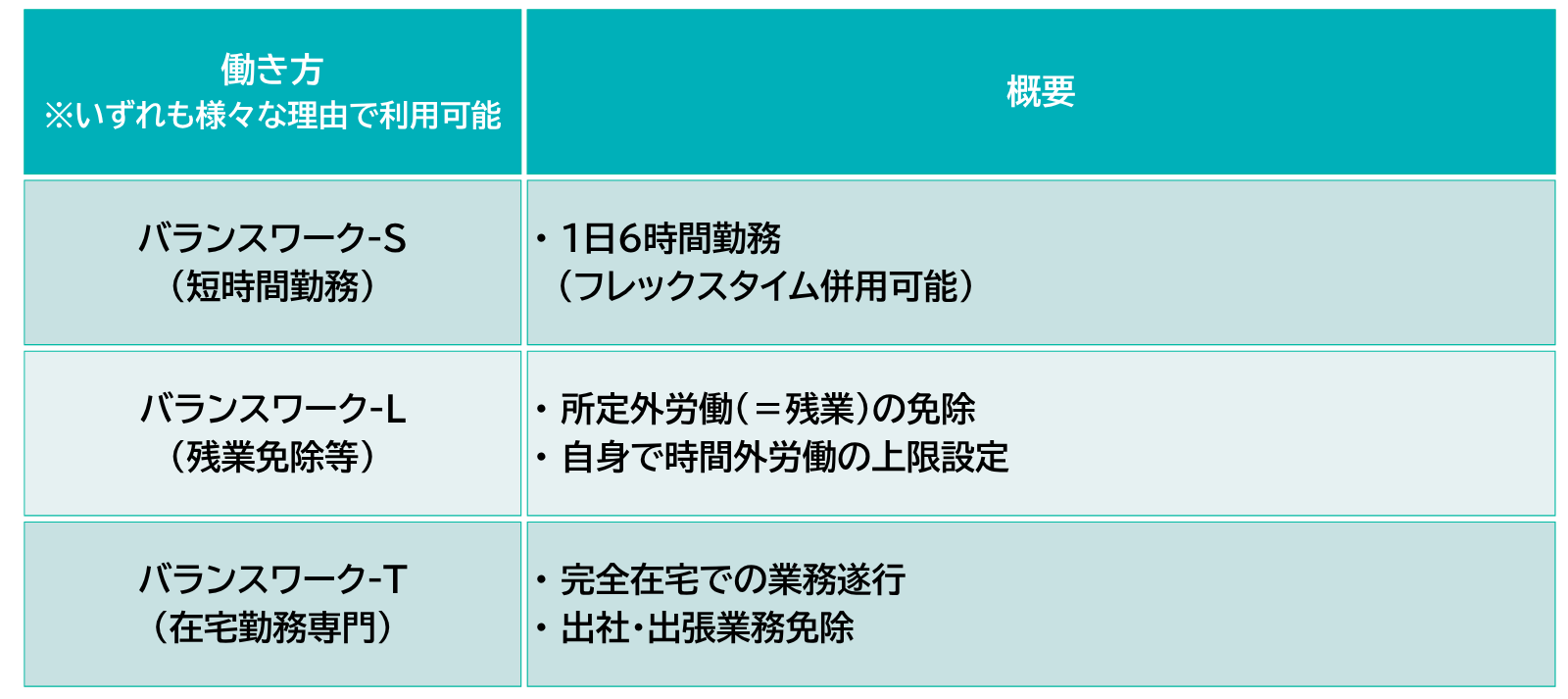
Child rearing is a valuable opportunity to face one's family and grow as a person during this important period in life. B-EN-G will continue to strive to create a work environment where all employees can raise their children with peace of mind and balance work and family life.
In our next article, we will provide more details on how to work after returning to the workplace and how to balance work and childcare.
*2 B-EN-G 's work-life balance system is not limited to childcare, but also allows employees to choose a work style that suits them from among alternatives to their usual work style when they need to change their work style due to caregiving, illness, or other temporary circumstances.