

The manufacturing of gene and cell therapies is hampered by analog management using "paper and pen" and the strict quality standards (GMP). Mr. A, who is in charge of manufacturing management at Japan's leading academic center, adopted the manufacturing record management system "BatchLine" despite having no prior experience, and successfully implemented digital transformation in a short period of time. How did a non-specialized site overcome regulations and build a robust, data-driven manufacturing foundation? We explore their journey and future vision.
The research institute's mission and its role in gene and cell therapy development.
The research institute we interviewed is a core domestic center for translational research, handling everything from basic research results to clinical development and actual manufacturing support. Supported by a government-led advanced medical practical application project, it is working to develop and operate a manufacturing and supply infrastructure for next-generation therapeutic vectors that complies with international quality standards (GMP) and advanced domestic manufacturing quality control standards.
Mr. A, a member of the manufacturing management team in the gene therapy field, is involved in the production of vectors such as AAV (adeno-associated virus) and lentiviruses under the guidance of the supervising professor. At this center, they are collaborating with domestic academia and bio-ventures to implement next-generation medicines into society. Their important mission is to provide a platform that covers everything from manufacturing to quality control, enabling innovative therapeutic research to proceed smoothly without being hindered by barriers such as manufacturing costs and regulatory compliance.
Implemented Products/Solutions
Specific challenges in the field of cell-based therapies and vector manufacturing.
Mr. A himself was not originally deeply familiar with the practical aspects of GMP, and at the beginning of his involvement in the project, he started by trying to understand the standards of "what needs to be done and to what extent to meet regulatory requirements." In particular, the AAV manufacturing process has a very large number of steps, from upstream transfection and cultivation to downstream affinity purification, ultracentrifugation, and final quality evaluation. The record-keeping alone for this process generates a huge amount of paperwork.
Through his practical experience in the field, he felt firsthand the difficulty of ensuring "data integrity," which guarantees the reliability of data, and the challenges of guaranteeing reliability in anticipation of future inspections and regulatory compliance. With traditional analog operations using "paper and pen," it is difficult to completely eliminate the risk of human error. He keenly felt how challenging the path to industrialization and practical application will be through his work.
Overview of a typical vector manufacturing process
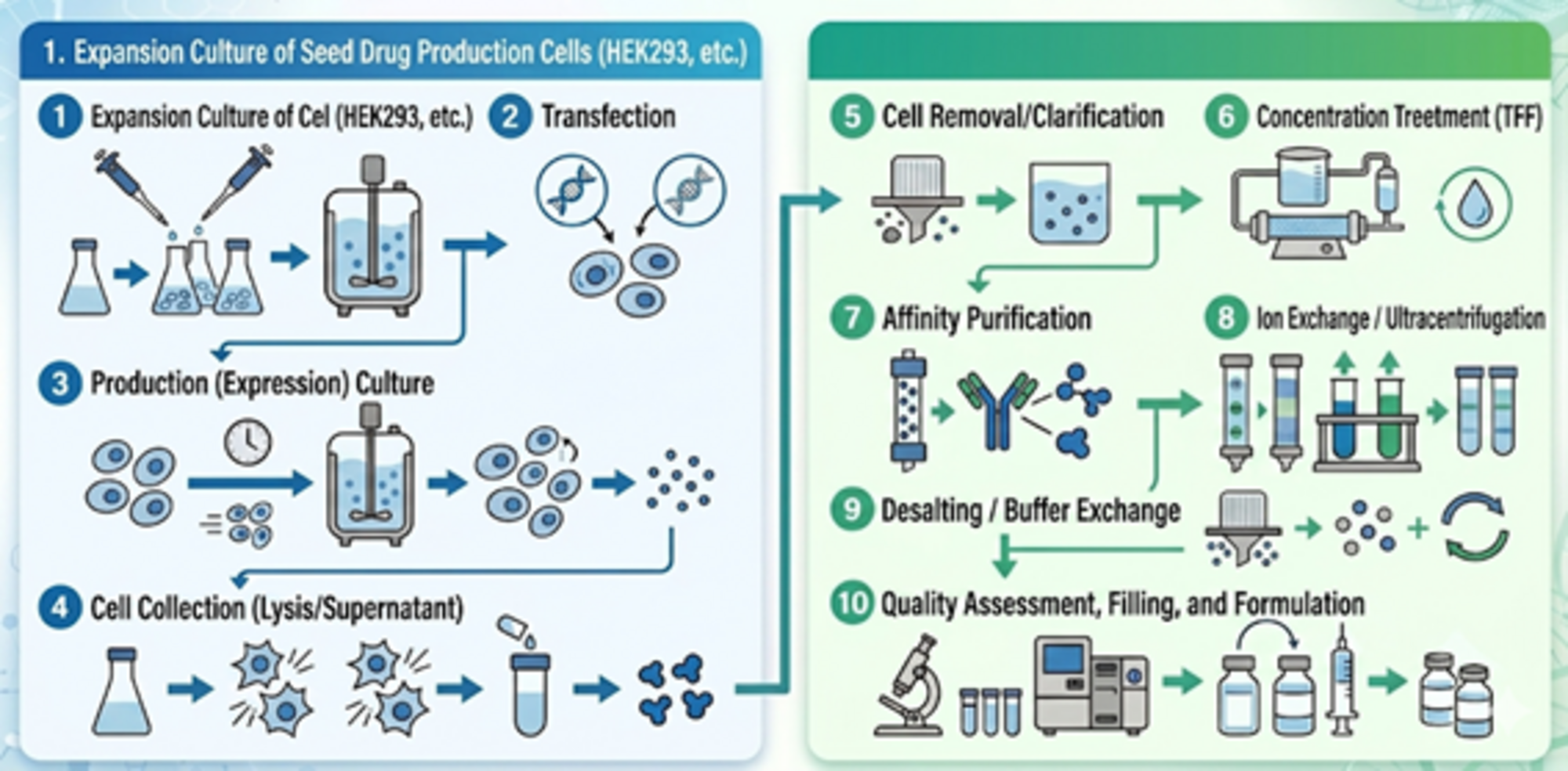
*The image used is an AI-generated illustration.
Factors contributing to the successful adoption and rapid implementation of the "BatchLine" manufacturing record management system.
To overcome the challenges of analog management and regulatory compliance, the research institute adopted the manufacturing record management system "BatchLine." Mr. A cites the extensive support provided by the BatchLine team as a major factor in the successful implementation.
This project had a strict deadline: to "establish a manufacturing base as quickly as possible" within a limited research period of several years led by the government. On the other hand, Mr. A himself had absolutely no experience in introducing or verifying GMP-compliant systems (CSV: Computerized System Validation), and initially proceeded by trial and error, looking up the meaning of each technical term one by one.
We chose BatchLine from among many systems because of its high compatibility with our existing paper-based manufacturing order record system and the fact that it's cloud-based and allows for a small-scale start, making it ideal for an academic environment with limited budgets and resources. However, looking back, we realize that without the provider's close communication tailored to the research institute's level of familiarity and their step-by-step support in establishing the system's operation, we could never have achieved this rapid deployment.
The ingenuity in the implementation process and the effects brought about by digitalization
The biggest challenge in the actual implementation process was finding the right balance in determining "how far digitalization and stricter standards should be taken to ensure sufficient validation." Rules that are considered obvious by GMP experts on the corporate side may risk operational failure if applied directly to the academic environment, which operates with its own unique workflows and limited personnel. Therefore, repeated checks were conducted to build a system that was in line with the realities of the field.
Currently, a hybrid operation combining paper and digital records is still the norm, but the integration of manufacturing orders, records, and procedures into a seamless digital system has reduced transcription errors and approval delays. They are seeing tangible improvements in terms of data integrity.
Furthermore, in terms of quality control (QC), we are simultaneously developing an "academic-derived rational quality evaluation standard (a minimum necessary quality control package)" that meets international requirements while eliminating excessive costs and processes. In the future, we intend to integrate test data based on this standard into BatchLine, creating a system that allows for consistent digital management from the manufacturing of the active pharmaceutical ingredient to the final quality evaluation on the same system. Although we are still only halfway there, the foundation for manufacturing driven by highly reliable data is finally becoming solid.
Future developments and a vision for the future beyond digitalization
"Even someone without expertise in GMP or IT can advance digitalization to this extent with strong support and a flexible system," says Mr. A, reflecting on his experience and expressing his hope that his journey will serve as a pioneering case study for colleagues both domestically and internationally who are facing resource shortages and regulatory hurdles.
Even after the government-led research and development period ends, plans are underway to transfer the business to a non-profit sustainable promotion organization (non-profit support foundation) that will act as a "bridge" between academia and industry, in order to sustain this valuable manufacturing and development base. This organization will function as an ecosystem that seamlessly connects research and development in regenerative medicine, cell therapy, and gene therapy from basic to clinical and practical applications. Mr. A is convinced that establishing a digitized and sustainable manufacturing system in Japan, where the mechanism for supplying excellent technologies from academia to industry is still under development, is of great significance for the entire biopharmaceutical field.
Going forward, the organization will focus on developing the next generation of talent and providing expert consulting support as its core business pillars. Mr. A himself expressed his determination to pass on his experience to the next generation, saying, "I want to give back to the community, in the form of education and consulting, the practical knowledge of digital manufacturing that I have diligently accumulated through the introduction and operation of BatchLine."
Mr. A's next goal is to steadily build a track record of data-driven manufacturing using BatchLine and to feed back this advanced operational model to other domestic sites and CDMOs (Contract Development and Manufacturing Organizations). He aims to take steps towards a future where, in 10 years, this digital manufacturing infrastructure will become an essential social infrastructure for stably and quickly delivering safe, high-quality, cutting-edge therapeutic drugs to patients suffering from intractable diseases at "appropriate costs unique to academia."
The future of cell-based therapies
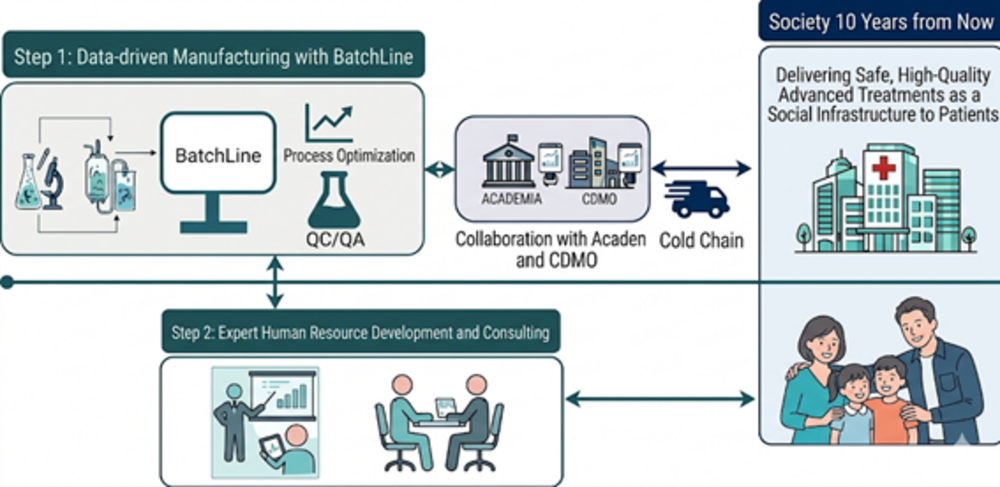
*The image used is an AI-generated illustration.
*This article is a case study based on digitalization efforts at a leading biotechnology research and manufacturing base in Japan. Organization names and job titles mentioned in the text have been abstracted to more general terms.
Related Solutions
Relevant information and case studies based on solutions presented above.
Related Case Studies
Sakamoto Yakuhin Kogyo Co., Ltd.
Manufacturing Execution System Specialized for the Pharmaceutical Industry: PAS-X MES Case Study
Medicine
SCM Execution & Improvement
Life science solutions
Nxera Pharma Japan Co., Ltd. (Formerly Idorsia Pharmaceuticals Japan Ltd.)
Compatible with Global Requirements: Case Study of a Project to Build a Sales Management System Compatible with JD-NET
Medicine
Life science solutions
SAP

GE Healthecare Pharma Limited
Promoting Understanding among Global IT Teams: JD-NET-compliant Enterprise Resource Planning System Implementation Project Case Study
Medicine
Life science solutions
SAP


