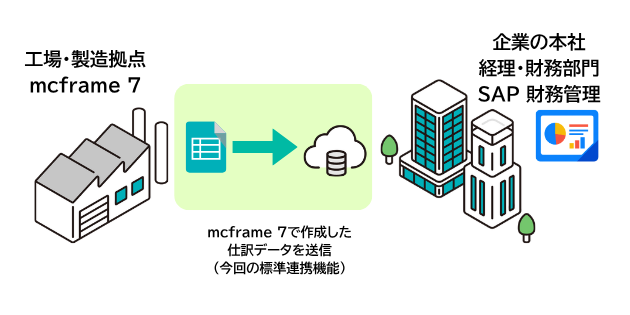
With the update to its manufacturing package "mcframe 7," B-EN-G has implemented a function to integrate with SAP 's accounting system "SAP Cloud ERP Financial Management (hereinafter, SAP Financial Management)" as a standard feature.
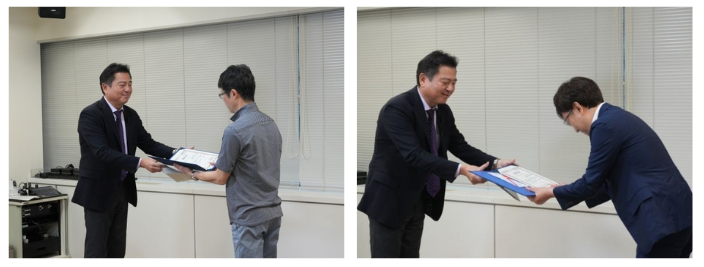
This initiative received a "Special Award" at the company's internal awards ceremony in fiscal year 2026.
It was Mr. Kino from the Solutions Business Division who shared his knowledge of SAP financial management with the mcframe development team during the project. Mr. Kino joined the company in 2020 and, while supporting companies in implementing SAP as a financial accounting consultant, he also takes on the role of project manager, driving SAP implementation projects forward. How did the two business divisions collaborate to create a single function? We spoke with Mr. Kino and the development team from the Product Business Division to find out.
Features that were previously developed individually are now standard features that are available "from the start."
Previously, B-EN-G developed a system to connect mcframe and SAP financial management individually for each customer project. However, this required repeating similar development processes for each project, and furthermore, developing the integration functionality for mcframe 7 required the expertise of highly skilled engineers.
The discussion about making this a standard feature began to move forward when we were considering development themes for the new version of mcframe 7 (Ver. 7.0.3 SP3). The Product Business Division selected this function, which connects mcframe 7 with SAP Financial Management, as one of the key features of the new version.
The Product Business Division's aim in creating this function was not just to solve on-site problems. One of the goals was to increase opportunities for the two business divisions to learn about each other's products and to foster a sense of unity within the company through the collaboration of both products. Mr. Kino explains the overview of the function as follows:
"In short, it's a function that links accounting entries from mcframe 7 to SAP Financial Management. You can send data at any time you like from the mcframe 7 side. For example, we envision using it to send all the journal entries created in mcframe 7 to SAP Financial Management at the end of the month to coincide with the closing process."
In manufacturing companies, money changes hands every time materials are purchased at the factory or products are manufactured and sold. In the world of accounting, these transactions are recorded in a fixed format called "journal entries." mcframe 7 automatically creates journal entries based on factory transaction data, while SAP Financial Management centrally manages the financial information of the entire company.
This new feature will build a "bridge" between these two systems. Developing this feature required a deep understanding of both SAP Financial Management and mcframe 7. How did the two business units, each specializing in a different system, form a team?
Developing as a team by bringing together each person's strengths.
The Solutions Division is responsible for supporting the implementation of ERP systems, including SAP, and related solutions, while the Products Division is responsible for developing and providing proprietary products such as mcframe. Although the two divisions usually hone their expertise in their respective areas, they do have contact in actual projects. Mr. Kino explains: "Not just in financial management, but in SAP implementation projects, if we use mcframe to handle the operations of the production department, the two divisions sometimes work together."
This time, we went a step further than just collaborating on the implementation project; a project team comprised of members from both business divisions took on the responsibility of developing the product itself. From the Product Business Division, the development team, led by the development leader of mcframe 7, participated, while from the Solutions Business Division, Mr. Kino, a specialist in financial accounting, joined the team. The team created a dedicated channel on Slack, and whenever a question arose, they could immediately nominate someone to ask.
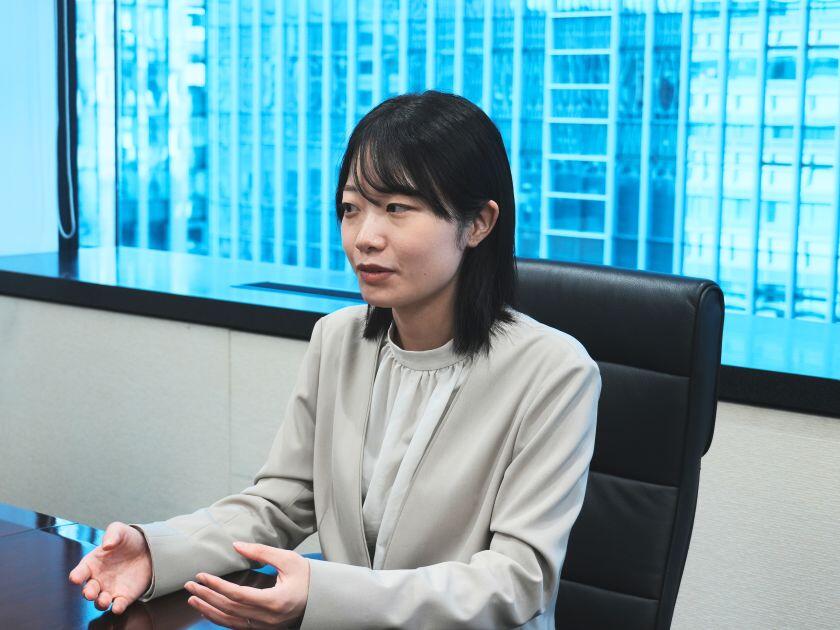
Ms. Kino says she was impressed by the way the development team members approached their work. "Instead of just asking the person in charge questions about how journal entries are actually created in SAP and how linked documents are displayed on the screen, the team members logged into the SAP environment themselves and tried it out to see for themselves. That approach was very impressive."
On the other hand, there were also differences in assumptions between the two systems. Key concepts such as departments, items, taxes, and journal entries had different specifications and assumptions in mcframe 7 and SAP Financial Management. Even when using the same terminology, there were differences in how the systems handled them, so the team had to confirm and reconcile each difference in specifications. There were many instances where they were unsure about how to interpret the specifications. In such situations, the team did not make decisions based on the convenience of one side, but instead compared two perspectives: "Can it maintain versatility as a standard function?" and "Can it withstand practical use in an actual implementation environment?" They shared their reasoning and sought a realistic compromise.
"Where is it getting stuck?" Identify the cause.
The discussions among the project members were also used to determine the scope of what should be included as a standard feature. The development team drew the line as follows: The integration mechanism itself is common to all customers, so it is essential as a standard feature. On the other hand, the individual items to be integrated often differ from project to project, and adding or removing them is relatively easy, so we decided not to over-engineer them.
The development team tackled numerous challenges in completing the standard features. The development leader meticulously investigated the causes of errors, repeatedly prototyping and testing until they successfully exchanged data between the two systems for the first time. During the testing phase, they also discovered that some functions did not work correctly depending on the type of computer (server) running the system. The development leader, working with the team member responsible for setting up the server environment, went through a process of trial and error to resolve this issue. Challenges that would have been difficult to solve alone were overcome by the combined efforts of team members with their respective areas of expertise.
These experiences have also been utilized in preparing for operational use. The development team established a system that allows them to identify and resend the problematic data even if an error occurs during data transmission. By repeatedly verifying and improving in this way, they overcame obstacles and completed the integration function. So, how will this change our customers' work? Mr. Kino explains: "Journal entries that users previously had to create manually will now be automatically integrated. We expect that this will allow them to dedicate that time to more valuable tasks."
Furthermore, the development team believes that this integration feature will be beneficial not only to customers but also to those managing the implementation projects. Because the integration parts, which were previously designed and developed for each project, can now be used from the start, a reduction in the time required for requirements definition, development, and testing is expected.
Beyond "mcframe × SAP"
Regarding receiving the Special Award, Kino speaks frankly: "The latter half of the project coincided with a busy period for another project I was in charge of, so I wasn't able to participate much. Therefore, I was a little surprised when I heard about the award. However, we are all very honored that our efforts, in which the Solutions Business Division and the Product Business Division brought together their respective expertise, have been recognized within the company."
Furthermore, some participants commented that they realized through this project that trusting and empowering each individual's expertise leads to significant results. Other comments from project members included: "It was an opportunity to deepen my technical knowledge," and "The experience of working closely with members from different business divisions and persistently troubleshooting and resolving unfamiliar problems was invaluable."
Based on this experience, Kino-san spoke about his future goals as follows: "By developing this together, I now know who in the Product Business Division to ask about what, and it's become easier to consult with them than ever before. In projects that include the integration of mcframe and SAP, I would like to actively consult with them if any questions or issues regarding mcframe arise. Furthermore, I would like to promote 'mcframe × SAP' as a single brand."
This project is an initiative in which two business units combined their respective expertise to enhance the value of a single product. The deepened connections between the business units through this project will also serve as a foundation for B-EN-G to create the next value. Project members have already come up with new ideas, such as integrating products handled by the Solutions Business Unit other than SAP with mcframe, and developing mcframe 7 using AI. Moving forward, B-EN-G will continue to combine the strengths of each business unit to support the operations of our customers involved in manufacturing.