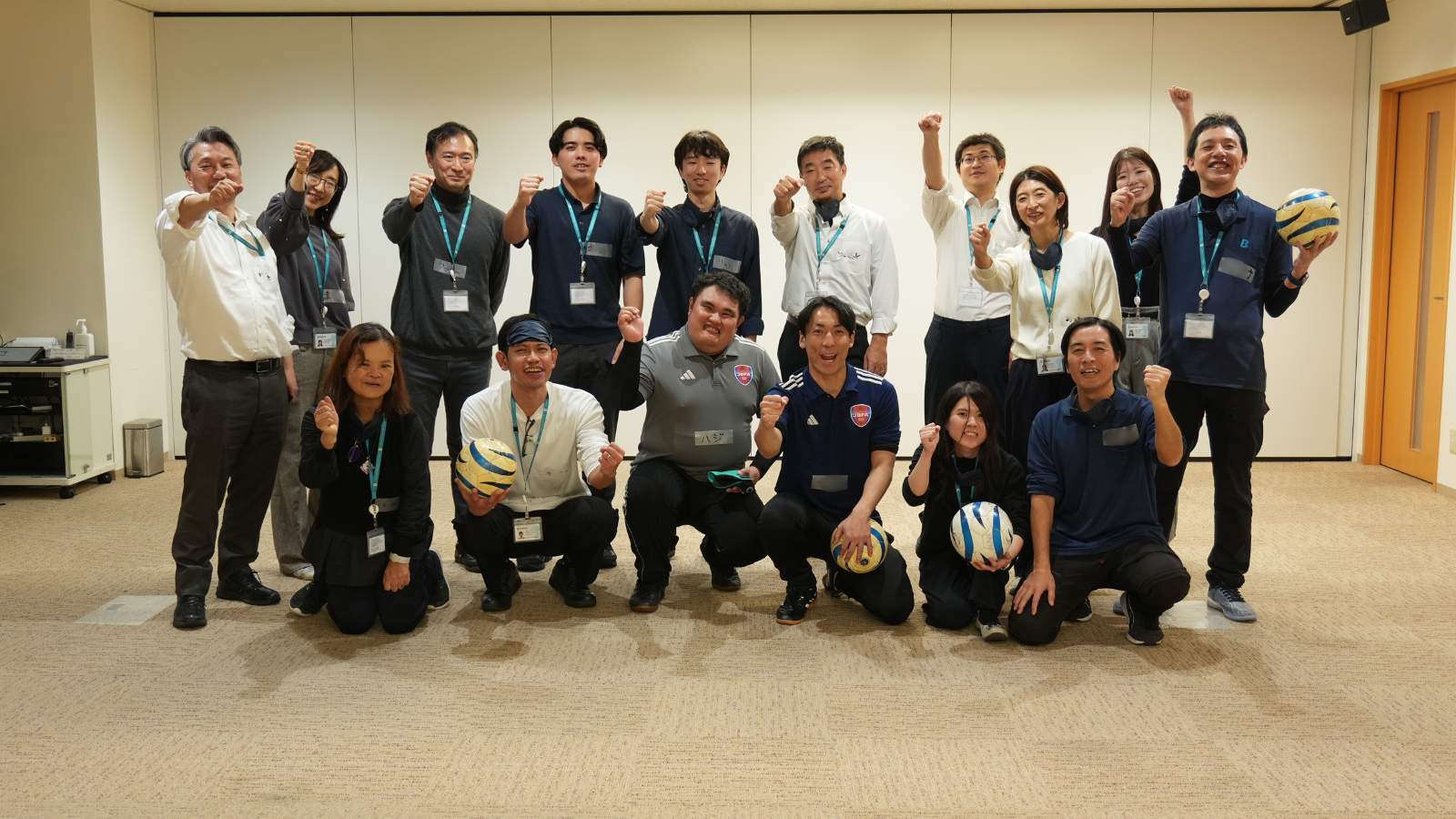
A "Blind Football® Experience Session" was held at the B-EN-G Tokyo office with the aim of promoting understanding of DEI (Diversity, Equity & Inclusion) within organizations through parasports.
On the day, 13 members from various departments gathered, and with professional lecturers such as blind soccer player Hajime Teranishi and former F Leaguer Kohei Okamura, the workshop was filled with enthusiasm.
◆Instructor Profile◆
Mr. Kohei Okamura
NPO Japan Blind Football Association
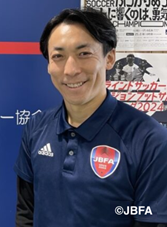 He became fascinated with soccer during his student days. After graduating from university, he chose to pursue a career as a professional futsal player. He made his debut in the F League (Japan Futsal League) in 2014 and was selected as a candidate for the Japan National Futsal Team in 2016. He won the 28th All Japan Futsal Championship held in March 2023. After retiring, he joined the Japan Blind Football Association (also affiliated with Criacao Co., Ltd.) and began working as a training instructor. He currently works as both a training instructor and in charge of existing sales at the Japan Blind Football Association.
◆Instructor Profile◆
Mr. Hajime Teranishi
NPO Japan Blind Football Association
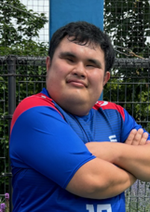 Due to a retinal disease, his eyesight began to deteriorate around the age of five, and he became completely blind in his second year of junior high school. While in junior high, he was invited by an instructor at a boarding school for the blind to start playing blind football, and at the age of 16, he took to the pitch in the East Japan League. From 2010 to 2021, he represented Japan in various tournaments (including the Tokyo 2020 Paralympics, the IBSA World Championships (2010), the IBSA Blind Football World Grand Prix (2018, 2019, 2021), and the IBSA Blind Football Asian Championships (2017-2019)). Since 2019, he has been playing for Papelesial Shinagawa (now Shinagawa CC Papelesial). In addition to his activities as a player, he currently works as a training instructor and in charge of human resources and general affairs at the Japan Blind Football Association.
"How to convey information" and "trust" through a physical experience without sight
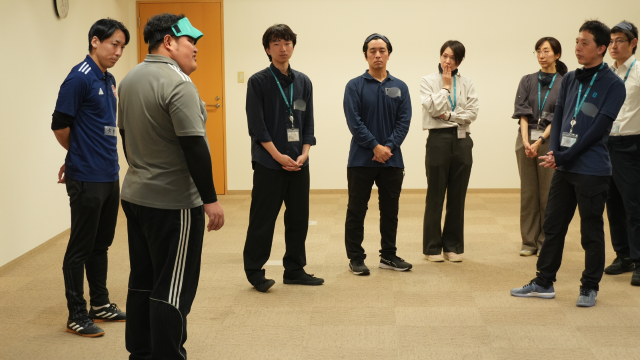
The core of the experience was a workshop in which participants were blindfolded. Participants played games such as a game in which participants had to gather together to complete a given task using only their voices, and then count the number of people who had gathered. Another game involved a person without an eye mask telling the masked team member the location of the goal by voice, leading them to kick the ball accurately into the goal. The workshop was challenging, yet fun, and very exciting.
This experience made me keenly aware of how difficult it is to communicate using only words, when communication usually relies on visual information such as eye contact and gestures.
Participants commented, "What may be right for me may be the opposite for the person I'm guiding. This gave me an opportunity to think about what kind of words to use that are effective," and they experienced firsthand the importance of "sharing awareness" by giving specific instructions that put oneself in the other person's position.
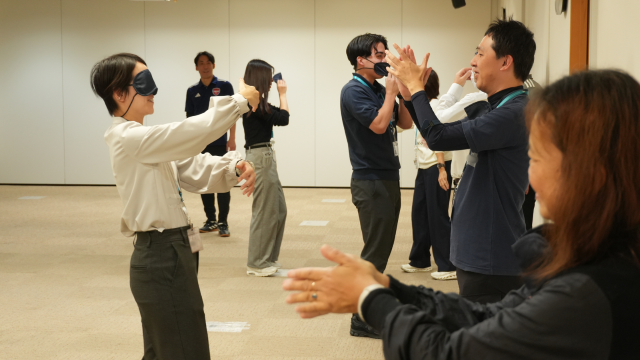 For safety, I take a defensive stance with both arms and take one cautious step at a time toward the sound of applause.
 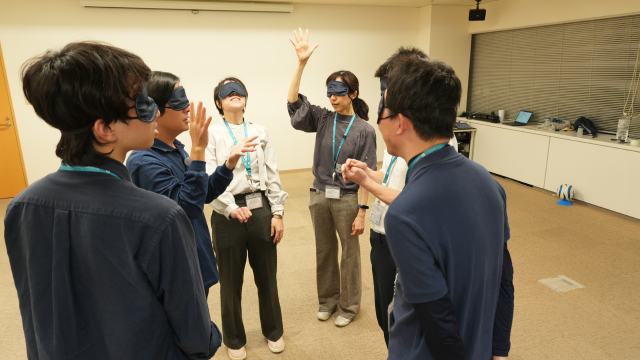 With their vision blocked, they gather together to answer a specific question and count the number of people. Each team has their own unique way of checking, which is fun!
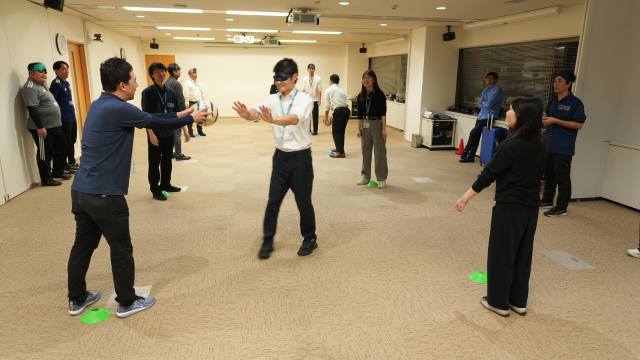 Touch the ball that makes a sound for blind football! Which team has the most touches and is more communicative?
 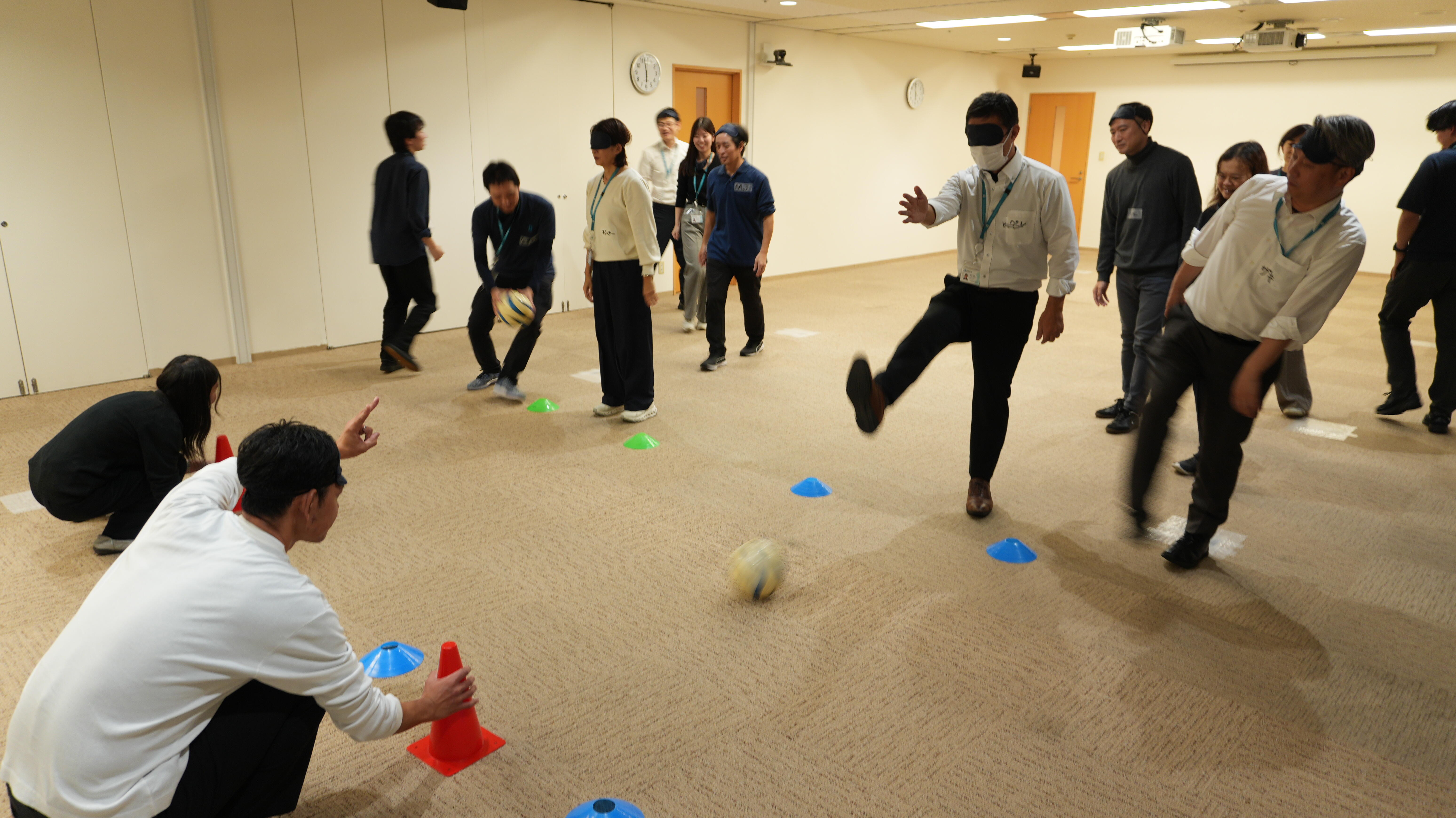 First of all, it's hard enough just to place your foot on the ball without being able to see it. But it's amazing if you can kick the ball accurately and hit the pole!
Learning about "social consideration" and "respect for individuality" from the words of professionals
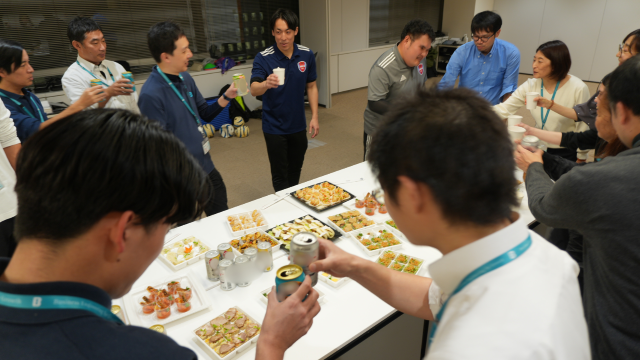
At the social gathering following the workshop, Teranishi shared specific stories about the accidents and difficulties he has had in his daily life as a result of being blind, as well as the inconveniences he has experienced with public services. Through these stories, participants had a valuable opportunity to reconsider the current state of consideration in society as something that concerns them personally.
Many participants also seemed to remember the realization that "there is no need to be overly cautious around people with disabilities, but rather to treat them as individuals with their own unique characteristics."
Deep realizations gained through experience
In a survey conducted after the trial session, many participants commented that it was not just a sports experience, but that it was something they learned that was directly relevant to their work and daily lives.
- Realizing a shared understanding: I learned the importance of communication that takes into account the other person's position and situation.
- Building trust: Through repeated trial and error as a team, we were able to experience the deepening of invisible bonds.
・Support for DEI: I was able to empathize with the feelings of people with visual impairments and become aware of the limitations they face in society.
The "DEI Circle" that connects to the future of the organization
Participants were extremely satisfied with this trial session (78.6% very satisfied, 21.4% satisfied), with many responding that they "want to participate again" and "it was a meaningful experience."
The opportunity to learn not only about DEI but also about professional techniques and attitudes directly from professionals like Teranishi and Okamura was a major factor in raising participants' interest.
I felt that gradually spreading the "culture of being considerate of each other and speaking up to each other" cultivated at this experience session to those around us could be a step towards expanding the circle of DEI.
B-EN-G will continue to promote activities to expand the "circle of DEI."