
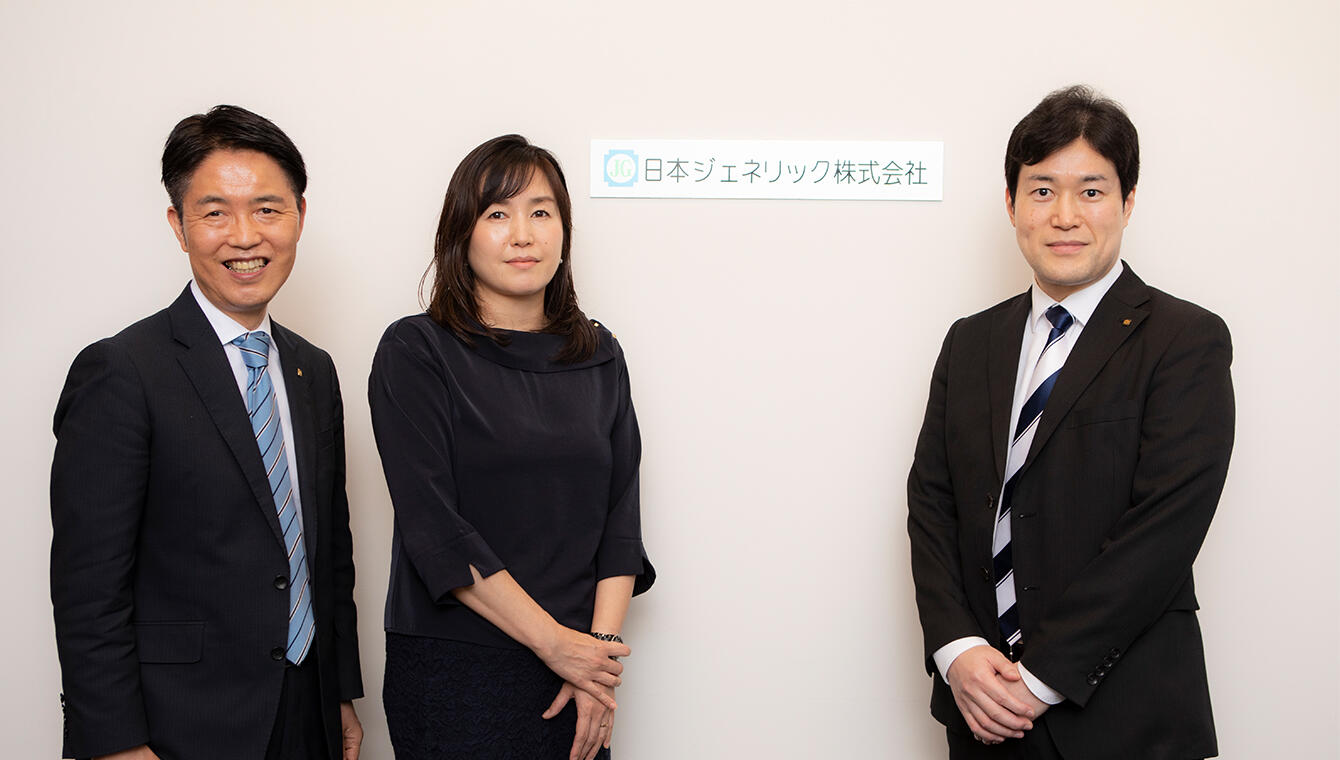
Many manufacturing companies, in addition to manufacturing in-house, often outsource the production of parts and products to other companies. In such cases, a series of tasks are usually involved, such as issuing purchase orders to the outsourcing companies (hereinafter: outsourcing companies), obtaining delivery date confirmations, and registering and managing this information in the company's own system. Currently, many companies still rely on email, telephone, and fax for coordination with outsourcing companies, and the task of registering the collected information into the management system has to rely on human effort. Nippon Generics, which manufactures and sells generic drugs, also used to operate in the manner described above, but by building a system that dramatically improves communication with outsourcing companies, they succeeded in reducing coordination work by 89 hours per month.
Implemented Products/Solutions
Challenges
Inconsistent communication methods, cumbersome information management, and the enormous burden of manual data entry into the production management system.
At Nippon Generic, when placing orders with manufacturing contractors, they would attach an Excel file containing a list of order information to an email and send it. While manufacturing contractors usually replied with delivery dates via email, some would print out the Excel file, handwrite the delivery dates, and return it by fax. The replies included not only delivery dates but also shipping details, and the company manually entered this information into its production management system each time.
Koichi Matsushita, manager of the Outsourcing Management Section in the Product Planning Department, reflects on this situation as follows:
"It was a real struggle to find past emails to check previous correspondence, and if the reply was sent by fax, we couldn't find it, or the handwriting on the fax was illegible, so we had to go through the trouble of contacting the sending company again by email or phone. For companies that didn't reply by the set deadline, we also had to contact them again by email or phone. Furthermore, we were manually entering information into the production management system and double-checking it, so this also placed a huge burden on us. To begin with, we were dealing with about 40 manufacturing outsourcing companies, so just keeping track of what information was coming back from which business partners, or not coming back at all, was a really big task." (Mr. Matsushita)
The company had introduced the production management system "mcframe" (developed by B-EN-G) in 2016 to improve the efficiency of its production processes. Mr. Matsushita had long wanted to introduce a system to the outsourcing of manufacturing processes as well, to streamline operations with a well-organized workflow.
Reasons for product selection
Investigating ways to systematize our company's business processes. Considering business system construction tools.
In response to these requests from the outsourcing management department, the systems department also began considering solutions.
"Our systems department understood the challenges faced by our user department and regularly gathered information," says Matsushita. Because there were virtually no specialized systems for communicating with manufacturing contractors, the systems department considered a business system development tool to be appropriate.
Comparison based on usage costs, system integration, and implementation track record in the manufacturing industry.
They also conducted research, including interviews with multiple tool providers, including those offering tools that were already being used in two or three departments within the company.
From among several tools, the outsourcing management department selected "Business b-ridge," a business system construction tool provided by B-EN-G.
Business b-ridge is a cloud system that allows companies to build their own business processes that span across companies or departments, quickly digitize paper-based or Excel-based tasks, and create a system for centralized information management and progress tracking without coding.
The cost of using the service is not based on a pay-per-use model, but rather on a fixed fee per user multiplied by the number of users.
"Of course, cost was an important requirement, but ultimately, integration with the production management system into which delivery date information is entered was a crucial point. Business b-ridge has a proven track record of integrating with numerous core systems, including production management, and the production management system we use is mcframe, provided by B-EN-G. We felt a great sense of security knowing that B-EN-G is very familiar with our production management operations, and we could expect strong support from them, given their more than 30 years of experience in the manufacturing industry as well as their deep knowledge of the pharmaceutical industry." (Mr. Matsushita)
Benefits
We streamlined communication with our manufacturing partners, reducing working hours by 89 hours per month.
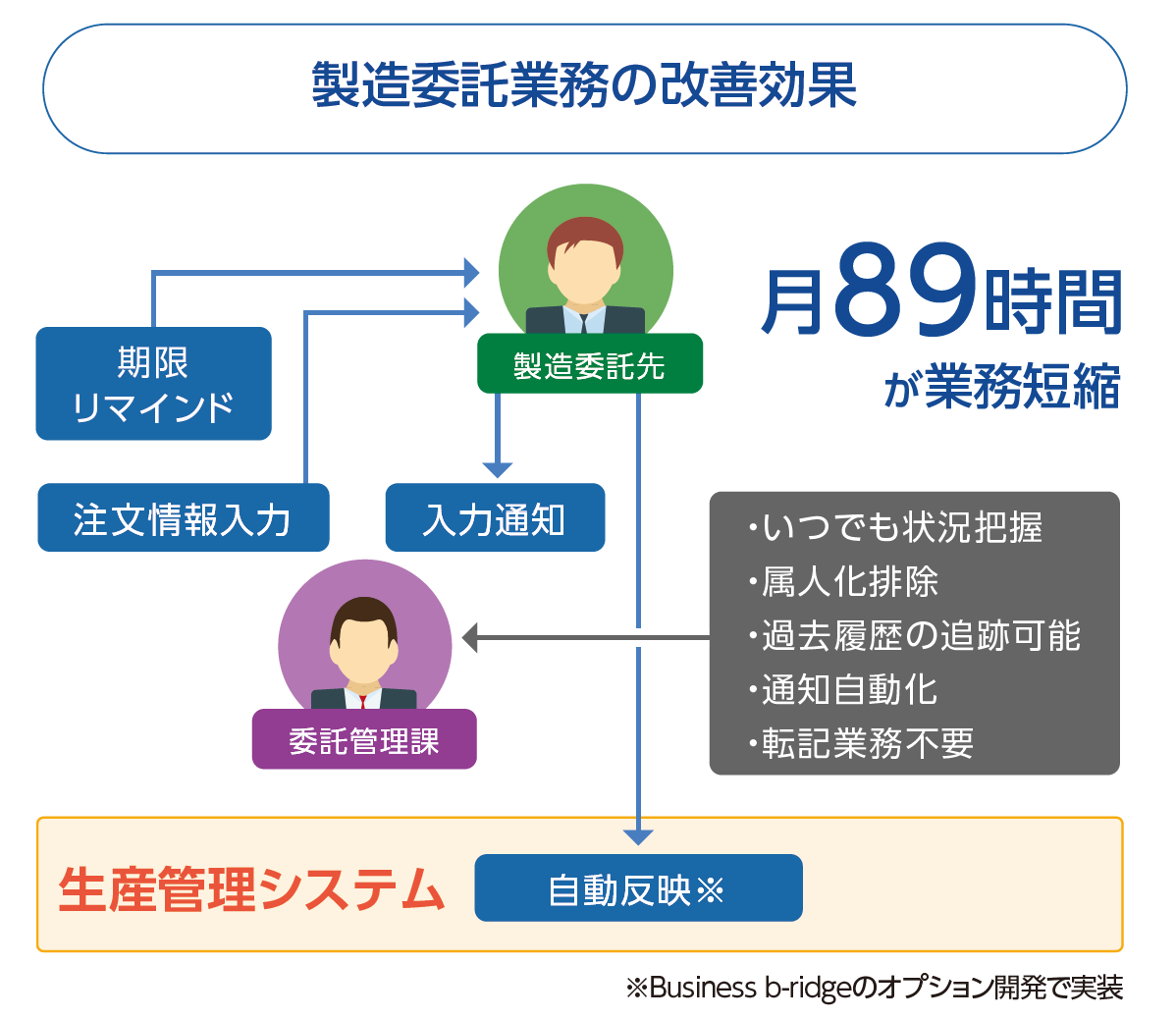
The manufacturing outsourcing system built with "Business b-ridge" allows for communication with manufacturing partners via a web interface. When the outsourcing management department registers order information for each manufacturing partner in the system, the order information is reflected on each partner's dedicated page, and an email is also sent. Each company logs into the system with their assigned permissions using an ID and password provided by Japan Generics and enters the delivery date.
If the information is not entered by the deadline for delivery date confirmation given to the manufacturing contractor, the system automatically sends a reminder email to the manufacturing contractor. Once the manufacturing contractor enters the delivery date confirmation, it is automatically linked and reflected in the production management system.
Regarding the effectiveness of this manufacturing outsourcing system, Kazuhiko Endo, section chief of the outsourcing management department, says that communication with manufacturing outsourcing partners has become dramatically more efficient.
"According to our company rules, delivery date information must be registered in the production management system a few days before the scheduled delivery date set in the production plan. However, as mentioned earlier, it was difficult to keep track of the response status, and if a response was not received, it required the extra effort of calling the manufacturing contractor to remind them. But with the manufacturing contractor system we have now built, we are immediately notified when a delivery date is confirmed, and reminder emails are automatically sent to companies that have not responded. We have been able to eliminate the work that previously required human checking and follow-up." (Mr. Endo)
Mr. Endo also emphasized the changes in operations brought about by the automated integration with the production management system.
"The average number of entries we entered into the production management system per month in fiscal year 2022 was 267. This is the total for the three of us in the outsourcing management department, and for entries with a large amount of information, it took 20 to 30 minutes to enter each one. If we calculate it at 20 minutes per entry, that's 20 minutes x 267 entries = 5340 minutes, which means the entire department was spending 89 hours and 10 person-days on it. Now that's completely eliminated. The 89 hours and 10 person-days we've saved can now be allocated to other important tasks such as daily delivery checks and inventory status checks. On the other hand, our manufacturing partners have also responded positively, saying, 'We can now centrally manage order information.'" (Mr. Endo)
The personal nature of the interaction is eliminated, and past history can be easily tracked.

Furthermore, Mitsu Sawada, section chief of the outsourcing management department, cites the elimination of the reliance on individual expertise in communication and the ability to easily track past interactions because a chronological record of past history is preserved, as advantages of the manufacturing outsourcing system.
"On the manufacturing outsourcing system, documents are managed and visualized on a per-order basis for each manufacturing outsourcing partner, making it very easy to track past history, and anyone can quickly take over the communication. We see the elimination of the reliance on individual emails and the ease of tracking past history as major benefits," says Mr. Sawada.
While Business b-ridge has brought numerous benefits to Generic Japan, Mr. Matsushita points out that there are points that must be carefully considered when implementing it.
"The manufacturing outsourcing system we built using Business b-ridge will dramatically improve our operations, but in order to use it, we will need the cooperation of our manufacturing partners and ask them to change their existing business processes."
In the case of Nippon Generic, all three staff members participated in a 30-40 minute online meeting with each manufacturing contractor, carefully explaining the system's purpose, benefits, and how to use it. They reportedly went through this process at a pace of 3-4 companies per month, taking a total of about a year. Based on the original operation manual, they added and improved upon it themselves, and the current version is now 6.
"Although it's not directly related to system construction, it's an unavoidable effort in order to get the new system up and running and achieve the expected results. However, I feel that the effort we put in and the careful communication we had with our manufacturing partners beforehand have paid off significantly." (Mr. Matsushita)
Future Outlook
Expanding the scope of business system usage will streamline the exchange of delivery slips and invoices.
Business b-ridge, which Japan Generic has adopted, allows user companies to build their own necessary business systems without coding. However, for systems that will be shared with external companies, the company plans to consult with B-EN-G, the tool provider, to ensure security, including access control.
"The manufacturing outsourcing system is a mechanism to streamline the exchange of purchase orders, but other documents exchanged with our manufacturing partners include delivery slips and invoices. We also consult with our manufacturing partners about production plans via email, so there are still many areas of work that can be made more efficient. In the future, we would like to build a system for exchanging these documents and consultations using Business b-ridge. We have already requested some business processes from B-EN-G and they have provided them, and we look forward to B-EN-G's strong support going forward." (Mr. Matsushita)
Case study company introduction
| Company Name | Japan Generics Co., Ltd. |
| Establishment | January 5, 2005 |
| Head office location | Minato Ward, Tokyo |
| Business Activities | Development, manufacturing, and sales of generic drugs, etc. |
| Company website | https://www.nihon-generic.co.jp// |
*Please note that organization names, positions, numerical data, etc. in the article are based on the time of the interview and may have changed by current viewing.
Related Solutions
Relevant information and case studies based on solutions presented above.
Related Case Studies
UBE Corporation (Formerly Ube Industries Co., Ltd.)
Improving Productivity and Transforming the Purchasing Process for Indirect Goods Purchasing: Cloud Purchasing Management System "SAP Ariba" Case Study
Chemical
Inter-company collaboration solutions
SAP

Saison Technology Corporation (formerly Saison Information Systems)
SAP Ariba Case Study: Reforming Work Styles by Enjoying the Benefits of Cloud Services
service
Inter-company collaboration solutions
SAP


