

Fiscal Year 2026 1Q Financial Results Briefing - Transcript (Including Q&A Session)
The briefing presentation content is posted below in both text and slide images.
Agenda
Speaker: Shigeaki Betsuno, CFO
I am Shigeaki Betsuno, CFO of Business Engineering Corporation. I will now explain our financial results for the first quarter of the fiscal year ending March 2027. This slide shows today's agenda.
Executive Summary of FY2026 1Q Financial Results
First, I will explain the executive summary for the first-quarter financial results.
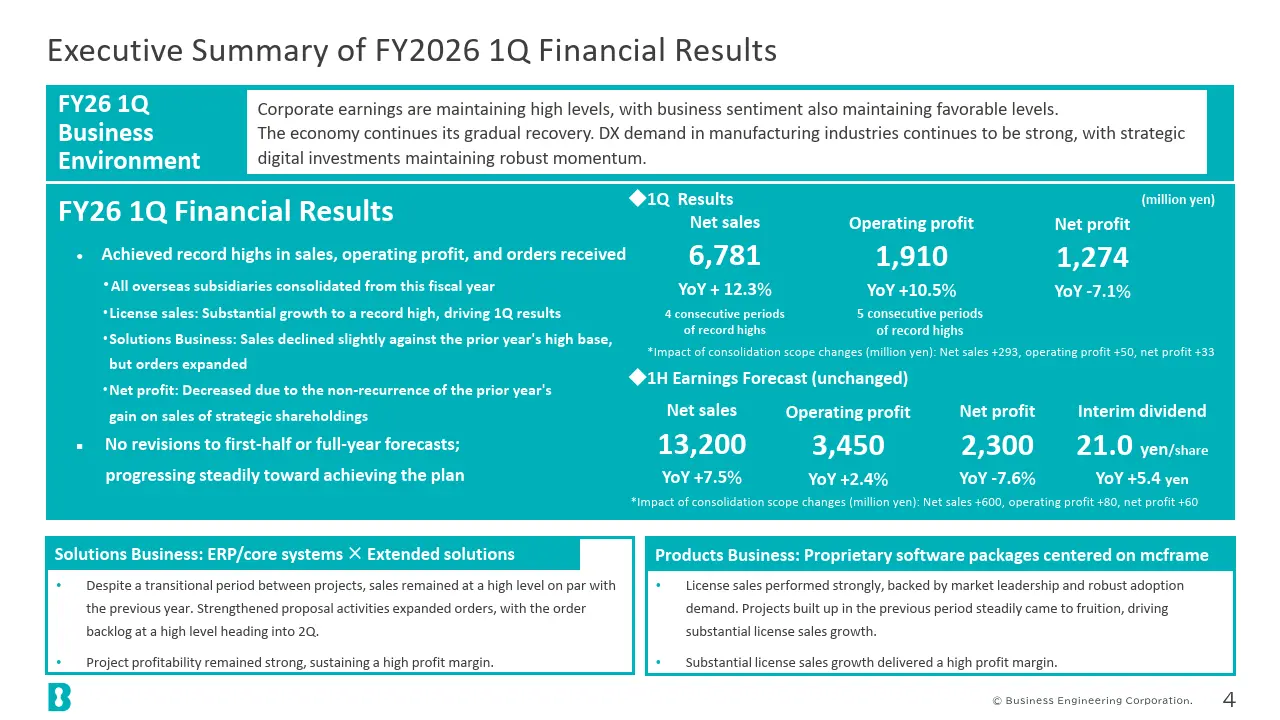
Regarding the business environment, despite concerns over the situation in the Middle East, demand for digital transformation (DX) in the manufacturing industry remained high during the first quarter, and strategic digital investments progressed steadily. Backed by these favorable tailwinds, our consolidated results reached record highs in net sales, operating profit, and order intake, making a very strong start to the fiscal year.
Starting from this fiscal year, all overseas subsidiaries have been consolidated. Net sales, including the impact of consolidation, reached ¥6,781 million, up 12.3% year on year. Operating profit was ¥1,910 million, up 10.5% year on year, and net profit was ¥1,274 million, down 7.1% year on year.
Strong growth in license sales within the Products Business drove first-quarter performance, with license sales hitting a new record high.
In the Solutions Business, net sales decreased slightly due to a high base in the previous fiscal year, but orders received expanded significantly.
Although net profit declined year on year, this was mainly due to a reaction against one-time gains on the sale of strategic shareholdings recorded in the previous fiscal year, and poses no operational concerns.
Based on these results, we have made no revisions to our first-half and full-year earnings forecasts, and performance is progressing smoothly toward achieving our annual targets.
Summary of Consolidated Income Statement
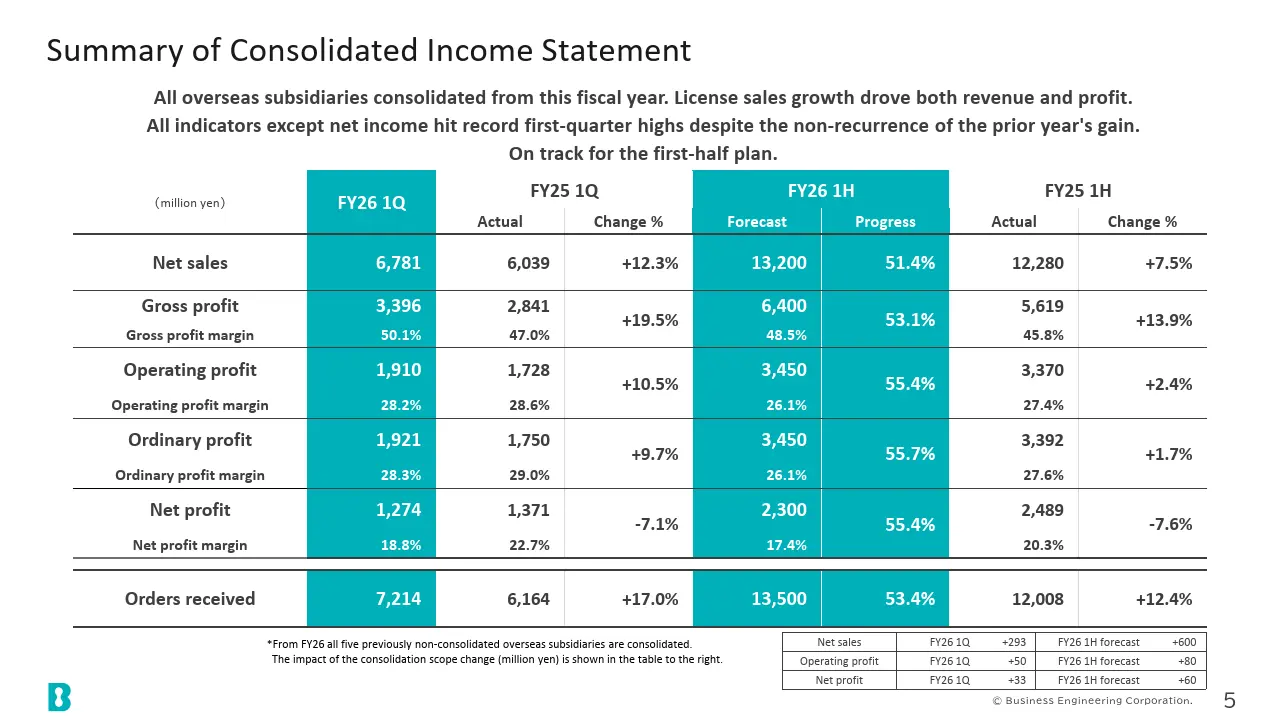
This is an overview of the consolidated P&L highlights. Net sales were ¥6,781 million, up 12.3% year on year, and operating profit was ¥1,910 million, up 10.5% year on year. On the other hand, net profit was ¥1,274 million, down 7.1% year on year.
Orders received grew substantially to ¥7,214 million, up 17.0% year on year. This ¥7.2 billion exceeds the ¥6.7 billion in net sales, indicating a steady accumulation of order backlog.
The table on the bottom right shows the impact of newly consolidated subsidiaries. Consolidation contributed ¥293 million to net sales; excluding this impact, organic net sales increased by 7.4% year on year.
Similarly, consolidation added ¥50 million to operating profit in the first quarter; excluding this effect, organic operating profit increased by 7.6% year on year. Even without the consolidation impact, we achieved true organic growth in both sales and profits.
Progress Against Full-Year Sales Forecast
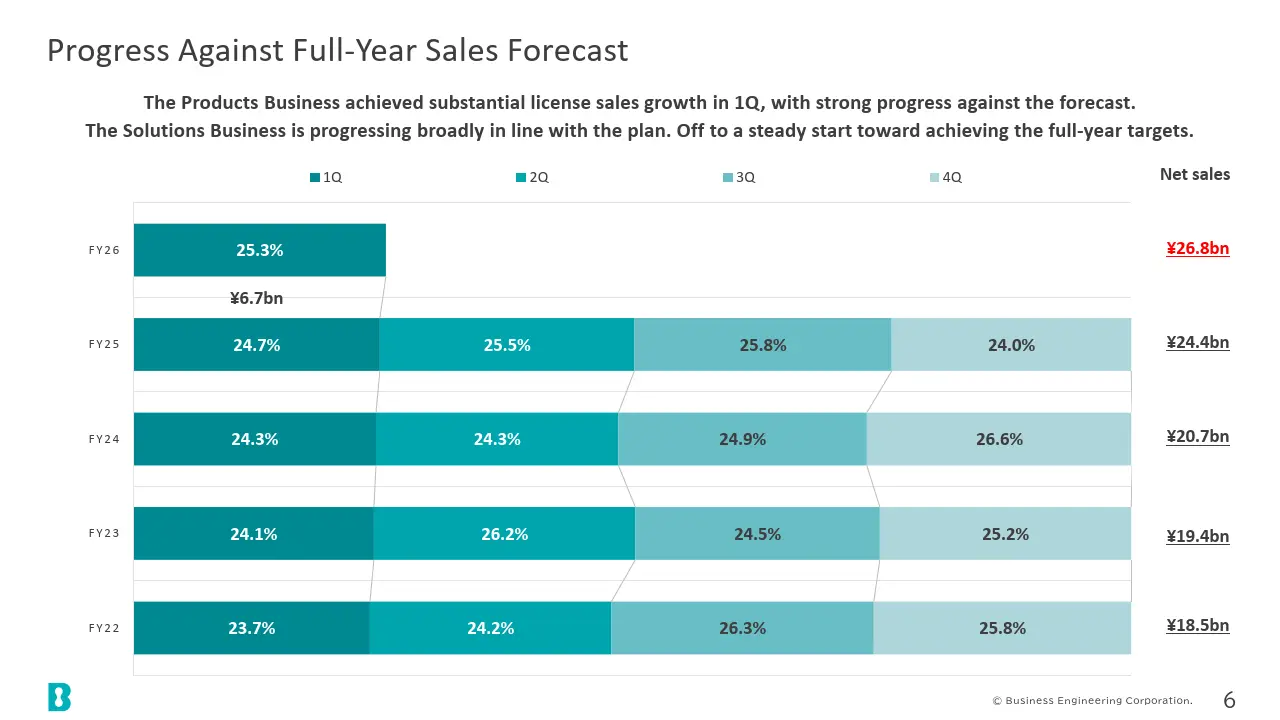
This slide shows our progress against the full-year sales forecast. Net sales for the first quarter reached ¥6.7 billion against our full-year plan of ¥26.8 billion, representing a progress rate of 25.3%. We are off to a smooth start toward achieving our annual targets.
Progress Against Full-Year Operating Profit Forecast
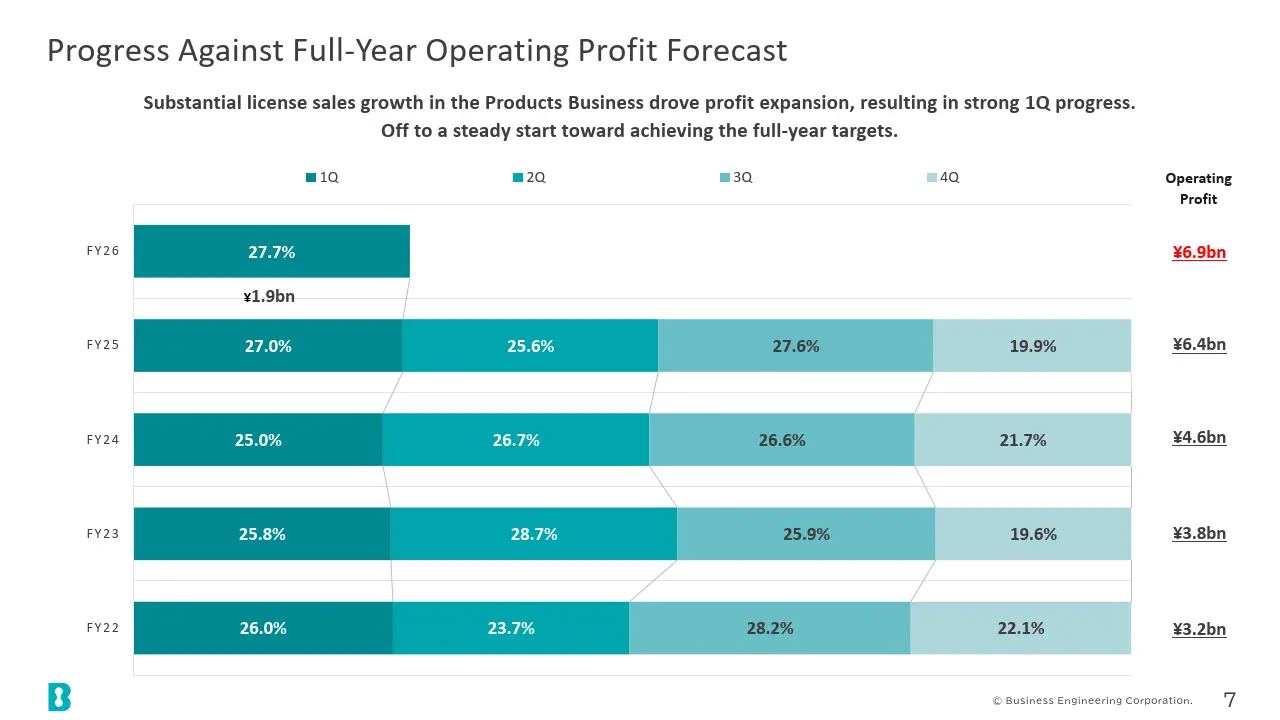
Operating profit for the first quarter was ¥1.9 billion against the full-year plan of ¥6.9 billion, achieving a progress rate of 27.7%. This also represents a smooth start toward reaching our full-year plan.
Analysis of Changes in Operating Profit (YoY)
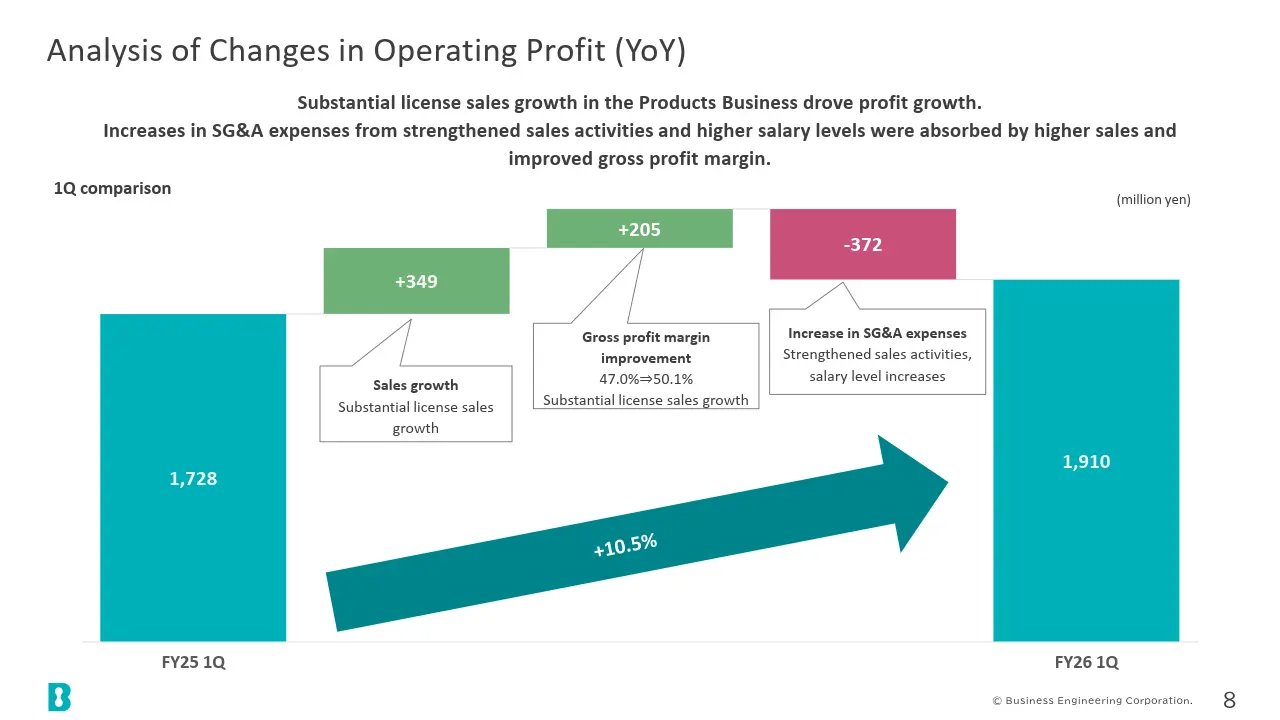
This is an analysis of changes in operating profit. Both top-line sales growth and an improved gross profit margin contributed positively. As mentioned earlier, these gains were driven by a substantial expansion in license sales within the Products Business.
On the other hand, SG&A expenses increased by ¥372 million. This was mainly due to the strengthening of sales activities, particularly in the Solutions Business, alongside a general increase in salary levels.
However, these cost increases were fully absorbed by top-line revenue expansion and the improvement in gross profit margins.
Sales & Operating Profit by Segment
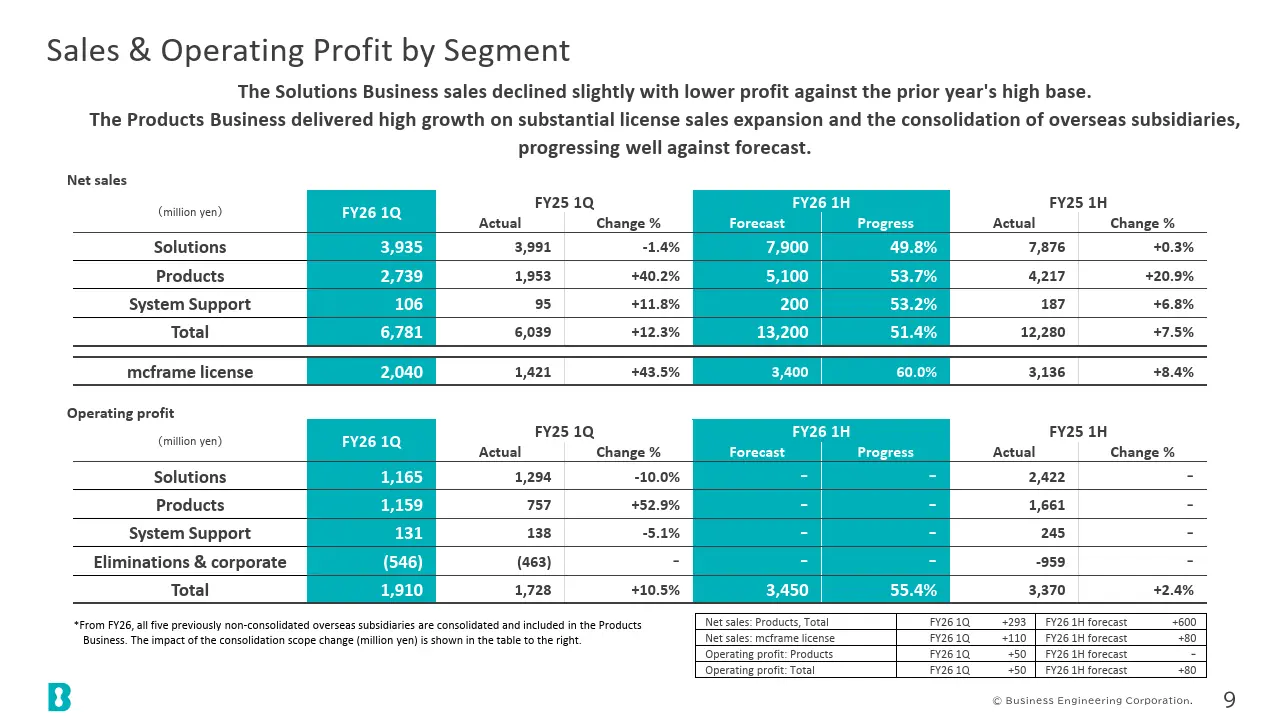
This slide covers net sales and operating profit by segment. Net sales in the Solutions Business were ¥3,935 million, down 1.4% year on year, representing a 49.8% progress rate against the first-half forecast.
Net sales in the Products Business expanded significantly to ¥2,739 million, up 40.2% year on year, achieving a progress rate of 53.7% against the first-half forecast.
Within this segment, mcframe license sales delivered strong growth, reaching ¥2,040 million, up 43.5% year on year, with a progress rate of 60.0% against the first-half forecast.
The Products Business includes the impact of expanding the scope of consolidation for overseas subsidiaries, as detailed in the bottom right of the slide.
Excluding the consolidation effect of ¥293 million from Products Business net sales, organic growth was up 25.2% year on year, demonstrating robust expansion even without the impact of consolidation.
Similarly, mcframe license sales increased by ¥110 million due to consolidation. Even excluding this amount, organic license sales grew significantly by 35.7% year on year.
Segment Information: Solutions Business
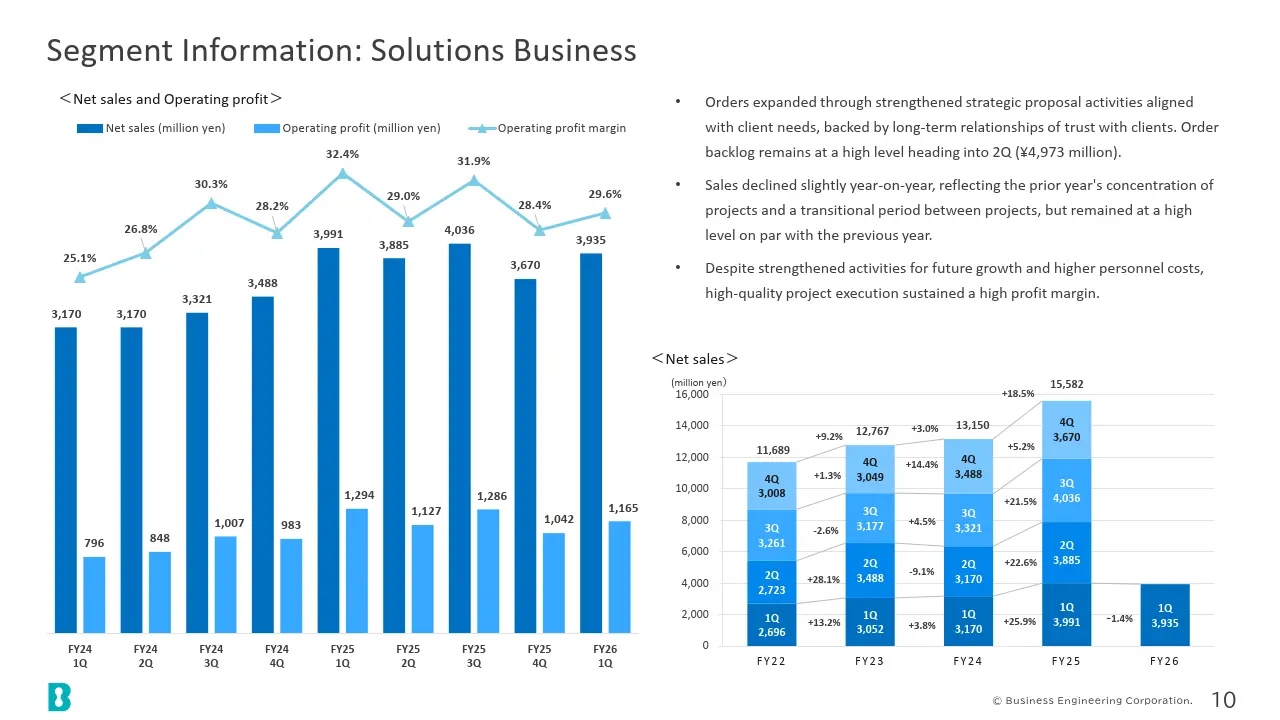
Let me discuss the Solutions Business. In this segment, we strengthened strategic proposal activities aligned with customer needs. Backed by long-term relationships of trust with clients, orders received expanded. The order backlog heading into the second quarter stands at a high level of ¥4.9 billion.
While net sales decreased slightly due to a reaction against an exceptionally strong performance in the prior year's first quarter, revenue is on an upward trend compared to the transition period between projects seen in the fourth quarter of last fiscal year. Furthermore, with expanding order intake, the outlook for the second quarter and beyond remains very bright.
Regarding profitability, despite the strengthening of activities for future growth and higher labor costs, the operating profit margin remained high at 29.6%, remaining at a high level of around 30%.
Segment Information: Products Business
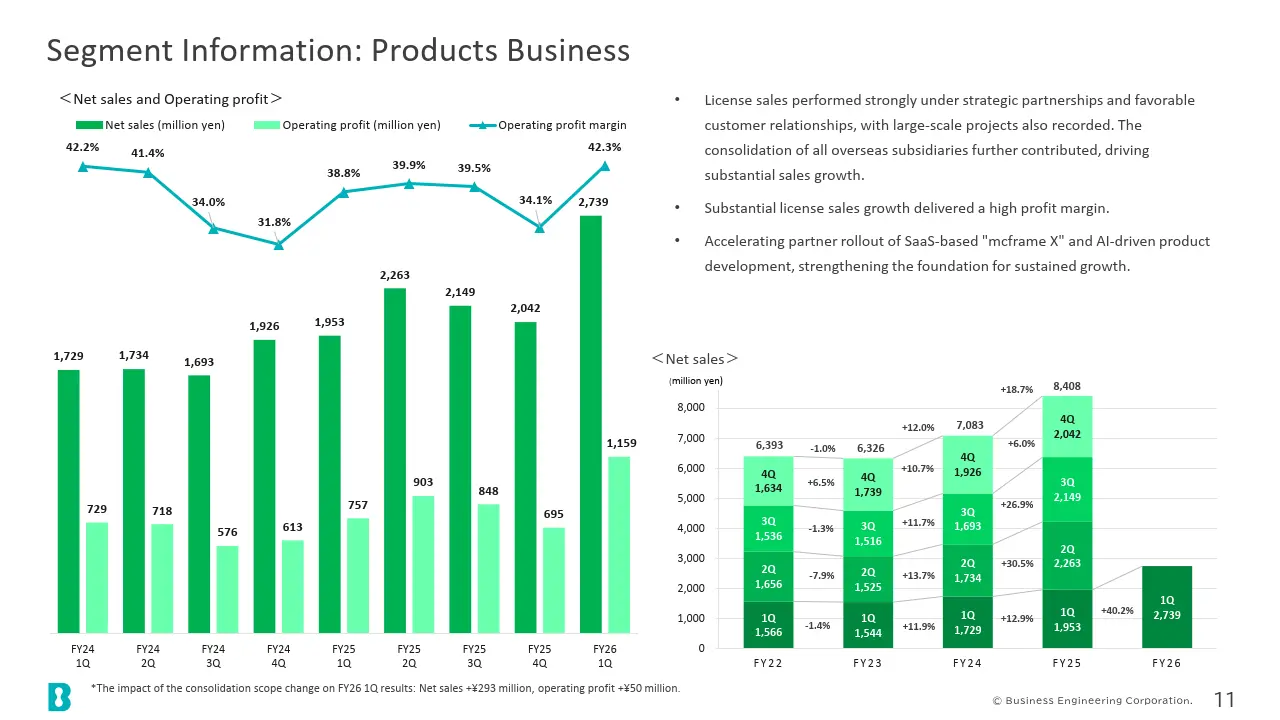
Moving on to the Products Business. As shown in the graph on the slide, this business achieved substantial growth in the current quarter. Driven by strong license sales under strategic partnerships and solid customer relationships, we recognized large-scale deals. In addition, the full consolidation of all overseas subsidiaries contributed to the significant top-line expansion.
Although net sales had dipped slightly in the fourth quarter of the previous fiscal year, we successfully converted those delayed projects into recognized revenue during this first quarter as anticipated. Furthermore, first-quarter sales were bolstered by the pulled-forward recognition of major projects originally scheduled for the second quarter.
Furthermore, while the consolidation of overseas subsidiaries added approximately ¥300 million, even excluding this contribution, net sales reached the ¥2.4 billion level, showing significant year-on-year growth and representing a very high level of organic increase.
As for the profit margin, the substantial rise in license sales drove a profitability boost, achieving a very high operating profit margin of 42.3%.
In addition, starting this fiscal year, we began rolling out our SaaS-type mcframe X through sales partners in this segment. Furthermore, we are accelerating product AI implementation initiatives to strengthen our foundation for sustained growth.
mcframe License Sales
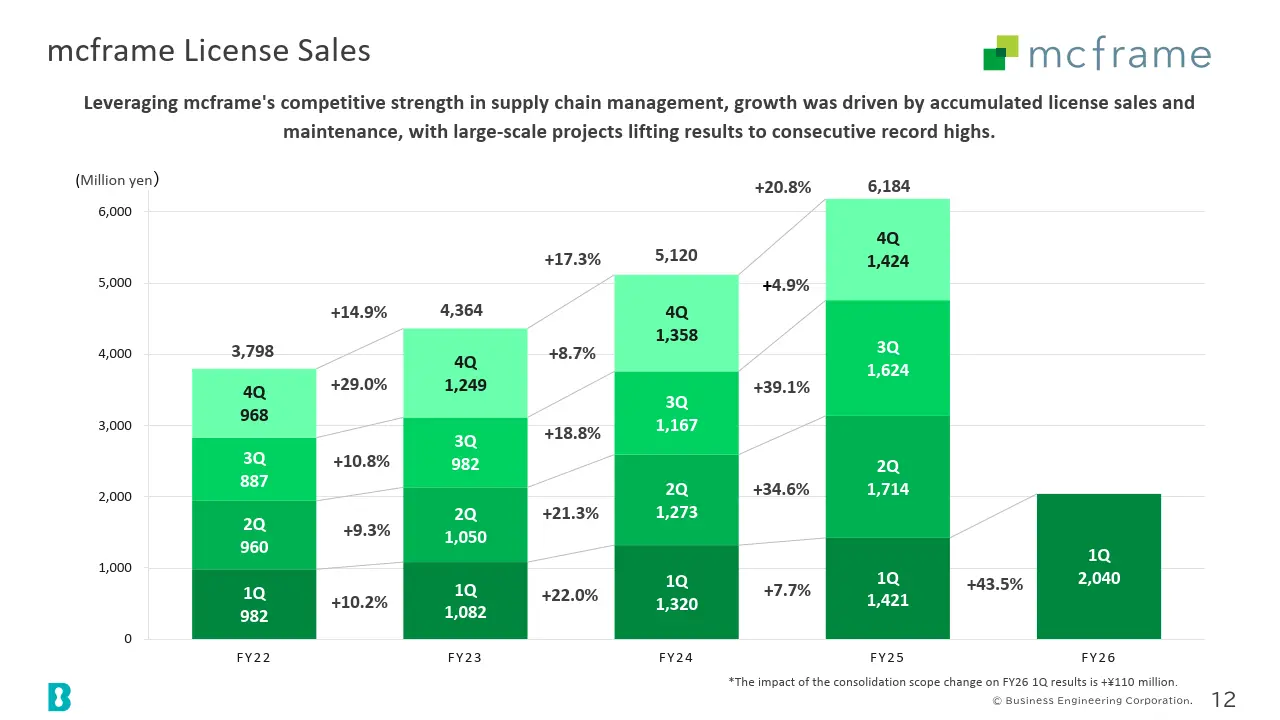
This slide shows the status of license sales. License sales achieved a very strong growth of 43.5% year on year. Even excluding the effect of consolidation, license sales delivered substantial growth of 35.7% year on year.
Summary of Consolidated Balance Sheet
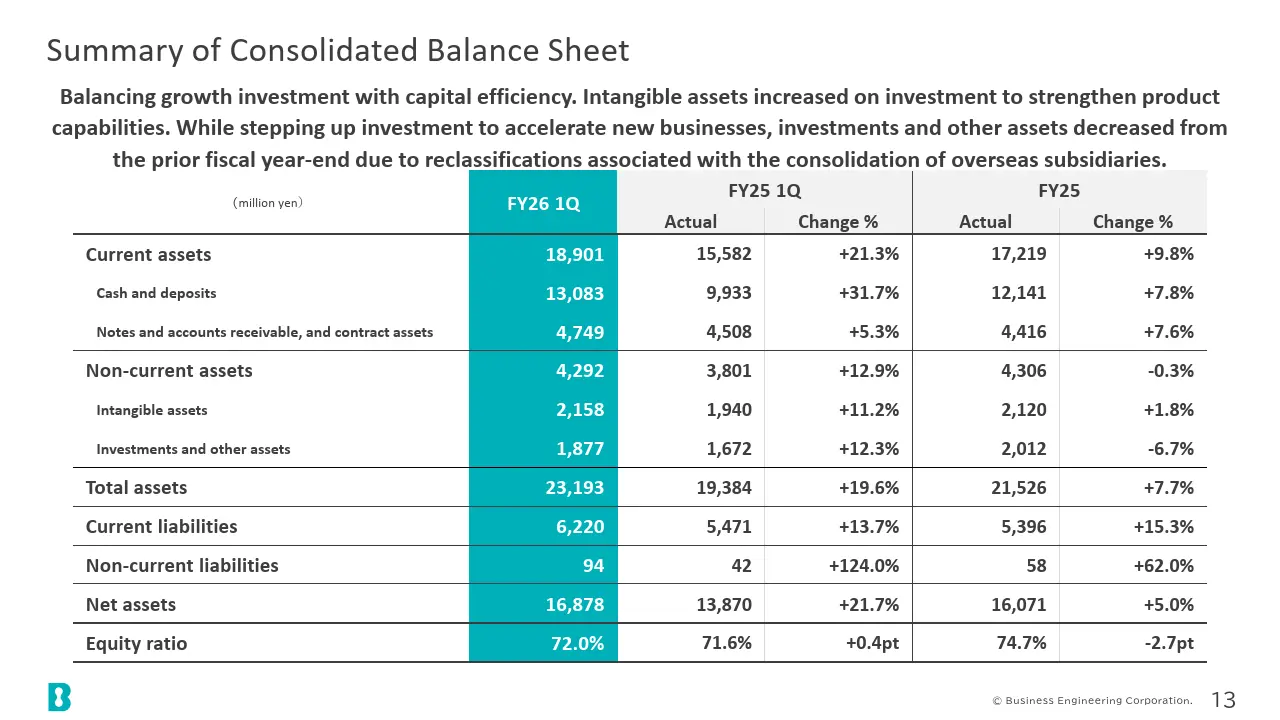
This is an overview of the consolidated balance sheet highlights. Total assets reached approximately ¥23.1 billion, up 7.7% from the end of the previous fiscal year. Net assets also rose to approximately ¥16.8 billion, an increase of 5.0% compared to the previous fiscal year-end, reflecting the impact of expanding our scope of consolidation. The equity ratio came in at 72.0%, representing a slight decline from the previous fiscal year-end.
Regarding non-current assets, the 1.8% increase in intangible assets reflects the accumulated results of our stepped-up annual investments in proprietary product development. On the other hand, the decrease in investments and other assets was due to the elimination of subsidiary stock accounts upon consolidating overseas subsidiaries, and does not indicate any actual asset reduction.
Product Evolution (Adopting AI) | The mcframe Evolution Story
That concludes the overview of our first-quarter financial results, but I would like to share an update regarding our AI strategy.
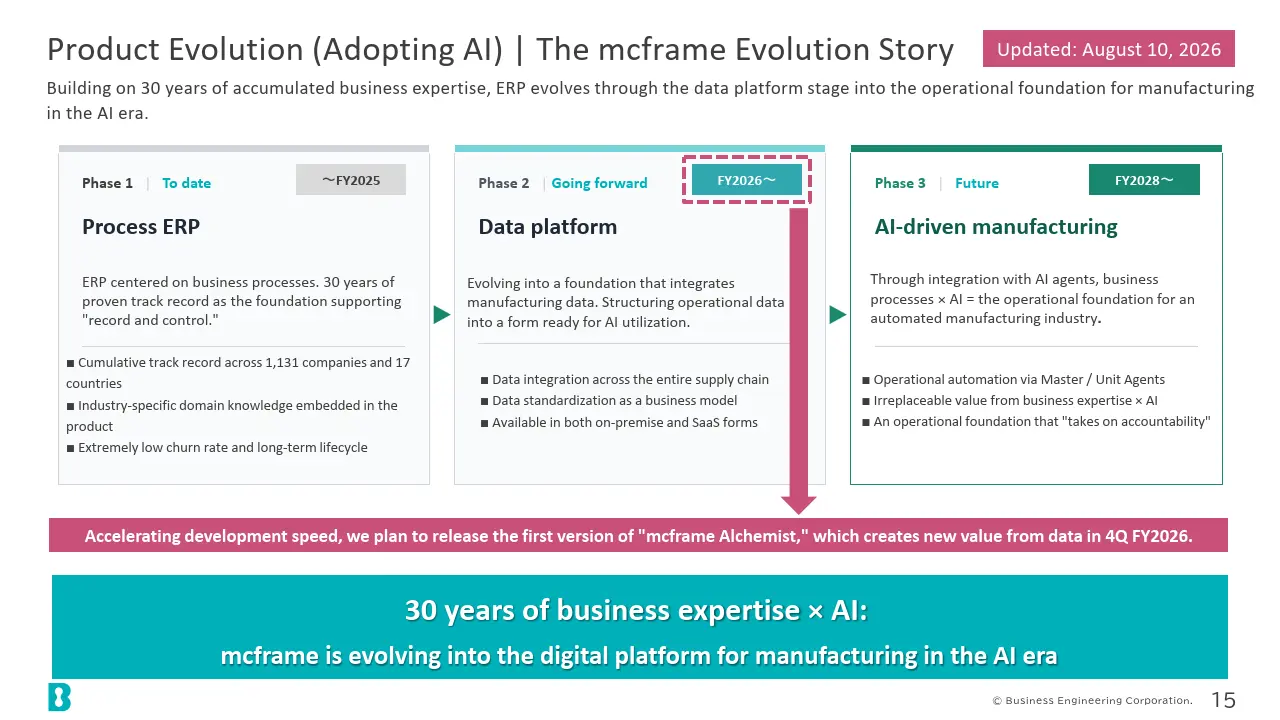
At the financial results briefing on May 12, we introduced several AI-related initiatives. As part of those product evolution efforts, we presented this roadmap for embedding AI into our proprietary product, mcframe.
In addition to our existing Process ERP, we announced plans to advance into Phase 2 during fiscal 2026 by transforming mcframe into a data platform to make it AI-ready. Ultimately, in Phase 3 starting from fiscal 2028, we aim to achieve AI-Driven Manufacturing, establishing an automated operational foundation for the manufacturing industry.
While that was our initial plan, we are currently significantly accelerating our Phase 2 initiatives. Driven by this faster pace of development, we plan to release the initial version of our data platform, named mcframe Alchemist, in the fourth quarter of fiscal 2026--early 2027.
We want to share with everyone that we are currently concentrating internal resources into this project, aggressively driving product AI integration forward.
Executive Summary of FY2026 Earnings Forecast
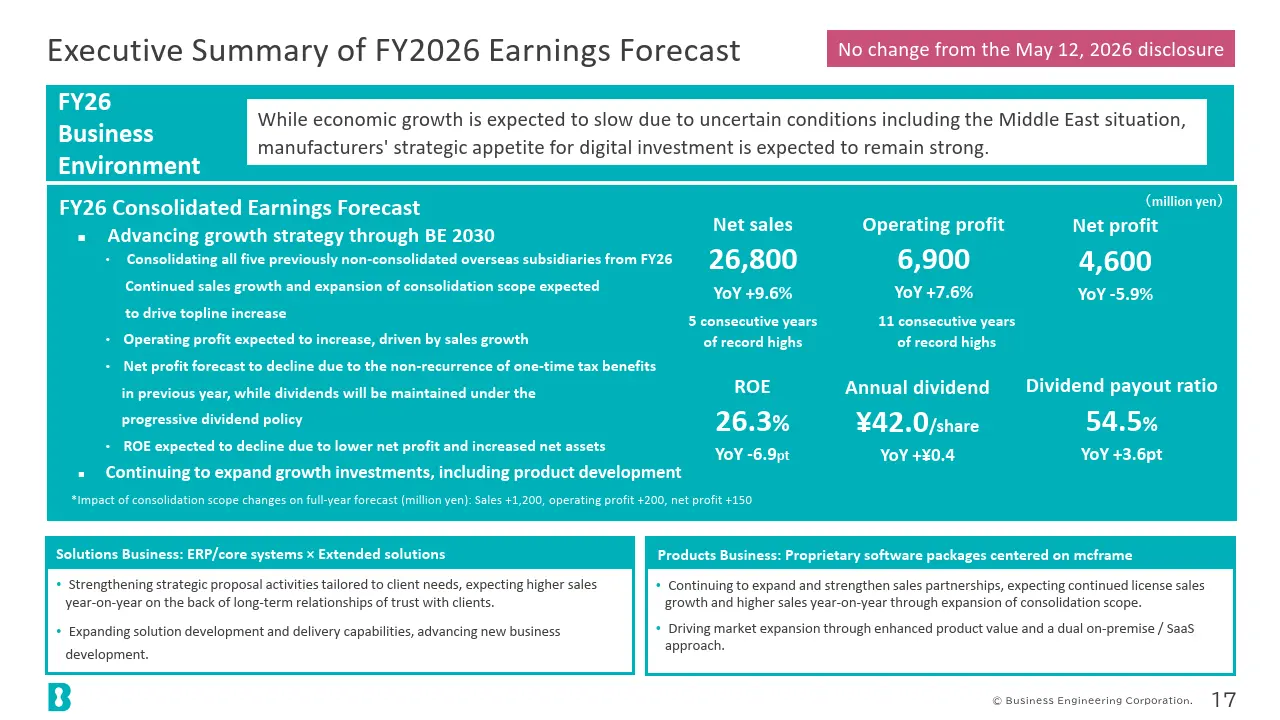
Finally, regarding our earnings forecast for the fiscal year ending March 2027. These figures remain unchanged from our initial announcement on May 12. We have re-posted the original presentation materials for your reference.
In the first quarter, we steadily built up our financial results, making solid progress toward our first-half targets. Moving forward, we remain committed to making steady progress toward achieving our long-term goals outlined in our growth strategy, BE 2030.
This concludes the financial results briefing for the first quarter of the fiscal year ending March 2027 for Business Engineering Corporation. Thank you very much.
Q&A Summary ①
Q: Order backlog in the Solutions Business is performing very well. Is this driven by winning large-scale deals, or is it due to the accumulation of small-to-medium-sized projects? Also, is this at a level where we can expect upside potential against this fiscal year's sales targets?
A: Rather than being driven by specific large-scale deals, this growth is due to the steady accumulation of small-to-medium-sized projects. Since our plan for this fiscal year already sets a stretch target, we cannot say at this point that sales will exceed expectations. However, visibility regarding our first-half achievements has increased significantly, and we are feeling a positive sense of momentum toward achieving our full-year targets.
Q&A Summary ②
Q: License sales for mcframe have grown substantially. Is the scale of individual deals expanding? Can we assume that the full-period result for first-half license sales will hit the forecast of ¥3.4 billion as planned?
A: Basically, it is appropriate to view this as tracking "on plan." We originally anticipated that first-quarter sales would be slightly elevated due to deals slipping from the fourth quarter of the previous fiscal year into the first quarter. On top of that, projects originally scheduled for the second quarter were pulled forward, driving the figures up significantly. Although the first-half progress rate is high at approximately 60%, we have left our first-half target unchanged and are progressing toward achieving the ¥3.4 billion plan.
Q&A Summary ③
Q: Regarding your AI strategy, please share the initial customer feedback on whether it aligns with market needs. Also, are there any concerns about increased expenses this fiscal year due to accelerating the pace of development?
A: The acceleration of our development effort was driven by very high interest and numerous inquiries regarding AI utilization from our sales business partners. We view this as a proactive move anticipating implementation by end-users, and we believe it aligns well with market needs.
Regarding expenses, we are managing this by shifting resources--re-prioritizing development themes and slightly postponing certain existing projects. Therefore, this has not led to a significant increase in overall costs or investment, and the impact on cost expansion is minimal.
Q&A Summary ④
Q: While first-quarter progress against the first-half forecast is strong, the plan for the second quarter on a standalone basis appears to show a drop in profit. Are there any negative factors, such as unexpected expenses or concerns about unprofitable projects?
A: There are no negative factors such as additional cost generation or unprofitable projects. This quarterly fluctuation is simply due to mcframe license sales being concentrated in the first quarter. In reality, we expect second-quarter standalone performance not to reach the high level seen in the first quarter.
Q&A Summary ⑤
Q: In the Solutions Business, we saw additional orders from large-scale projects last fiscal year. Has that trend settled down recently?
A: In the previous fiscal year, multiple large-scale projects were underway, creating an environment where additional orders were easily generated. In the current fiscal year, some of these projects have gone live, and the number of active large-scale projects has normalized, so additional orders are not as prominent as last year. Currently, we are in a transition period where we build up the pipeline for the next wave of projects.
Q&A Summary ⑥
Q: Could you update us on the status of SaaS-type mcframe X and explain the positioning of the AI platform mcframe Alchemist, which is scheduled for release early next year?
A: Two years have passed since the full launch of mcframe X. Having built up our in-house implementation track record and standardized delivery know-how, we have entered the phase where sales partners can independently handle implementations starting this fiscal year. Functional development is mostly complete, with recent releases focusing primarily on minor adjustments.
Meanwhile, mcframe Alchemist is a platform that enables building and accessing AI agents on top of existing mcframe data. We accelerated development in response to strong requests from partner companies. Moving forward, we plan to use this as a foundation for transitioning to the next phase--an automated operational foundation for manufacturing--while gathering active user adoption.
Q&A Summary ⑦
Q: Regarding orishia, your DX brand for frontline workers, you have already achieved early success by being selected for the TRIANGLE EHIME project. What is the current level of inquiries and market feedback?
A: Being selected for the digital implementation acceleration project promoted by Ehime Prefecture provided a great start, but similar projects are not springing up one after another at this point. However, since the need for frontline DX certainly exists, we are currently in a phase of patiently nurturing and building up this business step by step.
