

News
Survey on Trends in the Use of Information Systems/Digital Technologies by Companies Expanding Overseas
The "quality" of localization is being questioned, but the leadership in decision-making and value creation still rests with the Japanese headquarters.
Business Engineering Corporation
Business Engineering Corporation (Chiyoda-ku, Tokyo; President and CEO: Masakazu Haneda; hereinafter "B-EN-G") conducted the "Survey on Trends in the Use of Information Systems/Digital Technologies by Companies Expanding Overseas (2026 Edition)" targeting the Japanese headquarters and overseas subsidiaries of Japanese companies with overseas bases, under the supervision of Deloitte Tohmatsu LLC (Chiyoda-ku, Tokyo; Representative Executive Officer: Kenichi Kimura), and today announced the results.
This survey aims to clarify the relationship between the "maturity level" of Japanese companies operating overseas and the IT systems and DX (Digital Transformation) promotion that support it, amidst rapidly changing economic and social conditions abroad. The survey targeted Japanese companies with local subsidiaries overseas, regardless of business size, industry, or business type.
[What was revealed in this survey]
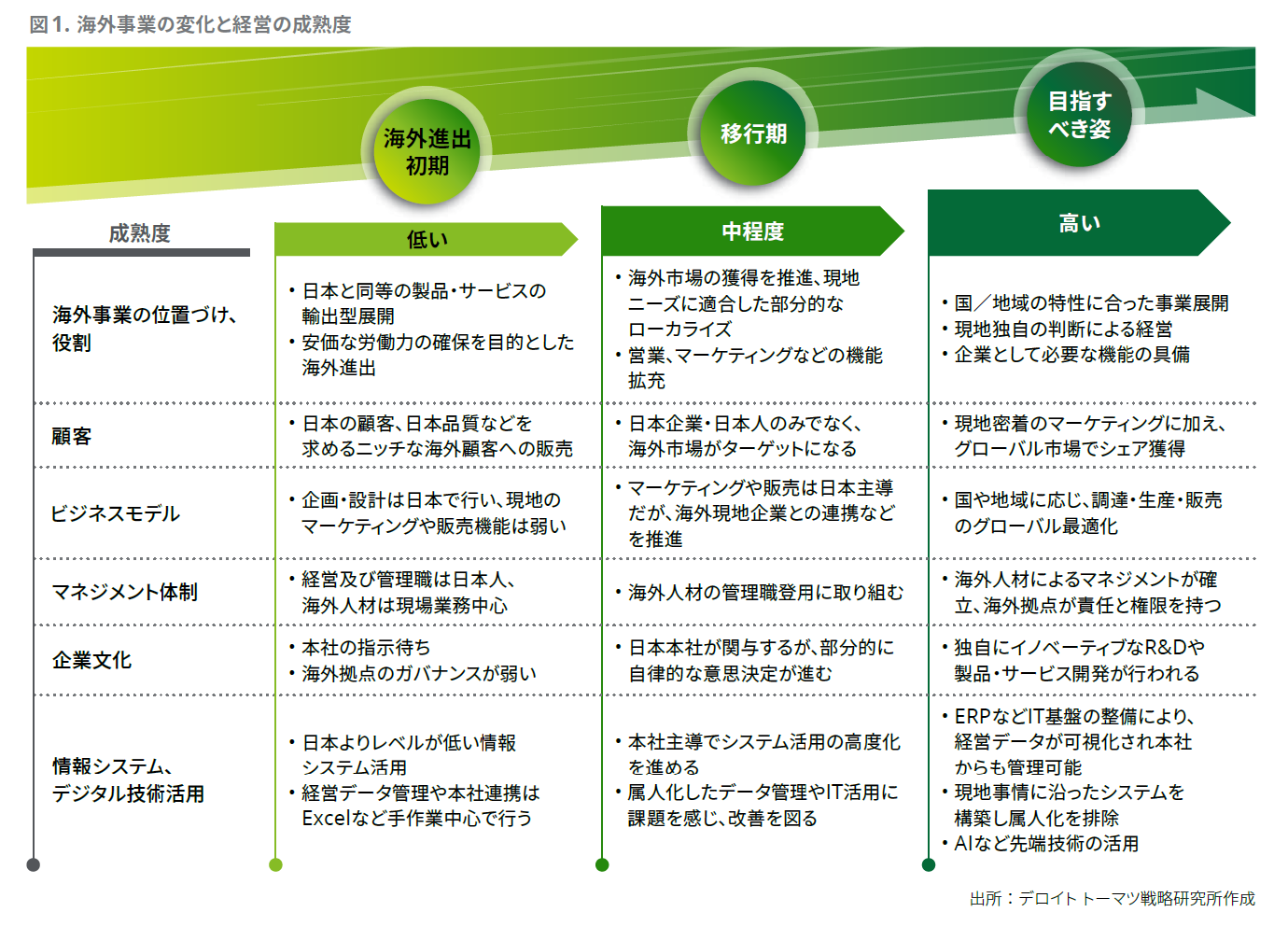
In this study, we defined the stages of overseas business development using a three-stage maturity model (Figure 1), ranging from "initial stages of overseas expansion" to "desired state," and analyzed the current situation of Japanese companies. As a result, while many companies have made progress in localizing institutional aspects such as the ratio of foreign personnel (non-Japanese) in management positions at major overseas bases and the delegation of some authority, it became clear that there is a significant gap between the current state and the desired state in terms of operational "quality," such as decision-making methods and the sophistication of IT utilization. Specifically, the following three challenges can be cited: ① the "quality" barrier of localization (localization of management), ② a shortage of AI and IT personnel, and ③ delays in moving away from analog infrastructure.
① The "quality" barrier of localization (localization of management)
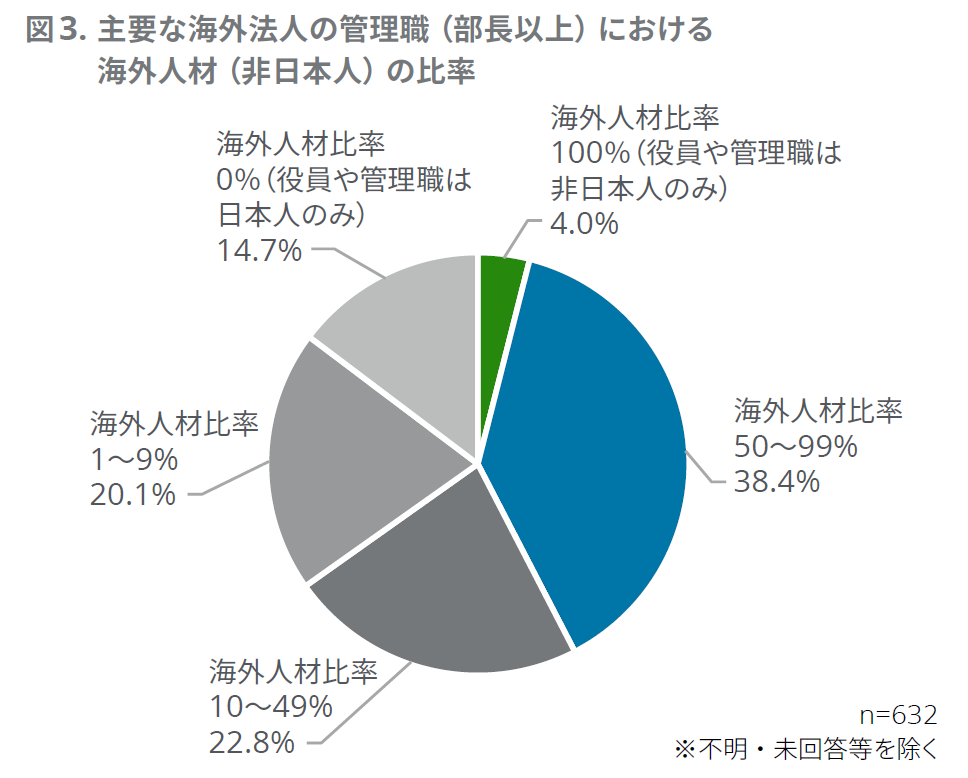
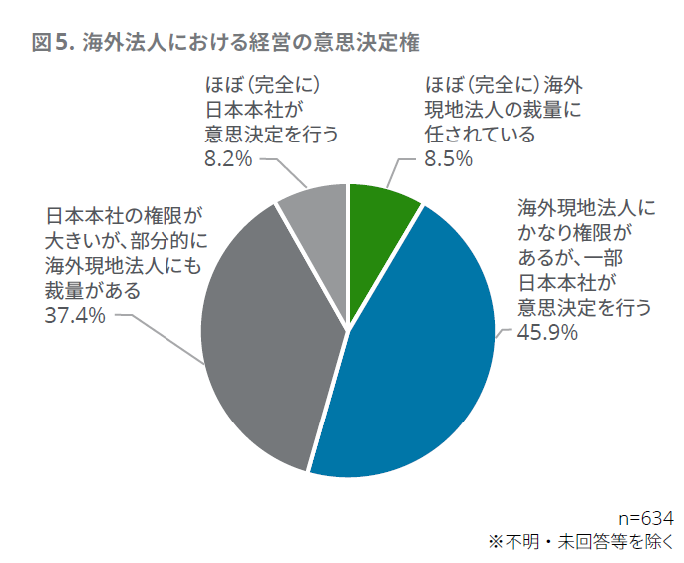
While the "number" of overseas talent is sufficient, "decision-making" remains Japanese-led. Even in companies that have been operating for a long time since their establishment, the "quality" barrier of localization is highlighted, preventing autonomous value creation. (Figures 3, 5)
②Lack of AI/IT human resources
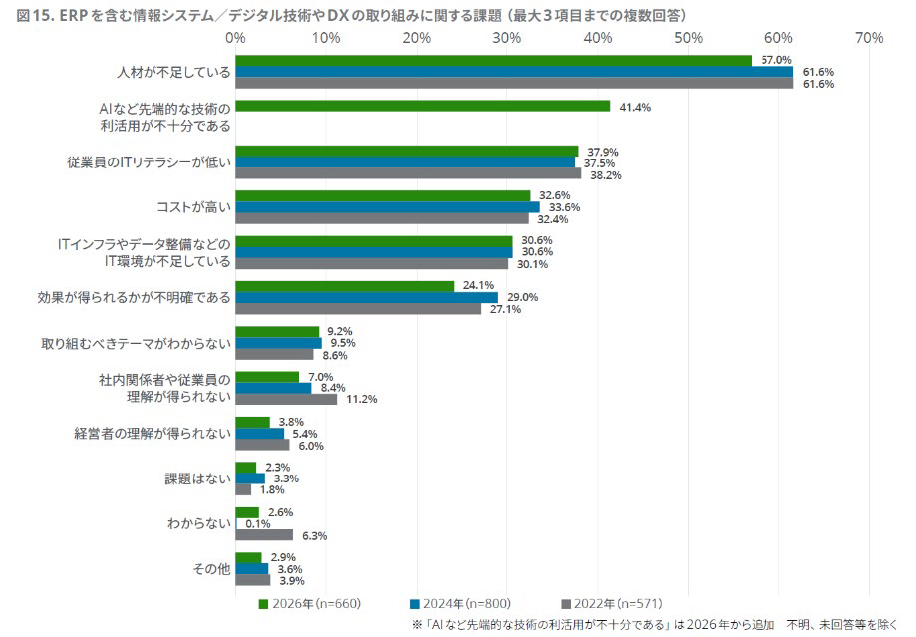
While there is a strong sense of insufficient utilization of advanced technologies such as AI, the biggest obstacle behind this is the "shortage of talent," which has consistently ranked first in all three surveys. Approximately 60% of respondents cited this issue, highlighting its severity. Especially at overseas locations, presenting an "attractive career path" to attract highly skilled AI and IT talent will be key to growth. (Figure 15)
③ Delay in moving away from analog infrastructure
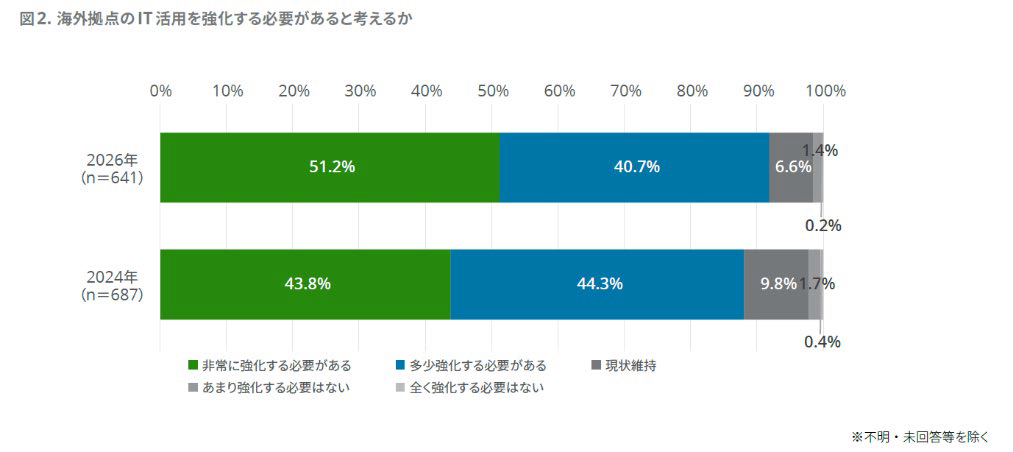
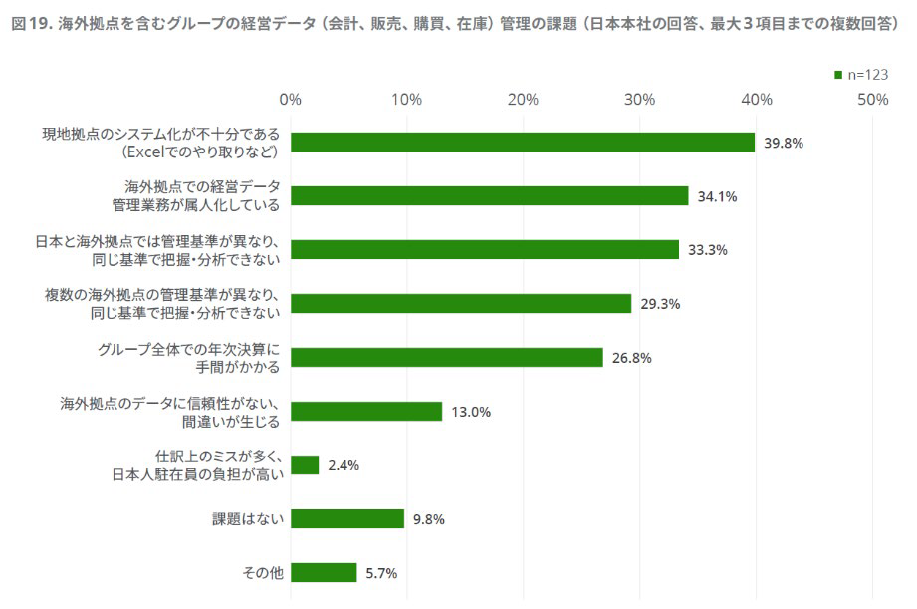
While over 90% (91.9%) of overseas offices have a need to strengthen their IT infrastructure (Figure 2), many companies still rely on Excel for management. Building a "de-analog" infrastructure to support real-time business decision-making is an urgent necessity (Figure 19).
[Survey Overview]
● Survey Name:"Survey on Trends in Information Systems/Digital Technology Utilization by Companies Expanding Overseas (2026 Edition)"
The "quality" of localization is being questioned as global management maturity improves.
"Transformation through the development of information systems as a management foundation and human resource development is essential."
Download URL:https://info.b-en-g.co.jp/offering/globalreport_2026
● Survey Objective:To clarify the "maturity level" and the actual state of IT/DX promotion at overseas bases.
● Survey subjects:Japanese companies with overseas bases, Japanese headquarters and overseas subsidiaries, headquarters of all industries, and employees of overseas subsidiaries. *The countries where overseas subsidiaries are located are mainly in Asia and India.
● Survey method:Web questionnaire
● Survey period:January 7th to January 31st, 2026
●Number of valid responses:660
●Respondent demographics:Japan headquarters: 18.6% / Overseas subsidiaries: 81.4%
Manufacturing: 58.0% / Non-manufacturing: 42.0%
●Supervised by:Deloitte Tohmatsu LLC
● Cooperation:Kyodo News Digital Co., Ltd., NNA Co., Ltd.
●Main survey contents
- Impact on overseas business due to changes in the international situation
- Management issues/business issues (multiple answers to up to 3 items, by region)
- Need to strengthen IT utilization at overseas bases (single answer)
- Challenges related to information systems including ERP, digital technologies, and DX initiatives.
(Multiple responses allowed, up to 3 items; by region) - Regarding the proportion of overseas personnel in management positions at overseas locations and management decision-making. etc.
[Reference: 2024 edition]
● Survey Name:"Survey on Trends in the Use of Information Systems/Digital Technologies by Companies Expanding Overseas (2024 Edition)"
Download URL:https://info.b-en-g.co.jp/offering/globalreport_2024
B-EN-G will continue to conduct similar surveys regularly in the future to identify issues faced by the Japanese headquarters and overseas subsidiaries of Japanese companies with overseas bases, and provide services and products that resolve these issues.
*When citing the results of this survey, please include the following attribution: "[From Business Engineering Corporation "Survey on Trends in the Use of Information Systems/Digital Technologies by Companies Expanding Overseas, 2026 Edition]"
■About Business Engineering Corporation (B-EN-G)
Since the early 1990s, when it was the first company in Japan to implement SAP ERP, Business Engineering has been supporting the digital transformation of its clients, primarily in the manufacturing sector, with IT solutions. It boasts extensive experience in IT planning, system construction, implementation, and operation consulting and support services, as well as the sales and implementation of its proprietary package software, "mcframe." Furthermore, it assists in system enhancement and improvement activities by leveraging data accumulated from core business systems (ERP), supply chain management (SCM), IoT, and more. With overseas subsidiaries in five locations—China (Shanghai), Thailand (Bangkok), Singapore, Indonesia (Jakarta), and the United States (Chicago)—Business Engineering provides products and services to companies expanding overseas, working closely with both Japanese and local partners to solve their business challenges.
For more information, please visit: https://www.b-en-g.co.jp/jp/
Note: All company and product names mentioned in this release are the trademarks or registered trademarks of their respective companies.
Business Engineering Corporation
Public Relations Group, Corporate Administration & Planning Division
TEL: 03-3510-1619
For inquiries, please contact us here.
Business Engineering Corporation
Corporate Administration & Planning Division Planning Department
TEL: 03-3510-1612
E-mail: global-survey@b-en-g.co.jp