

[Case Study] Establishing a DX platform to support group management with "SAP S/4HANA® Cloud" and achieving advanced SCM by linking sales, production, and procurement plans and results. DAIICHI KIGENSO KAGAKU KOGYO CO., LTD.
Daiichi Rare Elements Chemical Industry, a world-leading manufacturer of zirconium compounds, launched "D-Value," a project to integrate and standardize systems and business processes across its globally deployed locations. They adopted "SAPS/4HANA Cloud" as the framework for this project. Despite interruptions due to the COVID-19 pandemic, the implementation was successfully completed, establishing a management foundation that allows for quick assessment of the group's overall situation. Currently, they are working on continuous process maintenance and improvement, as well as leveraging advanced technologies such as AI to utilize data effectively.
Integrate and standardize global operations and systems with a Fit to Standard approach
Reason for introduction
Building the foundation for a "100-year company" that can respond to the transformation of the automotive industry, its main customer base.
Daiichi Rare Earth Chemical Industry is a materials manufacturer that produces, sells, and researches and develops inorganic compounds, primarily zirconium compounds, but also cesium compounds and rare earth compounds. Zirconium is a "rare element" with many excellent properties, and when formed into compounds, it exhibits various characteristics such as heat resistance and high durability. Taking advantage of these properties, the company's products are used in various forms throughout society, from industrial fields to household goods. In particular, many of the company's products are used in the automotive sector, and in 2020, it was recognized by the Ministry of Economy, Trade and Industry as one of the "Top 100 Global Niche Companies" for having the world's top market share of approximately 40% (estimated by the company) in the field of automotive exhaust gas purification catalyst materials.
In 2012, the company established VIETNAM RARE ELEMENTS CHEMICALJOINT STOCK COMPANY (hereinafter referred to as the Vietnamese subsidiary) as a base for procuring zirconium ore and manufacturing intermediates that serve as raw materials for its products. This established the world's only "integrated production within the group" system, in which intermediates are manufactured from raw ore in Vietnam and then processed in Japan according to customer requirements to create finished products.
Regarding the advantages of this system, Hamakami Yoshihisa of the Business Headquarters SCM Center explains, "By locating our headquarters and R&D base in Japan, and our manufacturing bases in both Japan and Vietnam, we have secured our own raw material procurement routes and have a dual supply chain, ensuring a stable supply of products. In the field of zirconium compounds, raw material procurement has traditionally been dependent on China, but in recent years, the geopolitical risks involved have been increasing. Our ability to achieve a stable supply of products while avoiding these risks is a major strength of ours, and is something that is highly valued by our customers."
Meanwhile, the market surrounding zirconium compounds is undergoing a major transformation, particularly in the automotive industry, the company's main customer, where electrification (EV) is progressing. Amidst this, the company has adopted the vision of becoming a "100-year company" with rare elements, and with an eye on further growth, launched its 10-year medium-term management plan, "DK-One Next," in 2022.
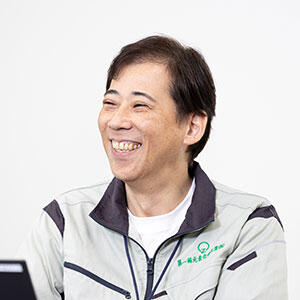
Business Division SCM Center
D-Value Project Japan Expansion Leader
Yoshihisa Hamagami
In "DK-One Next," six pillars have been established as initiatives to overcome the environmental changes that may occur in the next 10 years and to continue creating new businesses: "creation of new businesses," "reform of revenue structure," "realization of innovative manufacturing," "practice in building an organization that consistently delivers results," "further cultivation of what makes Kigenso unique," and "commitment to sustainability." As a measure to build a digital transformation (DX) foundation that supports the realization of these pillars, the company has been promoting the "D-Value" project, a business and system transformation project using "SAP S/4HANA Cloud."
We want to strengthen group management by unifying business processes globally.
Daiichi Rare Elements Chemical Industry established a subsidiary in Vietnam in 2012, followed by sales bases in China in 2013, Thailand in 2018, and the United States in 2019. Rie Mitsui of the ICT Management Department at the Corporate Headquarters recalls the situation at the time as follows.
"The systems at our overseas branches were all different, with each company implementing its own locally sold package or borrowing systems from our joint venture partners. As a result, it was difficult for headquarters to grasp the situation at each company until the financial reports were submitted."
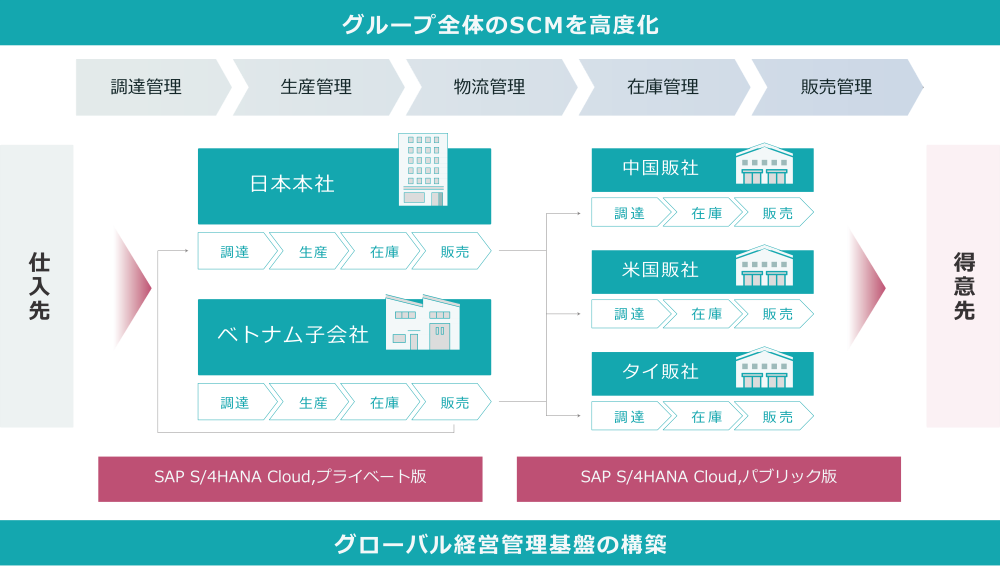
To rectify this situation and establish a proper foundation for group management, the D-Value project was launched in 2019. While implementing the "Public Edition" of SAP S/4HANA Cloud at sales offices in China, the United States, and Thailand, the company began implementing the "Private Edition" of SAP S/4HANA Cloud at its Vietnamese subsidiary in 2020. After a one-year interruption due to the COVID-19 pandemic, operations began in 2023. In the same year, the company also began implementing the Private Edition at its headquarters, transitioning to full-scale operation in April 2025.
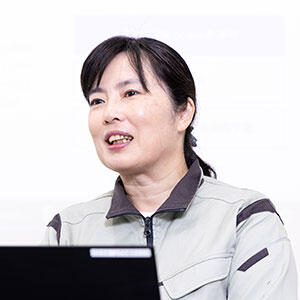
Management Headquarters, ICT Management Department
D-Value Project Overall Promotion Leader
Rie Mitsui
Project Background
The "Fit to Standard" approach aims to shorten implementation timelines and reduce costs.
Mr. Mitsui explains the reason for adopting SAP S/4HANA Cloud in the D-Value project as follows:
"We wanted to do more than just upgrade the system; we wanted to create a simple configuration that makes the most of the standard features of SAP products, which can be described as a 'treasure trove,' and to rethink our business processes, incorporating new ways of thinking without being constrained by the rigid scope of use." This is what is known as "Fit to Standard." The background to this was the belief that core business processes themselves could not be a source of differentiation for the company.
"We thought that adopting a 'clean core strategy' that eliminates individual company processes and personal processes as much as possible and avoids customizing the system would not only optimize the data stored in the system, but would also shorten project periods and reduce costs," says Mitsui.
Based on this policy, we decided to implement the public version of SAP S/4HANA Cloud for our overseas sales companies.
The private version was adopted for the Vietnamese subsidiary and head office after comprehensively considering factors such as the implementation project schedule, the public version's compatibility with Vietnamese requirements, and its flexibility for manufacturing bases. However, Mitsui continued to explore the possibility of introducing the public version of SAP S/4HANA Cloud to the Vietnamese subsidiary and head office until the very end in order to thoroughly implement the "Fit to Standard" and "Clean Core" strategies.
Building a system that links procurement to sales to advance global SCM
When deploying D-Value to its headquarters, the company set the goal of "enhancing the SCM across the entire group," and Mr. Hamagami took on the role of project leader. Regarding this goal, he said, "It means optimizing business processes from raw material procurement to sales globally and building a DX foundation to realize the six pillars of DK-One Next. For example, one of the pillars is 'reforming the revenue structure,' and in order to achieve this, it is necessary to reduce inventory as much as possible and maintain good cash flow. To do this, it is important to run operations while closely linking sales and production plans with data as the core, and bringing 'production volume' and 'sales volume' as close to equal as possible. We proceeded to build a system for this purpose using SAP S/4HANA Cloud."
In response to these words, Mr. Mitsui added the following explanation regarding the development of systems aimed at enhancing SCM.
"The SAP ECC 6.0-based ERP system that headquarters had been using was a typical 'System of Record (SoR),' and it only utilized functions for collecting and managing actual data. In other words, it wasn't a system that linked sales plans and production plans based on data, as Hamagami mentioned. Production plans were created using spreadsheet software outside the ERP system, and sales plans and actual costs were also managed in separate systems. There was no data indicating future inventory within the ERP system either. In the headquarters' D-Value project, we proceeded with creating a system to solve these problems." Specifically, by linking sales budgets, sales plans, and production plans and managing future inventory in the system, a mechanism for automatically proposing delivery date responses was realized using the standard functions of SAP S/4HANA Cloud.
In addition, the company has globally organized customer and material master data, revised and unified the coding system, and linked order placement and receiving between group companies across systems. Furthermore, they have simplified the system configuration by enabling actual cost calculations to be performed within SAP S/4HANA Cloud.
Implementation Results
Real-time visibility into business performance and future plans
In 2018, before the D-Value project began, there was a plan to "keep" SAP ECC 6.0 as the head office's ERP system and continue using it until support ended in 2027. However, given the possibility of increasing overseas locations in the future, "we concluded that it was necessary to prepare a foundation for global management and SCM at the head office for the future, and decided to utilize SAP S/4HANA Cloud. We feel that this decision has strengthened our core systems and yielded commensurate results," Mitsui explains.
Regarding its effects, Hamagami said, "The best thing about promoting this D-Value project is that we can now grasp business performance and future plans in real time. I expect that this will definitely speed up management decisions."
Furthermore, Mr. Mitsui stated, "The ability to grasp the overall situation and plans of the group through data is of great significance, and I feel that we have established the foundation for DX that will enable data-driven management. Going forward, I would like to contribute to strengthening group management by considering and verifying from various perspectives how to analyze and utilize the performance data and planning data managed by the system."
The key to project success lies in choosing the right partner.
Another achievement that Mitsui cited as a result of the D-Value project was that the implementation of SAP S/4HANA Cloud at each location, including the head office, proceeded as planned and continues to operate stably. Mitsui and Hamakami cited their choice of B-EN-G as their project partner as the biggest factor in this success.
Regarding B-EN-G's contribution, Mr. Mitsui recalled, "The deciding factor in our sales company adopting the SAP S/4HANA Cloud public version was B-EN-G's proposal to 'make full use of the standard functions.' Back in 2019, the public version had just been launched, and there were hardly any use cases, so we were worried about whether it would really be usable. B-EN-G has a very strong sense of challenge towards unknown solutions, and we felt that we could create a new future together," and continued.
"As expected, the public version project, with its completely new implementation method, features, and user interface, proceeded very smoothly. With the public version's regular updates several times a year, we strongly felt the wonderfulness of new features being added and the great advantage of having virtually no effort required for software maintenance."
Furthermore, B-EN-G made full use of their experience with this public version in formulating business processes for the later introduction of the private version, which allowed the D-Value project to achieve its initial goal of "Fit to Standard."
B-EN-G consistently approached our challenges from the perspective of "how can we make this happen?" and drove the project forward, which made us strongly realize that "who you work with is the key to success in ERP implementation."
Furthermore, Hamagami shared the following anecdote: "Before the D-Value project in Japan began, B-EN-G built a warehouse management system and a barcode system as a separate project aimed at organizing the movement of goods within the factory. This prior preparation has contributed to the smooth progress of this project and the stable operation of the system."
The company is also considering using AI to make effective use of the data that will be accumulated in the system, and is counting on the generous support of B-EN-G to help it make effective use of such innovative technology.
Case study company introduction
| Company Name | DAIICHI KIGENSO KAGAKU KOGYO CO., LTD. |
| Establishment | May 21, 1956 |
| Head office location | Kitahama, Chuo-ku, Osaka City |
| Overseas bases | Manufacturing and sales base: Vietnam / Sales bases: China, Thailand, USA |
| Business Activities | Manufacturing, sales, and research and development of inorganic compounds such as zirconium compounds, cesium compounds, and rare earth compounds |
| Company website | https://www.dkkk.co.jp |
*Please note that organization names, positions, numerical data, etc. in the article are based on the time of the interview and may have changed by current viewing.


