

[Case Study] Renewing the core business system with "SAP S/4HANA" to further enhance corporate value - Bushu Pharmaceuticals Ltd.
Bushu Pharmaceutical specializes in contract manufacturing of pharmaceuticals and investigational drugs, delivering its products to global markets in 56 countries worldwide.
Taking advantage of the expansion of its business operations following the merger of its Aizu factory, the company unified its core business systems, including accounting, sales management, procurement, and production management, with SAP's ERP "SAP S/4HANA," achieving transformation and standardization of its business processes. What challenges, efforts, and ingenuity were involved in achieving this success? This report details the entire project.
Issues before implementation
-
- Standardization and streamlining of core operations is urgently needed to accommodate business expansion due to factory mergers
- Strengthening accounting and financial compliance
- Speeding up the management PDCA cycle
Effects after implementation
-
- Realization of commonality and standardization of core business operations and establishment of IT platform
- Realizing improved legal compliance and internal governance through the digitization of business and the visualization of processes.
- It enables the real-time collection and aggregation of performance data, accelerating management PDCA cycles
Implementation Points
-
- Under top-down decision-making, a system was organized in which elite members from each relevant department were dedicated to implementing "SAP S/4HANA."
- With engineers from the technical department at the forefront, and involving personnel from various departments, we thoroughly worked on master data development and unifying item code and lot systems across all factories.
- By adopting a "Fit to Standard" approach, which involves adapting their own business processes to the standard functions and processes of SAP S/4HANA, they minimized the development of custom modules.
The starting point of reform
Taking advantage of the expansion of the factory, a top-down decision was made to introduce "SAP S/4HANA" to the entire company.
Bushu Pharmaceutical was established in 1998 as a CDMO (Contract Development and Manufacturing Organization) specializing in the contract manufacturing of pharmaceuticals and investigational drugs. Since starting operations as Bushu Pharmaceutical Kawagoe Plant in January 1999, the company has steadily expanded its business. In 2014, the "Misato Plant" was added from Eisai, and in 2021, the "Kazo Packaging Center" was opened. Subsequently, in 2022, the Aizu Plant was added from Sanwa Chemical Research Institute, and in 2023, the "Soka Packaging Center" was opened. As of the end of 2024, the company employs approximately 1,800 people.
The company is a "global market-oriented" CDMO, and has obtained GMP (Good Manufacturing Practice) certification, the standard for pharmaceutical manufacturing management and quality control, in Japan, the United States, and Europe. It exports its manufactured products to 56 countries, and does business with more than 95 contract manufacturers both domestically and internationally. These contract manufacturers include major pharmaceutical companies such as Amgen, Eisai, Kyowa Kirin, Gilead Sciences, Shionogi & Co., Ltd., Taiho Pharmaceutical Co., Ltd., Sumitomo Pharma Corporation, Chugai Pharmaceutical Co., Ltd., Eli Lilly Japan, Pfizer, and Janssen Pharmaceutical Co., Ltd.
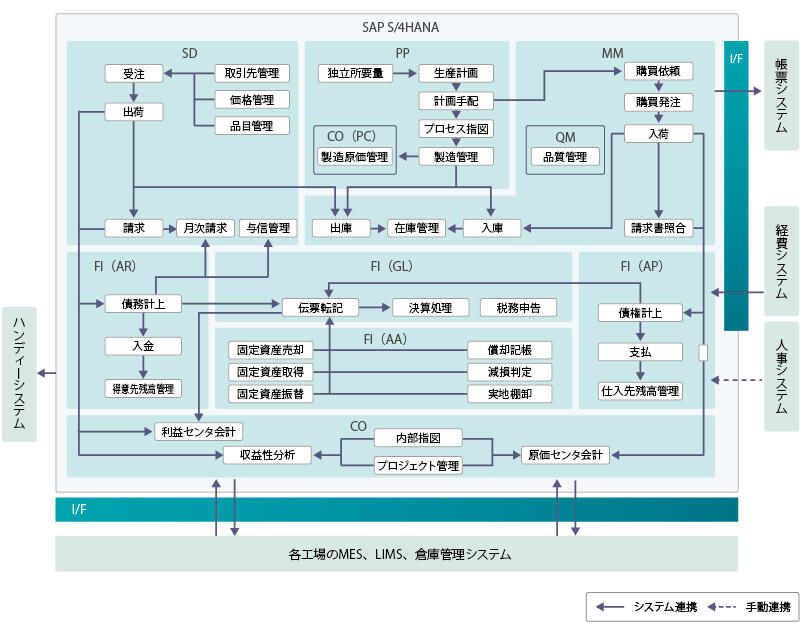
The company utilizes "SAP S/4HANA" as its core business system, which supports its operations across the entire organization. The company has implemented modules of SAP S/4HANA such as "Financial Management (FI)," "Management Accounting (CO)," "Sales and Distribution Management (SD)," "Inventory and Purchasing Management (MM)," "Production Planning and Production Management (PP)," and "Quality Management (QM)." By linking these modules with manufacturing execution systems (MES) and laboratory information management systems (LIMS) at each factory, they have achieved system standardization and business process standardization.
Regarding the background of the SAP S/4HANA implementation, Akifumi Fukuda, General Manager in charge of the Production Division at Bushu Pharmaceutical Co., Ltd., and one of the leaders who spearheaded the implementation project, explains as follows:
"The impetus for implementing SAP S/4HANA was the addition of our Aizu Plant, bringing our total to three plants. To maximize the business benefits of this expansion, we decided to unify and standardize the core business systems and processes, which had previously differed from plant to plant, using SAP S/4HANA, thereby optimizing our overall management resources. This transformation was decided upon under the strong leadership of our top management (President and CEO, Tadao Takano). Behind this decision was the aim to enhance both our value and credibility in the global market by utilizing SAP products, which are widely used in the global pharmaceutical industry."

Department Manager, directly under the Production Headquarters
Akifumi Fukuda
Masao Hasegawa, General Manager of the Accounting and Finance Department at Bushu Pharmaceutical Co., Ltd. and another leader of the SAP S/4HANA implementation project, added the following explanation regarding the background of the implementation:
"The Accounting and Finance Department had been using SAP's ERP products even before implementing SAP S/4HANA, but it was merely a tool for closing accounts and wasn't used for standard cost accounting. It wasn't integrated with sales management, procurement, or production planning/management systems, making it difficult to quickly gather information from those systems, hindering real-time performance tracking, and improving the speed and accuracy of budget and forecasting. In addition, there was a lot of manual data entry from paper documents submitted by various departments, making it difficult to flexibly respond to various legal regulations and compliance requirements such as the invoice system and the Electronic Bookkeeping Law. One of the goals of implementing SAP S/4HANA company-wide was to solve all of these problems at once."

Head of Accounting and Finance Department
Masao Hasegawa
Project launch
We will assemble a dedicated team to drive the project forward by gathering the best talent from each department.
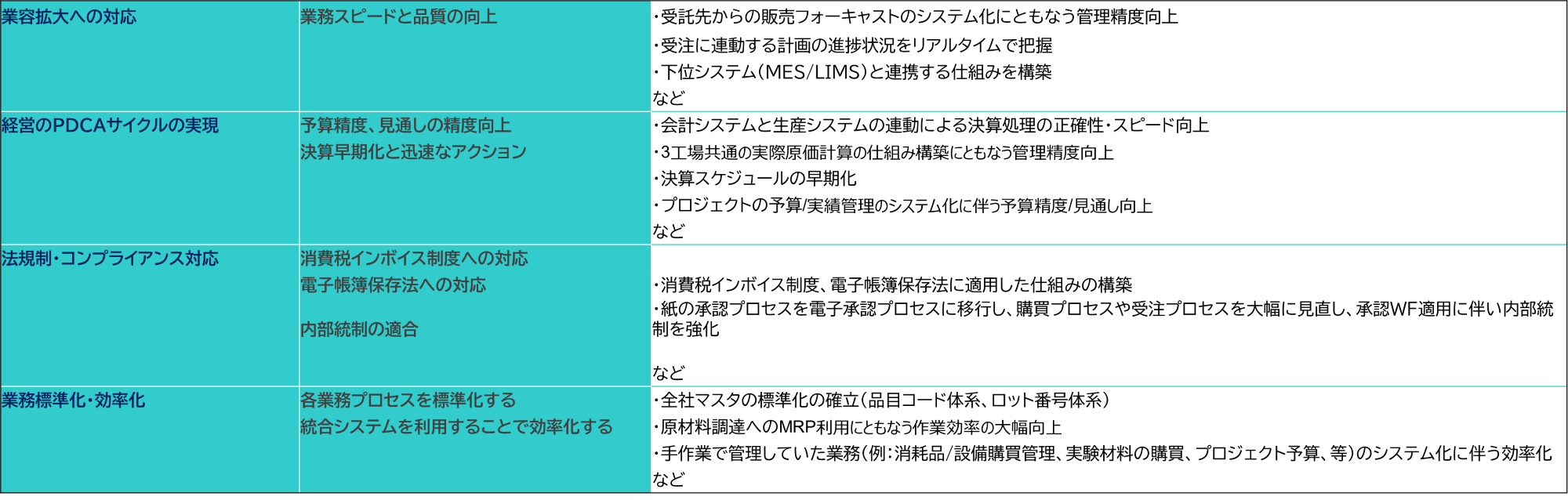
The major management goals that Bushu Pharmaceuticals set for itself when implementing SAP S/4HANA company-wide can be summarized into the following four, centered on optimizing resources and developing IT in accounting, sales, logistics, and production.
- ① Responding to business expansion (improving operational speed and quality)
- ② Realization of the management PDCA cycle (improvement of budget formulation and forecasting accuracy / acceleration of financial closing and swift action)
- ③ Compliance with laws and regulations, strengthening governance (compliance with consumption tax and invoice systems / compliance with the Electronic Bookkeeping Law / strengthening internal controls)
- ④ Business efficiency improvement (standardization and efficiency improvement of each business operation through the implementation of an integrated system)
Under these overarching goals, the company formed a project team by selecting personnel with expertise in their respective departments (accounting and finance, manufacturing, procurement, supply chain management, logistics, etc.). The implementation project was launched in September 2022.
The mission, according to the schedule, is to complete the company-wide implementation of SAP S/4HANA within approximately two years, by the end of August 2024.
Regarding the establishment of this system, Mr. Fukuda reflects as follows:
"In this project, we established a system where participants were assigned to the project full-time, rather than juggling it with their regular work. This was possible because it was a top-down project, but without this system, it might have been difficult to overcome the numerous obstacles encountered along the way and complete the company-wide implementation of SAP S/4HANA in two years."
Towards success
Major goals and measures to achieve them
The project team, which began implementing SAP S/4HANA, worked with its system integration partner, Business Engineering (B-EN-G), to identify business challenges and clearly define the objectives of "what we will achieve with SAP S/4HANA" in order to accomplish the four major goals mentioned earlier.
"The Misato Plant and the Aizu Plant were originally bases of separate companies, and each had its own distinct culture (way of working) and rules. In order to unify business processes and work regulations, the use of an IT system like SAP S/4HANA was essential, and it was very important to clearly define the objectives of what we wanted to achieve, or what we needed to achieve, through its implementation, and to ensure that all organizations were on the same page," recalls Fukuda.
Based on this approach, the company has set out the following detailed measures to be implemented using SAP S/4HANA. In implementing all of these measures, the company has focused particularly on master data management and the unification of material code and lot number systems across all factories. Regarding this point, Mr. Fukuda explains, "Whether an ERP system like SAP S/4HANA is successful or not depends on the master data, but in our case, we had challenges with master data management, so it was extremely important to maximize the accuracy of the master data. Similarly, it was also important to unify the material code and lot number systems, which differed from factory to factory."
Factors for success
Reasons for overcoming difficult challenges
Within the framework of the goals and strategies outlined above, Bushu Pharmaceutical first migrated its accounting, sales management, and purchasing systems to SAP S/4HANA, and then gradually switched its production systems at its three factories to SAP S/4HANA.
❶ Challenges and organizational changes in master data maintenance
However, as Mr. Fukuda mentioned earlier, this project is facing various difficulties along the way.
One of the most challenging aspects was preparing the master data. For example, during the initial data migration rehearsal for the SAP S/4HANA master data, inconsistencies were found in the master data prepared on paper, making it almost impossible to register any data.
Therefore, the company completely revamped its master data maintenance system in preparation for the second rehearsal. Specifically, the responsibility for master data maintenance was transferred to the technical department, and two new engineers were assigned to oversee the master data maintenance.
One of those engineers is Naoki Takahashi, manager of the Formulation Technology Group in the Formulation Technology Department at Bushu Pharmaceutical. He decided to hold regular meetings with B-EN-G to review the challenges and progress of master data development.
"Initially, we thought we could migrate the master data from the production management systems used at each factory to SAP S/4HANA almost as is. However, the failure of our first rehearsal made us realize that this was a mistake. As a result, the technical department, which is responsible for manufacturing process development and overseeing the item master data, took the lead in working on master data maintenance. We gathered about 20 people from various departments and held regular meetings to work on the re-maintaining of the master data. These meetings were held every morning at 11 a.m. and continued from around the summer of 2023 to June 2024. For the first two months, B-EN-G led the overall process, but later, our own members were able to manage the issues and progress surrounding master data maintenance, and we were able to properly migrate the data to SAP S/4HANA." (Mr. Takahashi)
❷ Standardization of item codes and lot number systems
The technical department continues to be responsible for coordinating master data maintenance even after the project is completed. In addition, the "Code Center," organized by Bushu Pharmaceutical's Corporate IT department, performs master data maintenance in response to maintenance requests compiled by the technical department.
Similar to master data maintenance, the unification of item codes and lot number systems was also considered a key theme in the project and underwent extensive discussion.
Tomoki Igarashi of the Kawagoe IT Group, IT Department, Corporate IT Headquarters, Bushu Pharmaceutical, who was in charge of this work, said, "The item codes and lot number systems differed considerably from factory to factory, so unifying them was quite a challenging task. However, in this project, we were determined to achieve unification, and we took a firm stance of not accepting any opposition from the field. B-EN-G also provided us with proposals based on other companies' case studies at the best possible time. As a result, while finding a compromise with the limited time, we were able to unify the item codes and lot numbers in a way that we believe is optimal for the current system configuration."
❸ Challenges and Improvements of Standard Costing
Furthermore, the accuracy of the standard costs was initially poor, and it seems they had to repeatedly revise the master data, accumulate costs, and analyze the resulting reports.
Regarding the reasons for this, Keita Kaneko, who participated in this project as the project manager for B-EN-G, points out the following:
"At Bushu Pharmaceutical, the accounting and finance department was responsible for creating the standard cost Bill of Materials (BOM), and the manufacturing and technical departments were not involved. Furthermore, the management methods for work hours, machine hours, and QC hours differed at each of their Kawagoe, Misato, and Aizu plants. This made it easy for errors to occur in quantities, output quantities, work hours, machine hours, and QC hours in the standard cost BOM. However, through the SAP S/4HANA implementation project, we feel that the master data maintenance skills of the Bushu Pharmaceutical team members have improved, and their understanding of how to link manufacturing and cost has deepened."
Hasegawa agreed with this point and continued, "Indeed, the accuracy of standard costs has improved, and standard costs for each item are now calculated properly. Also, what is beneficial for the accounting and finance department is that it is no longer necessary to create a Bill of Materials (BOM) for costs."
❹ Rapid decision-making and a strong support system
In addition, the implementation of SAP S/4HANA required all locations to change their existing work methods.
"In this project, we basically adopted a 'Fit to Standard' approach, aligning our operations with the standard functions and processes provided by SAP S/4HANA. This meant that each department in our core business operations had to change their previous ways of working. However, because this project was top-down, there was little resistance from the departments to the changes. Furthermore, the project's reporting line was handled by Advisor Okada on the management side, which allowed for speedy decision-making. In addition, morning and evening meetings were held during periods of heavy workload, and thanks to the thorough and persistent support from B-EN-G, we were able to overcome numerous problems and ultimately implement SAP S/4HANA almost exactly as planned," said Mr. Fukuda.
Project Outcomes
Changes and effects that SAP S/4HANA has brought to each workplace
❶ Paperless operations and improved accuracy of cost management
Company-wide operation of SAP S/4HANA began in 2024. Regarding the business changes and effects brought about by this, Yohei Doi, Group Manager of the Cost Group in the Accounting and Finance Department at Bushu Pharmaceutical, said, "Since the introduction of SAP S/4HANA, the accounting and finance system and the core business system have been connected, and we have been able to improve operations such as linking accounting entries. In addition, the introduction of SAP's workflow has made progress in going paperless, which has also led to increased operational efficiency. In the future, since the material ledger function of SAP S/4HANA has made it possible to grasp the actual cost for each item, we would like to use this data to improve the accuracy of cost management."
❷ Enables speedy information sharing between locations.
Furthermore, Mitsuharu Shibasaki of the Misato Planning Group, Supply Planning Department, Supply Chain Management Headquarters, Bushu Pharmaceutical Co., Ltd. explains the effects of implementing SAP S/4HANA as follows:
"By having our three factories operate SAP S/4HANA, we can now centrally manage information such as production plans, raw material procurement, and product shipments for each factory, starting from the sales plan. As a result, each factory can instantly check inventory levels and the status of incoming and outgoing shipments. This has also enabled the rapid and accurate sharing of inventory information between factories without human intervention, leading to improved operational speed in the supply chain."
❸ Optimizing procurement plans and utilizing data
On the other hand, Mr. Fukuda describes the benefits of implementing SAP S/4HANA as follows:
"After implementing SAP S/4HANA, the MRP (Material Requirements Planning) function made it clear what needed to be procured and by when. As a result, at the Misato Plant, previously a lot of time and effort was spent confirming delivery dates and order quantities when the production planning department placed orders with the procurement department. However, with the implementation of SAP, the ordering process is now precisely managed, and the accuracy of order quantity forecasts has improved. This has significantly reduced the amount of work required for confirmation and improved operational efficiency. Ultimately, this has demonstrated an even greater ability to ensure a stable supply of medicines to our customers and patients."
In addition, the company has created an index that indicates the operational efficiency of its factories, showing how much time and effort it takes to produce one formulation.
"We expect that by comparing and analyzing this indicator with actual results, we can obtain data that will be useful for management," Fukuda explains.
As described above, the company-wide implementation of SAP S/4HANA has yielded significant benefits in the company's operations. Bushu Pharmaceutical highly regards B-EN-G as a partner that contributed to this success. The key points of their evaluation are summarized below.
The benefits of B-EN-G as evaluated by Bushu Pharmaceutical
-
- They possess strong communication skills that enable smooth and speedy interaction at every stage of the project.
- He always presented multiple concrete and clear ideas as options, along with the advantages and disadvantages of each. This always led to in-depth discussions within the project team.
- The proposals were always specific, which demonstrated their high level of technical skill and track record.
- He provided persistent support until difficult tasks such as migrating data to SAP S/4HANA were completed, which was an inspiration to the team members.
B-EN-G will continue to provide support that earns this kind of positive feedback.
Comment from Tadao Takano, President and CEO of Bushu Pharmaceuticals Ltd.
As we announce on our company website, my goal is to "develop Bushu Pharmaceutical into a unique company that is the leading CDMO in Asia."
As one solution, we have decided to implement SAP S/4HANA.
The background to this was our desire to maximize the business benefits of expanding our operations, as we now have a three-factory system with the addition of the Aizu Plant. To achieve this, we needed to standardize and unify our operations, and we believed this could be accomplished through the introduction of an integrated system.
Looking at our major pharmaceutical clients, almost all of them have implemented SAP's core systems to conduct their business. This demonstrates that it is a trustworthy product in the compliance-sensitive pharmaceutical industry.
Our company has cleared inspections in Japan, the US, and Europe to obtain GMP certification, and we export our products to 56 countries through our clients. In recent years, we have also launched the "GATEWAY to ASIA®" project, which involves importing bulk products from international biopharmaceutical companies, conducting quality testing, inspections, and secondary packaging, and supplying them to Asian countries. We are also focusing on supporting global pharmaceutical companies aiming to expand into Japan and Asia.
The purpose of this SAP S/4HANA implementation is to centralize data management from manufacturing to sales and finance, improve operational speed and accuracy, and gain even greater trust from our customers.
In fact, through the system implementation, the business processes themselves have been redefined, and various changes have occurred due to strengthened information sharing between departments. In order to continue meeting our customers' needs, we want to make good use of SAP S/4HANA and be the company that people say, "We want to rely on Bushu Pharmaceutical."
Case study company introduction
| Company Name | Bushu Pharmaceuticals Ltd. |
| Establishment | August 3, 1998 |
| Head Office and Kawagoe Factory Location | Takeno, Kawagoe City, Saitama Prefecture |
| Business Activities | Contract manufacturing of pharmaceuticals and investigational drugs |
| Main business locations | Kawagoe Factory, Misato Factory, Aizu Factory, Kazo Packaging Center, Soka Packaging Center |
| Company website | https://www.bushu-pharma.com/ |
*Please note that organization names, positions, numerical data, etc. in the article are based on the time of the interview and may have changed by current viewing.


