
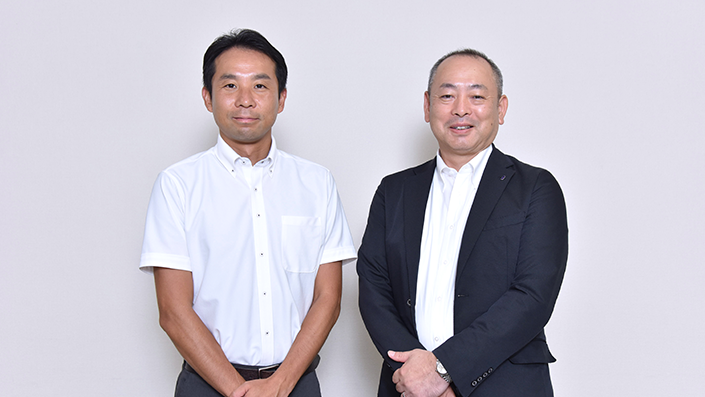
Towa Denki Co., Ltd. (Minato-ku, Tokyo; President and CEO: Shinichi Fujimine), an electronics trading company with clients including major Japanese manufacturing groups and doing business globally in a wide range of fields from mobility to home appliances, medical equipment, heavy electrical appliances, and IoT devices, has adopted Business Engineering (B-EN-G)'s "Data Utilization Advisory Service for Promoting DX" to begin creating an environment for widely utilizing data for business improvement and reform and business decision-making. Ultimately, the company aims to achieve digital transformation (DX) in the true sense of the word, by transforming its corporate culture itself into a data-driven one.
With a consolidated employee count of around 240, the company is not a large corporation, but it is pursuing a down-to-earth DX strategy that is realistic and promising in terms of costs and resources. We spoke to Terumasa Ishii, Senior Managing Director and General Manager of the Administration Division, and Yuya Sakurai, Manager of the Systems Department, who are key figures driving the series of projects, about the key points of the initiative, the background and history, and how they work with technology and IT vendors.
Using the cloud resulted in costs much lower than expected
--Please tell us the background to why you started this project.
ISHIIWe've always been concerned about the possibility of managing the data accumulated daily in various systems within the company in an integrated manner, and extracting the necessary data as needed to analyze and utilize it. For example, materials for management meetings were created by aggregating the necessary data from multiple systems and compiling it into spreadsheets, but this was all done manually, which limited the ability to utilize the latest information in a timely manner and placed a heavy burden on the staff. Also, in recent years we have introduced CRM/SFA to support sales, but information that sales should refer to is also accumulated in traditional core systems such as sales management, and when we try to combine this information for analysis and utilization, the time and effort required to aggregate and process the data was a bottleneck.
On the other hand, I had the impression that in order to establish a system that could collect, process, and analyze data in an integrated manner across systems, it would be necessary to prepare a large-scale server and purchase related software at great expense, which I thought would be difficult for anyone other than a large company.
However, when we consulted B-EN-G about this issue, they proposed a system that would allow us to start small using the public cloud.
We found that we could get started much cheaper than we had expected, so we decided to get started.
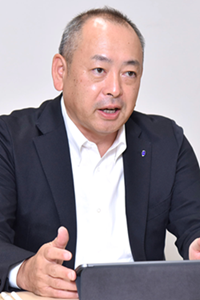
Terumasa Ishii
--We've heard that you are using Microsoft Azure, Microsoft Power BI, and other services to build a data utilization platform that will gradually expand in scale and functionality. What specific initiatives will you be taking?
Sakurai: Based on the basic principle of aggregating data in Azure, the first step was to convert the materials from the management meetings that Ishii mentioned into Power BI reports, making it possible to check the latest information on demand.
Ishii: In Step 2, which we are currently preparing, we will develop new reports to spread data utilization among the management, middle management, and field staff. In addition, our company is not just about purchasing and selling materials and parts, but is also focusing on a business that offers total proposals up to processing. However, the knowledge and know-how on how to select the most suitable processing partner to meet each customer's needs has become tacit knowledge among veteran sales people.
In step 3, we will create a database of this information, convert it into explicit knowledge, and raise the level of competence of our mid-career and junior employees. We also plan to add customer satisfaction information to this database and share it with suppliers and customers, thereby revitalizing the entire business ecosystem. Our ultimate goal is to create a corporate culture where operations and decision-making are based on data through these initiatives.
With each step, we will expand and broaden our data utilization infrastructure, and in the process, we hope to create a system in which data utilization will directly lead to business growth. The idea is that the data utilization infrastructure will grow along with the business.
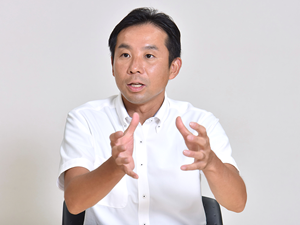
Yuya Sakurai
Sakurai: In Step 1, we worked with B-EN-G on development using Power BI and Azure operations, which allowed us to accumulate skills and know-how within the company.
We are now able to think with greater resolution about what steps we need to take to achieve Step 3, and we are constantly updating our roadmap.
I feel that this is also one example of the "growth" that Ishii mentioned.
Data is a company's most important asset
--The ultimate goal of creating a corporate culture where operations and decisions are based on data is exactly what it means to aim for DX in the truest sense.
Ishii: It's true that we are aiming for DX, but that's an afterthought (laughs).
I have always worked in accounting, and at the same time, I was also in charge of maintaining the company's systems in the Administration Division. Having spent so much time looking at financial information and information systems, I came to the conclusion that data is a company's most important asset. If we can compile information about relationships with customers and suppliers, and cash movements, in an easy-to-understand format and deliver it to the people who need it, we will be able to continuously improve our competitiveness as a company. I realized that this is what leads to what is commonly known as DX.
--How should you choose an IT vendor as a partner in building the infrastructure for DX?
IshiiWe have been working with B-EN-G since we introduced the ERP "mcframe GA" to all our overseas bases. Following B-EN-G's advice, we called the people in charge from all bases to our headquarters, explained our policy, and provided training. This resulted in a successful implementation and operation that went smoothly.
In this project, too, they shared the project's objectives and what success would look like for our company, taking into account our management challenges, from the proposal stage onwards, and I feel they worked both mentally and physically with us to achieve that goal. Generally speaking, I think that a vendor with whom you can build such a relationship of trust is an effective partner for DX.
Sakurai: This time, I feel like B-EN-G is working with us to find the optimal solution, from the perspective of what is best for our company, including transferring skills that Towa Denki should be handling in-house. That's very reassuring.
Case study company introduction
| Company Name | Towa Electric Co., Ltd. |
| Establishment | February 1946 |
| Head office location | Minato Ward, Tokyo |
| Business Activities | Sales of electrical materials, electronic materials, chemical materials, and metal materials, as well as synthetic resin raw materials, industrial films, and molded products. |
| Business Locations | Head office and 12 other domestic locations, 14 overseas locations including Singapore, China, Vietnam, etc. |
| Company website | https://www.towadenki.co.jp/ |
*Please note that organization names, positions, numerical data, etc. in the article are based on the time of the interview and may have changed by current viewing.
Related Solutions
Relevant information and case studies based on solutions presented above.
Related Case Studies
NISHIMATSU CONSTRUCTION CO.,LTD.
Data Utilization Infrastructure Development (MDM and BI Environment): Case Study for Promotion of Digital Transformation
Construction/Engineering
Data Management Platform Implementation & Utilization
DIC Corporation
Achieving Advanced Performance Management and Improved Efficiency: Case Study of Building a Consolidated Global Performance Management Infrastructure
Chemical
Data Management Platform Implementation & Utilization
KONICA MINOLTA, INC.
Master Data Management (MDM) System Construction: Case Study Supporting Sophistication of Global Management
Precision mechanical equipment
Global Expansion
Data Management Platform Implementation & Utilization


