

Fiscal Year 2025 Financial Results Briefing - Transcript (Including Q&A Session)
The briefing presentation content is posted below in both text and slide images.
Agenda
I am Haneda, President of Business Engineering Corporation. I will now explain our financial results for the fiscal year ending March 2026. This slide shows the agenda for today's presentation materials.
Executive Summary of FY2025 Financial Results
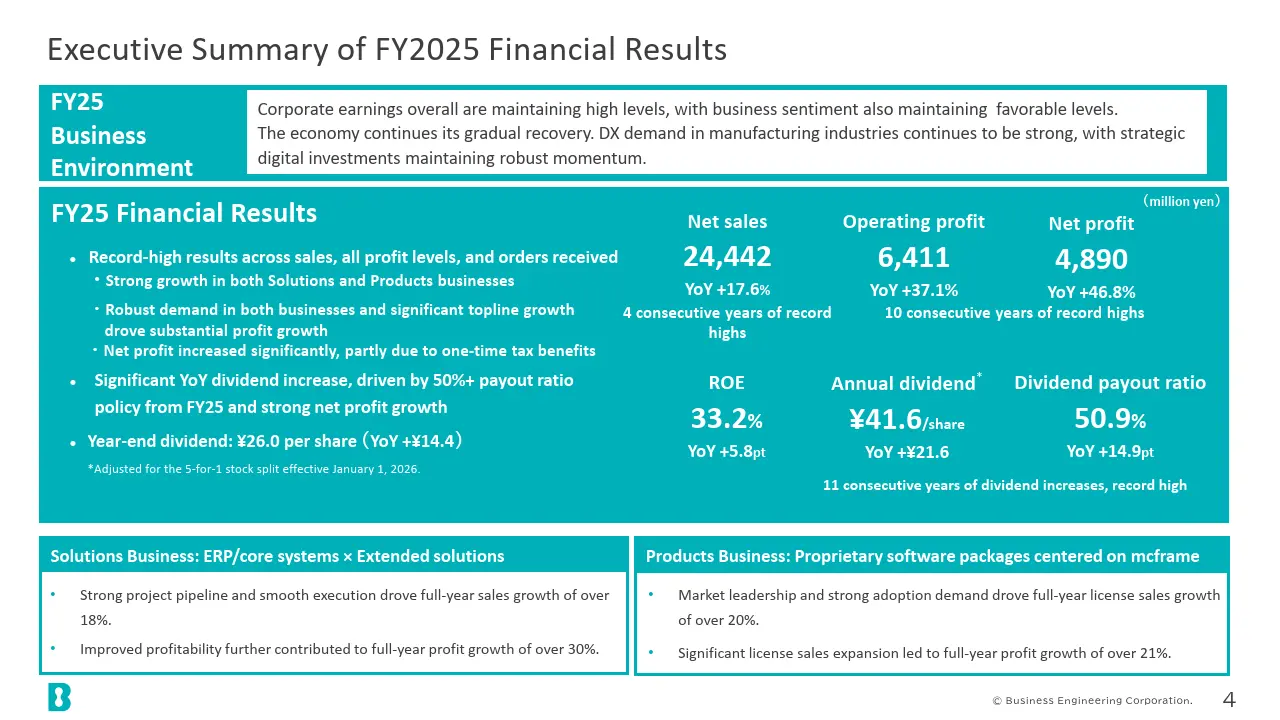
First, I will explain the executive summary for the fiscal year ending March 2026. The business environment in fiscal year 2025 progressed favorably, with digital investment in the manufacturing industry remaining strong. Against this backdrop, our full-year results reached record highs in all areas, including net sales, profit at each stage, and order intake.
Both the Solutions business and the Products business achieved strong growth. In addition, net income increased significantly, partly due to temporary tax burden reduction measures.
Regarding the annual dividend, we have decided to change our policy to a dividend payout ratio of over 50% starting from fiscal year 2025. Reflecting the significant increase in net income, the dividend has been substantially raised.
Summary of Consolidated Income Statement
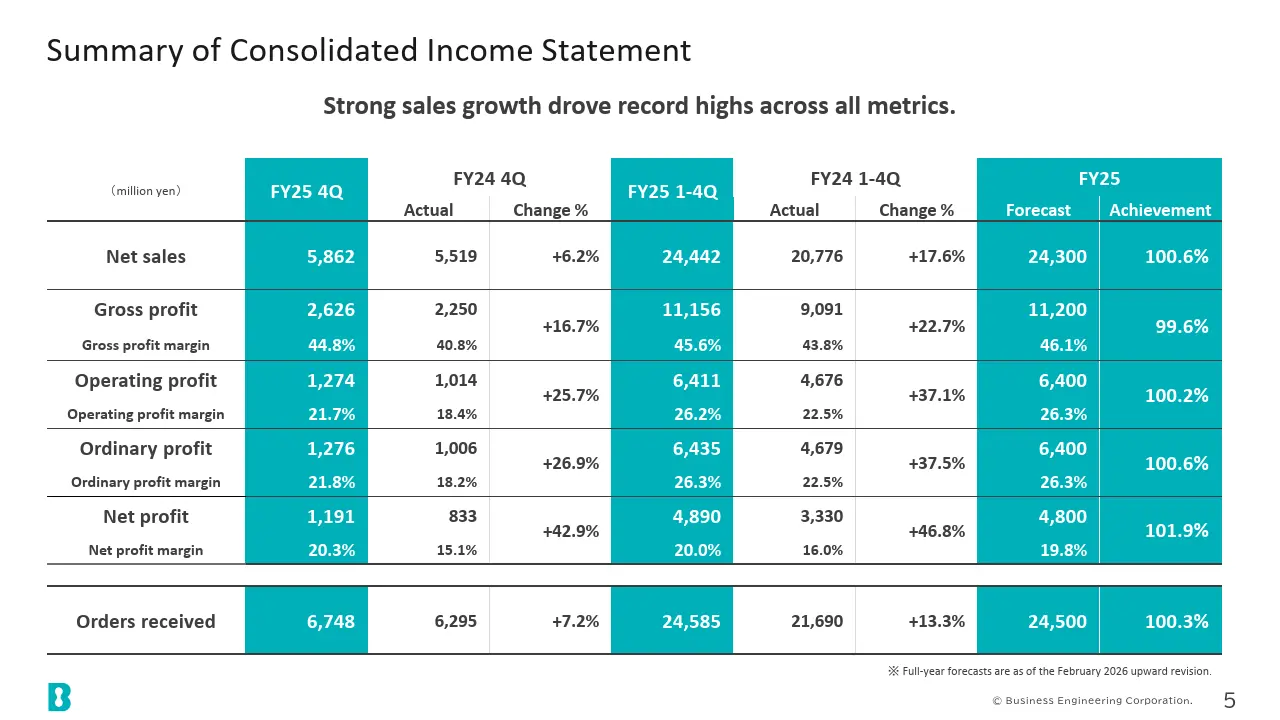
These are the P&L highlights. Driven by significant revenue growth, we achieved record highs across all metrics for the full fiscal year. Net sales increased by 17.6% year-over-year, operating profit by 37.1%, and net income by 46.8%.
Analysis of Changes in Operating Profit (YoY)
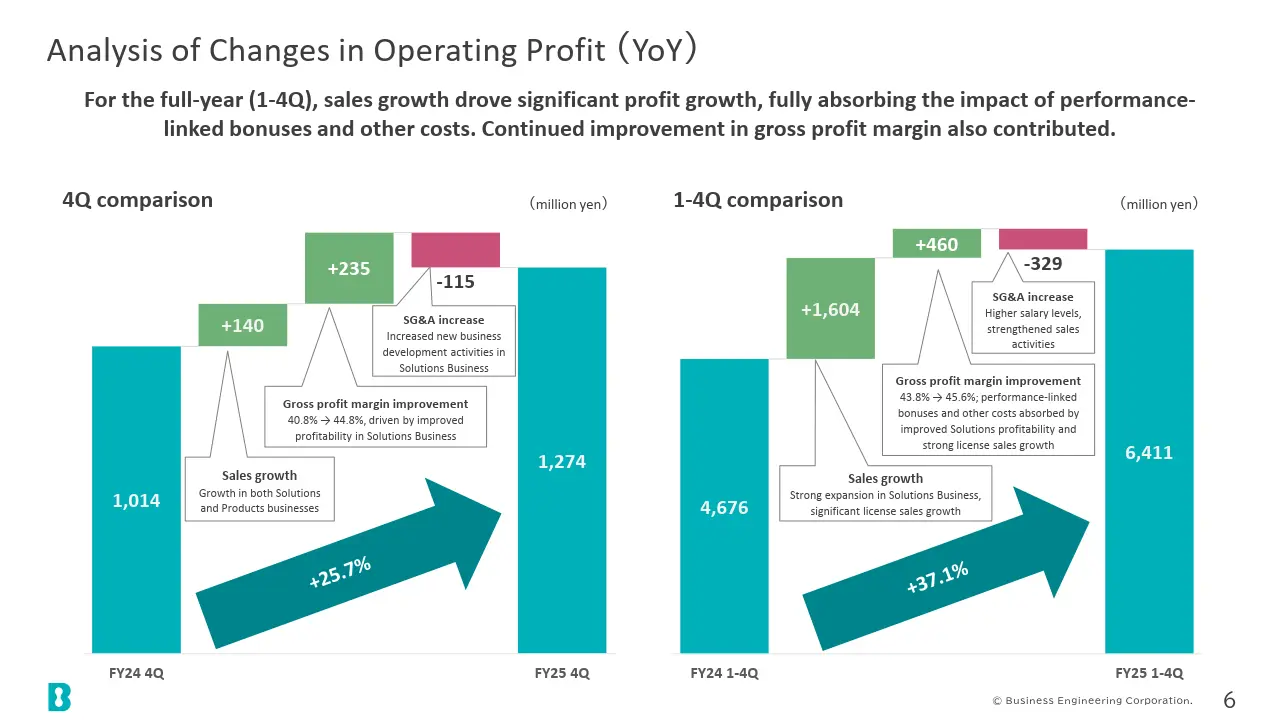
This is an analysis of changes in operating profit. In the cumulative fourth quarter, increased sales drove a significant improvement in profit. Although performance-based bonuses and other measures were implemented, their impact was absorbed by the effect of higher revenues.
Sales & Operating Profit by Segment
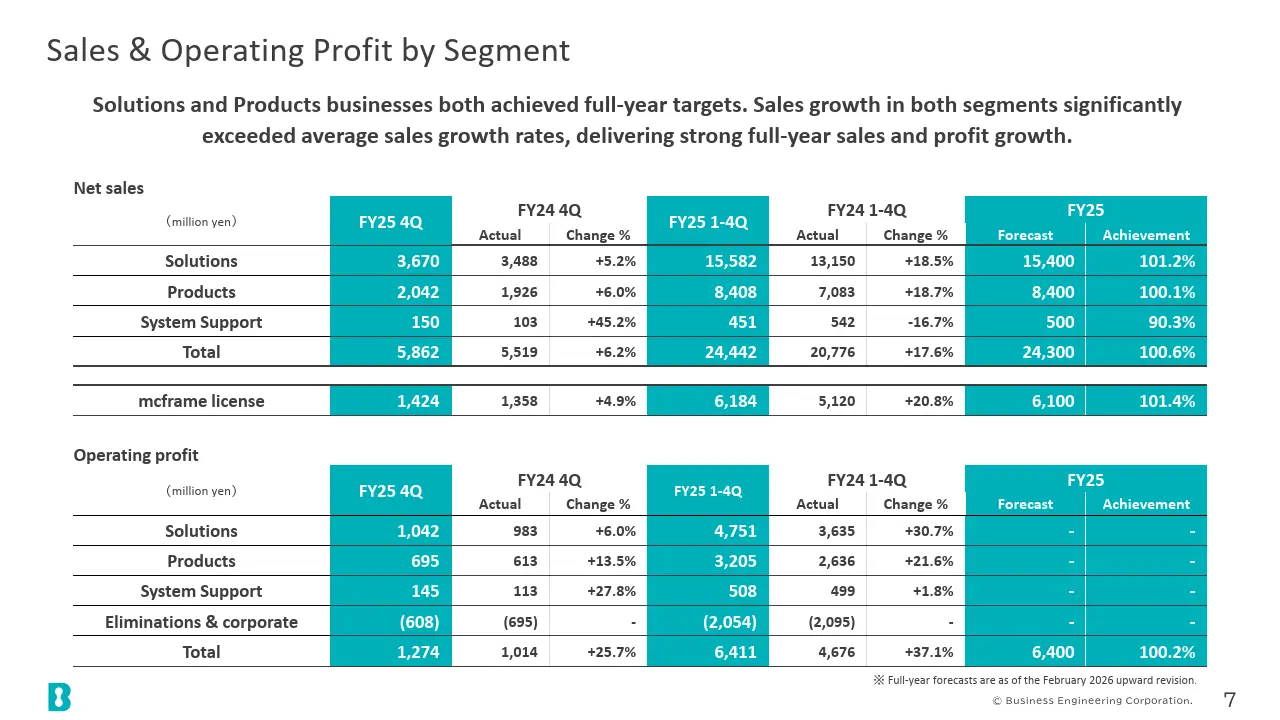
This shows revenue and operating profit by segment. Both the Solutions business and the Products business achieved results exceeding the upwardly revised full-year plan. Both businesses have grown significantly above their historical compound annual growth rates.
Segment Information: Solutions Business
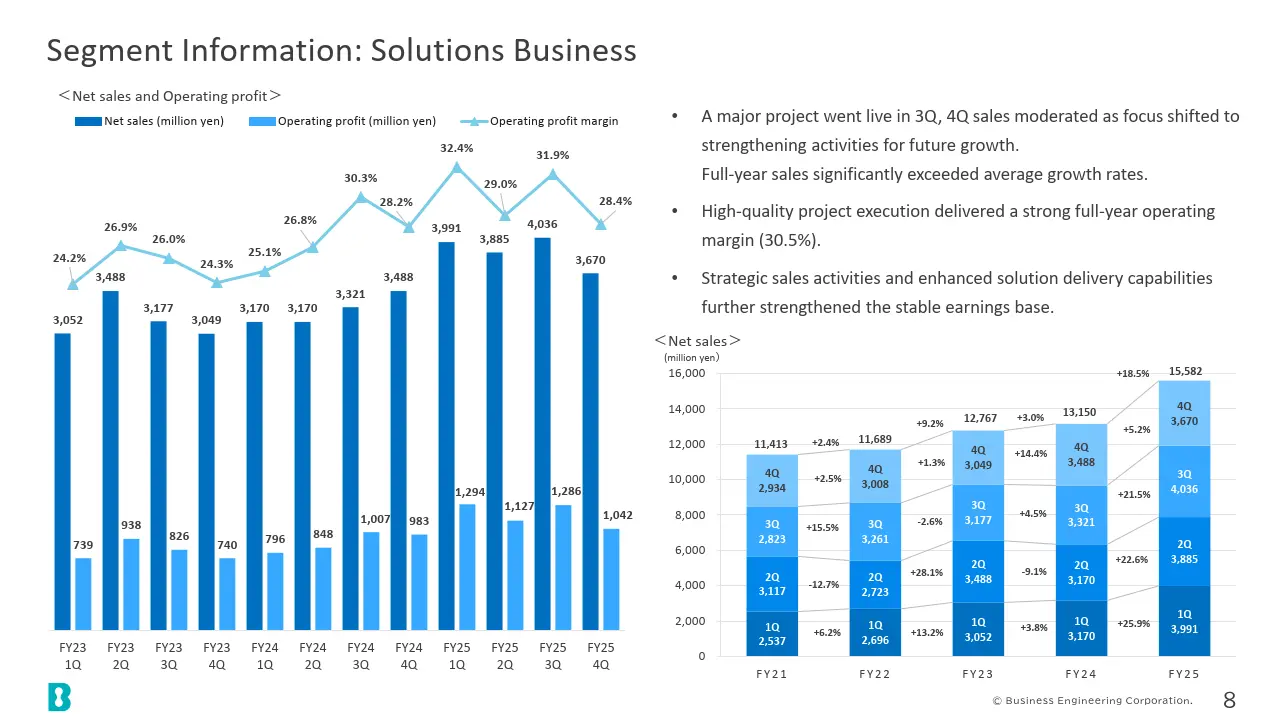
Let me explain the Solutions business. Although revenue in Q4 temporarily settled due to the impact of some large projects that went live in Q3, the full-year results significantly exceeded the average growth rate overall. In addition, operating profit margins remained at a high level, supported by smooth project execution.
Segment Information: Solutions Business Recurring Sales Trends
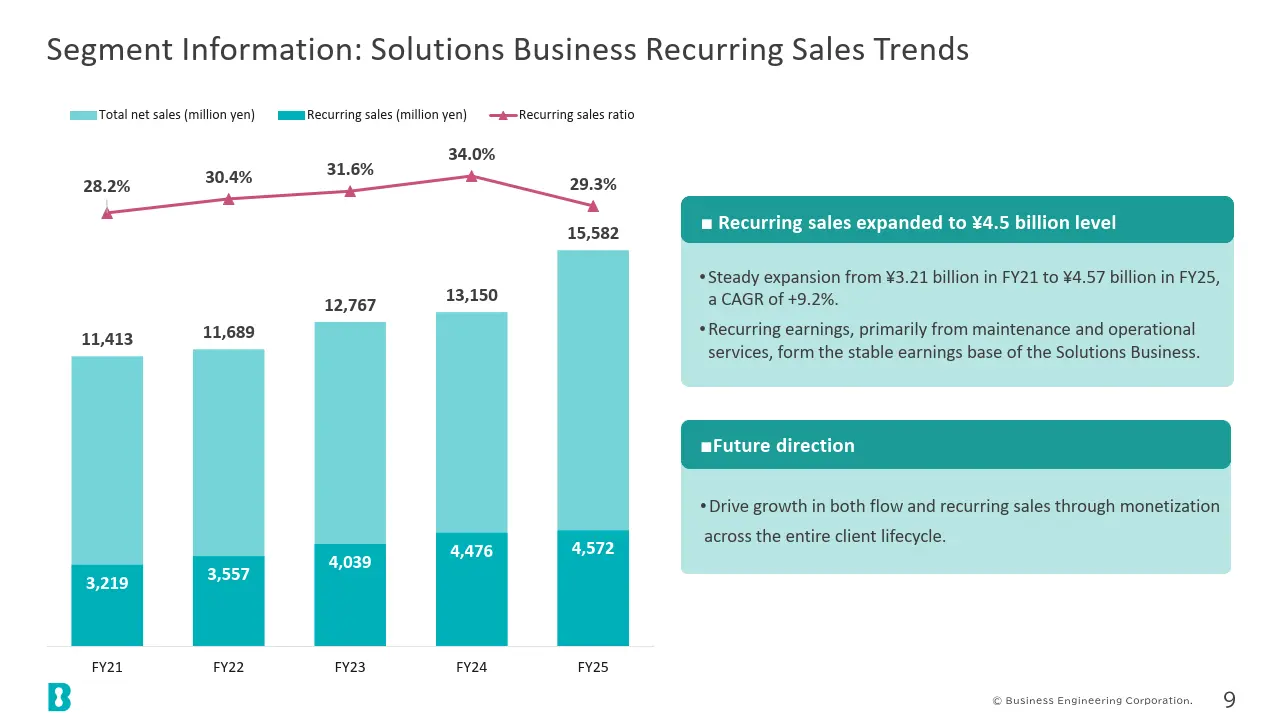
This shows the recurring revenue trends in the Solutions business. Although the recurring revenue ratio has declined due to significant overall revenue growth, recurring revenue itself continues to increase steadily.
Segment Information: Products Business
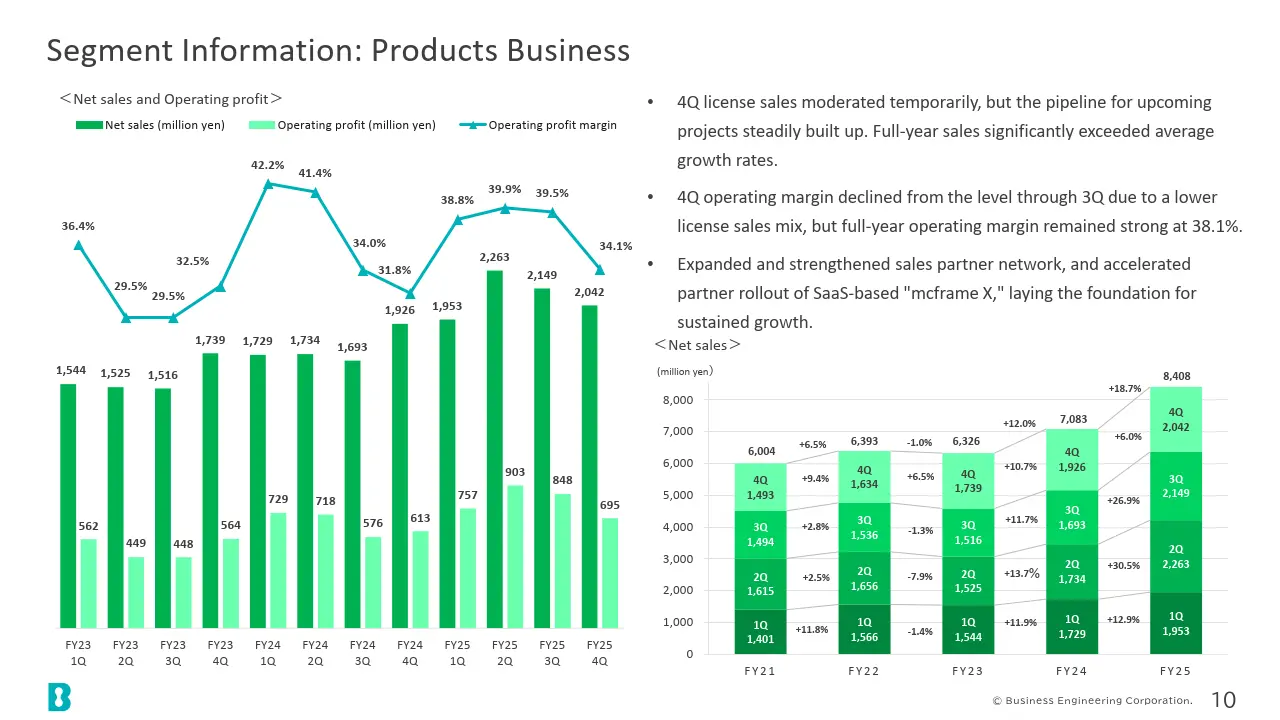
Next, I will explain the Product Business. While license sales in Q4 have temporarily settled down, deals for fiscal year 2026 are steadily accumulating. We focused on expanding sales partners and rolling out our SaaS product "mcframe X".
mcframe License Sales
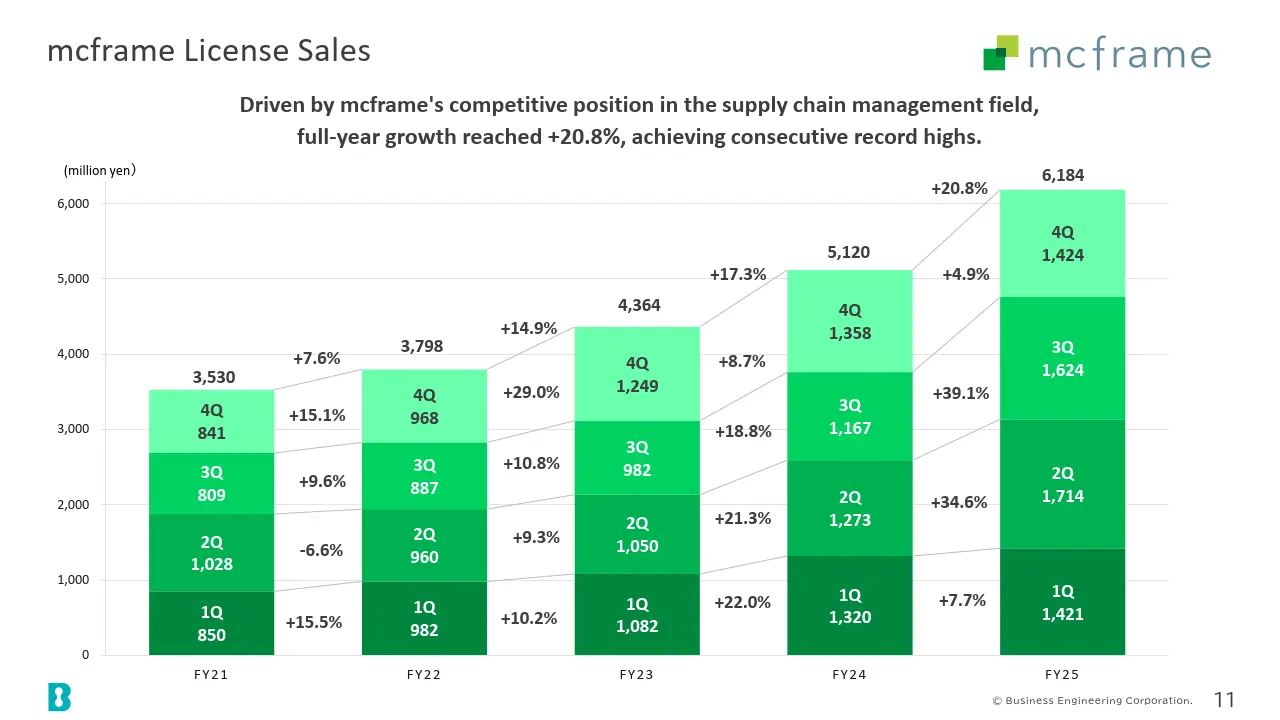
This shows the trend in license sales of "mcframe". Backed by the market superiority of "mcframe", we achieved high growth of 20.8% for the full fiscal year.
mcframe License Sales Recurring Sales Trends
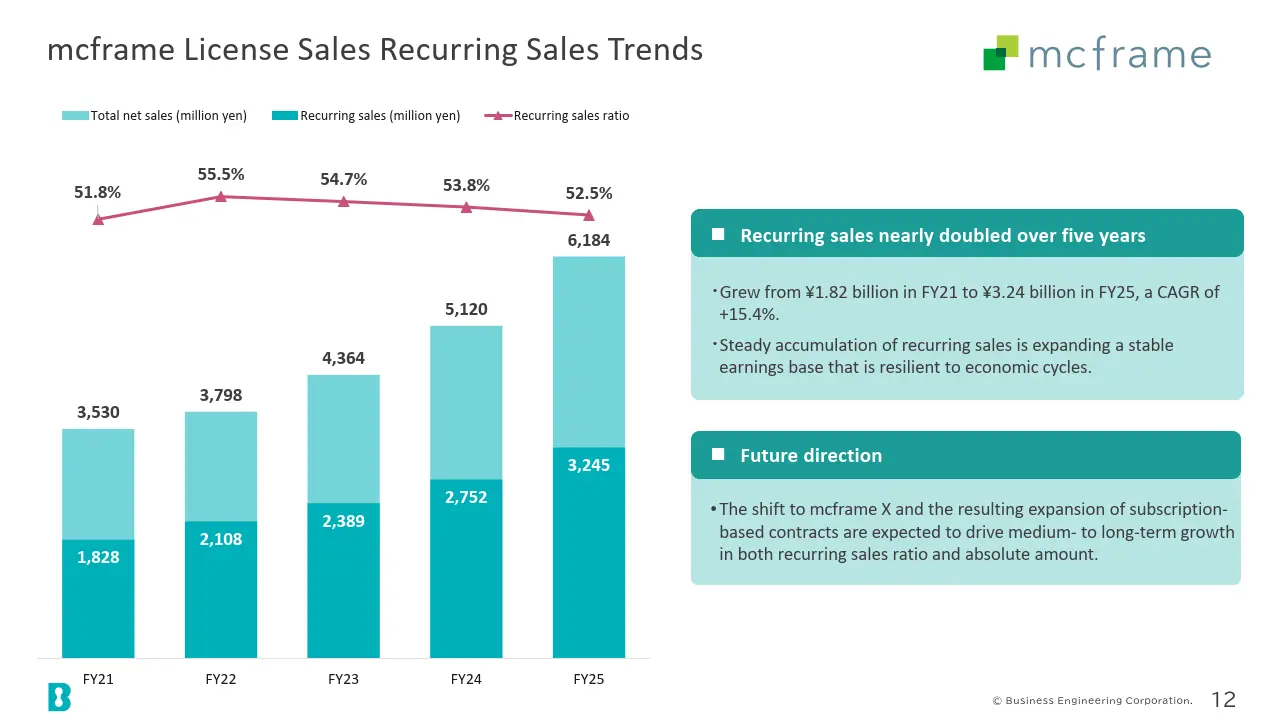
This is a graph showing the trend of recurring revenue from "mcframe" licenses. License maintenance has grown due to steady acquisition of new "mcframe" licenses, and recurring revenue has also increased.
Summary of Consolidated Balance Sheet
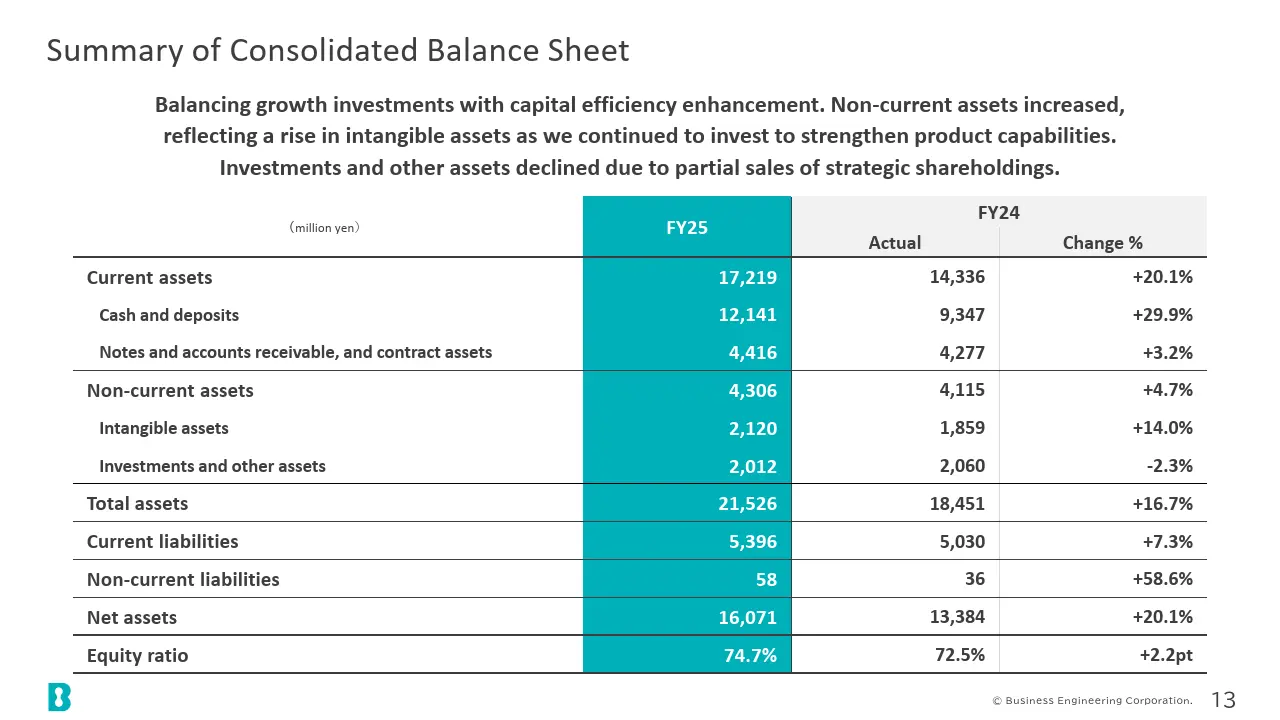
Here is an overview of the BS highlights. Intangible fixed assets have increased due to investments in product development. On the other hand, investments and other assets have decreased due to the partial sale of policy-held shares.
Summary of Consolidated Cash Flows
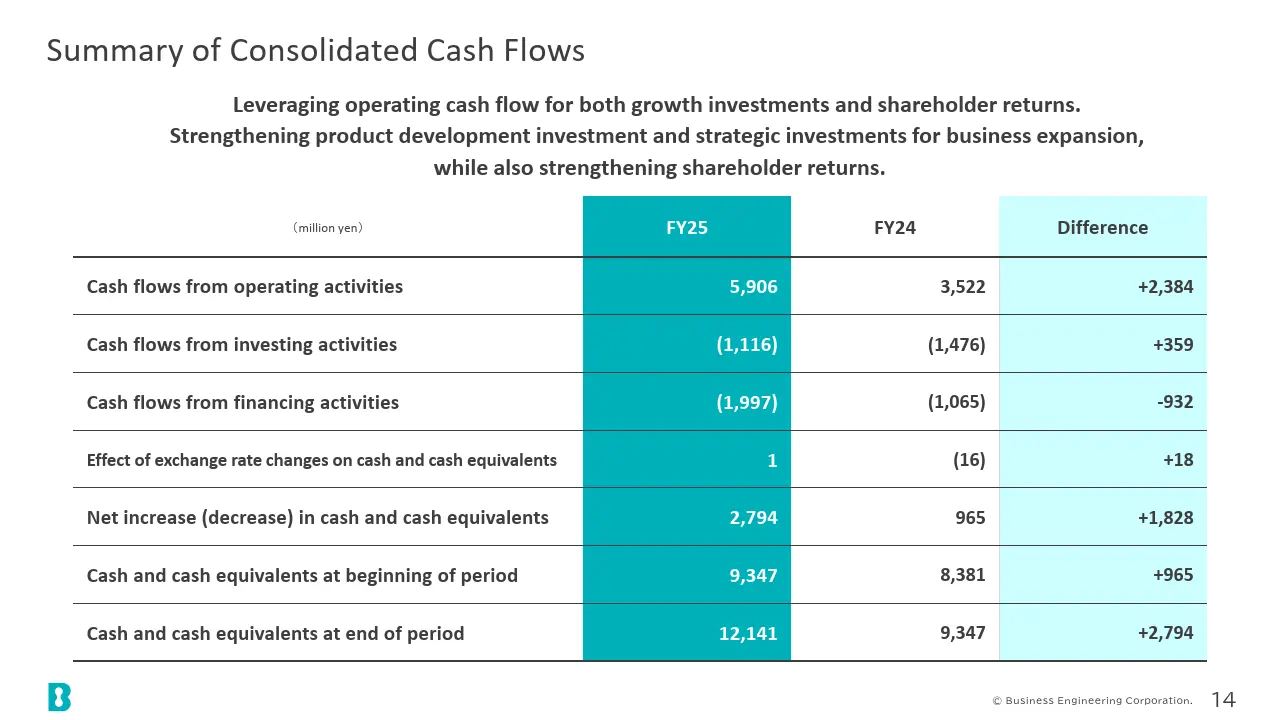
Here are the highlights of the consolidated cash flow. Cash flow from operating activities increased by approximately 2.4 billion yen. Going forward, we will promote product development investments and strategic investments to accelerate future growth.
Introduction | About BE 2030
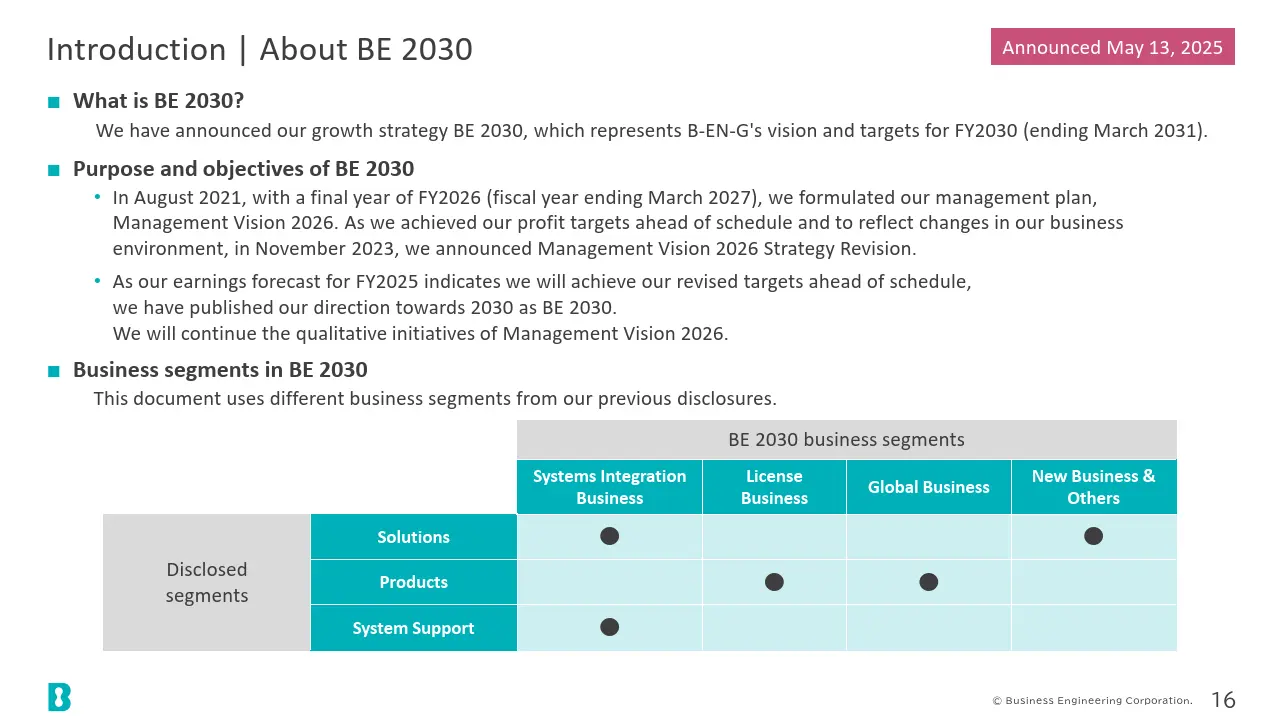
Next, I will explain the progress of our medium-term management plan, the growth strategy "BE 2030". This slide is a comparison table between the currently disclosed business segments and the business categories of "BE 2030".
BE 2030 | Progress Toward Our Targets
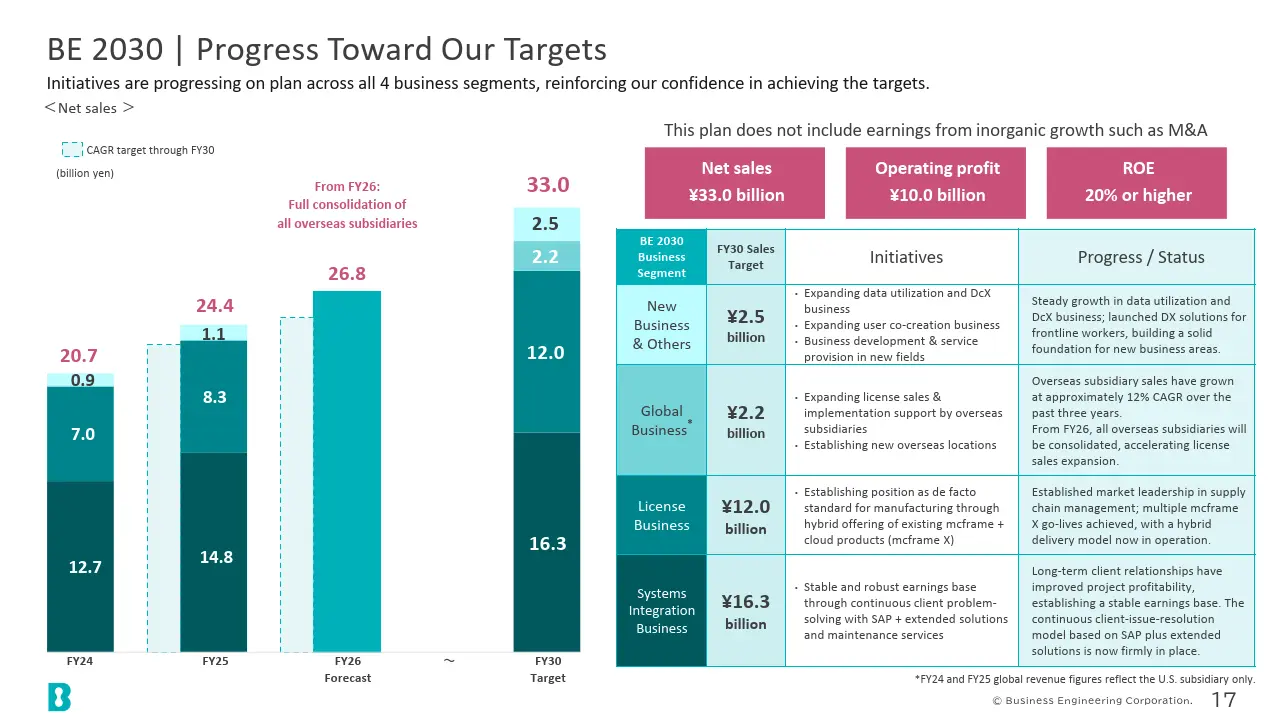
The fiscal year 2030 targets under "BE 2030" are set at net sales of ¥33.0 billion, operating profit of ¥10.0 billion, and ROE of 20% or more.
The compound annual growth rate (CAGR) for net sales toward this target is indicated by the dotted line in the bar chart on the left side of the slide. As you can see, we achieved net sales exceeding the average growth rate in fiscal year 2025. In fiscal year 2026, the consolidation of overseas subsidiaries is expected to contribute to net sales again surpassing the average growth rate.
BE 2030 | Progress Update
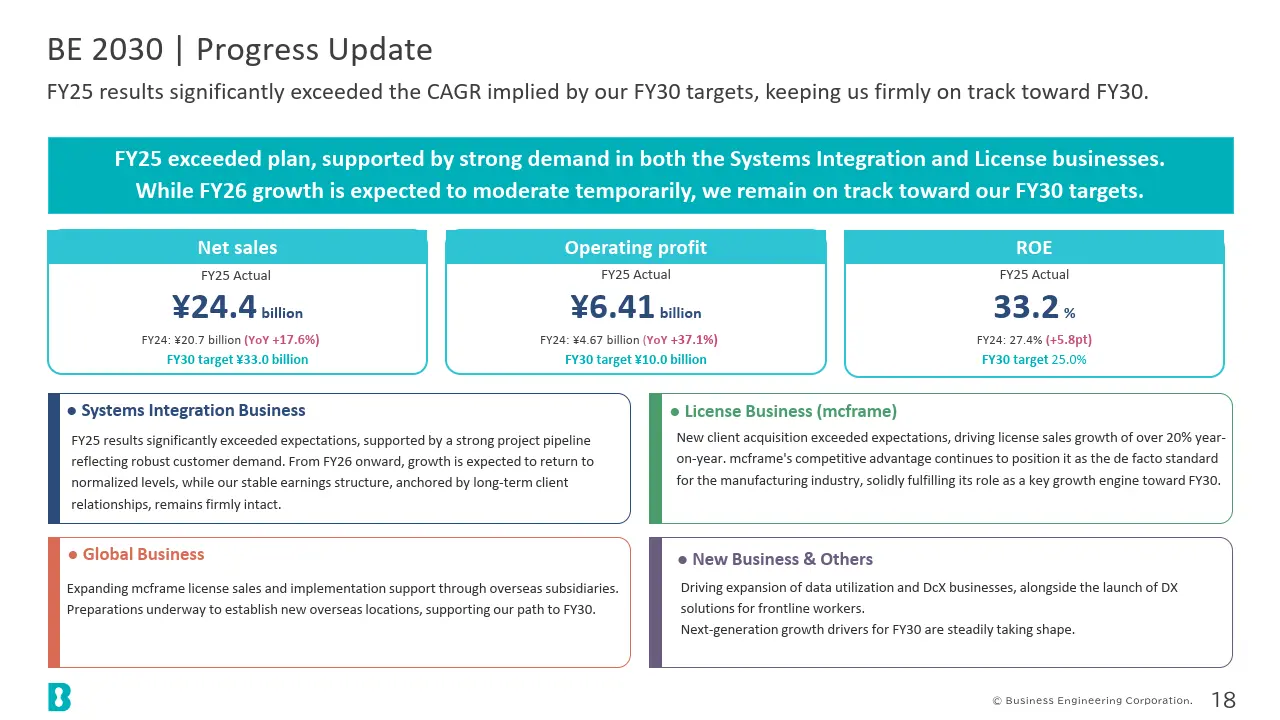
Progress in 2025 exceeded plans for both the system integration business and the license business, supported by strong demand. In fiscal 2026, although the growth rate itself is expected to be lower than in fiscal 2025, it is projected to exceed the average growth rate relative to targets.
Global Business | Accelerating Growth and Consolidation of Overseas Subsidiaries
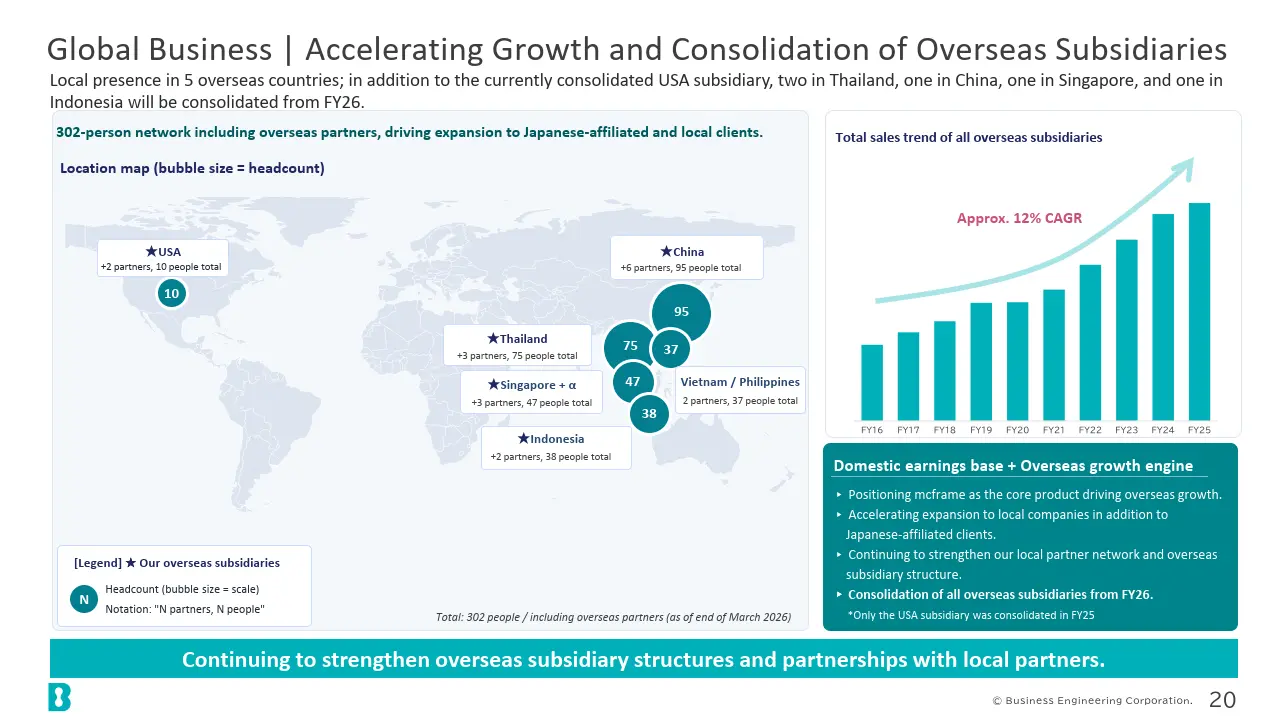
Next, I will explain our global expansion. Currently, we have local subsidiaries in five countries overseas. Until now, only our U.S. subsidiary was included in consolidation, but starting in fiscal year 2026, in addition to the U.S. subsidiary, local subsidiaries in China, Thailand, Singapore, and Indonesia--five countries in total--will be included in consolidation.
The bar chart on the right side of the slide shows the trend in sales of overseas local subsidiaries. We have continued to grow at an average annual rate of approximately 12 percent.
Growth Strategy Toward FY30: Global Business Sales of ¥2.2 billion (Consolidated)
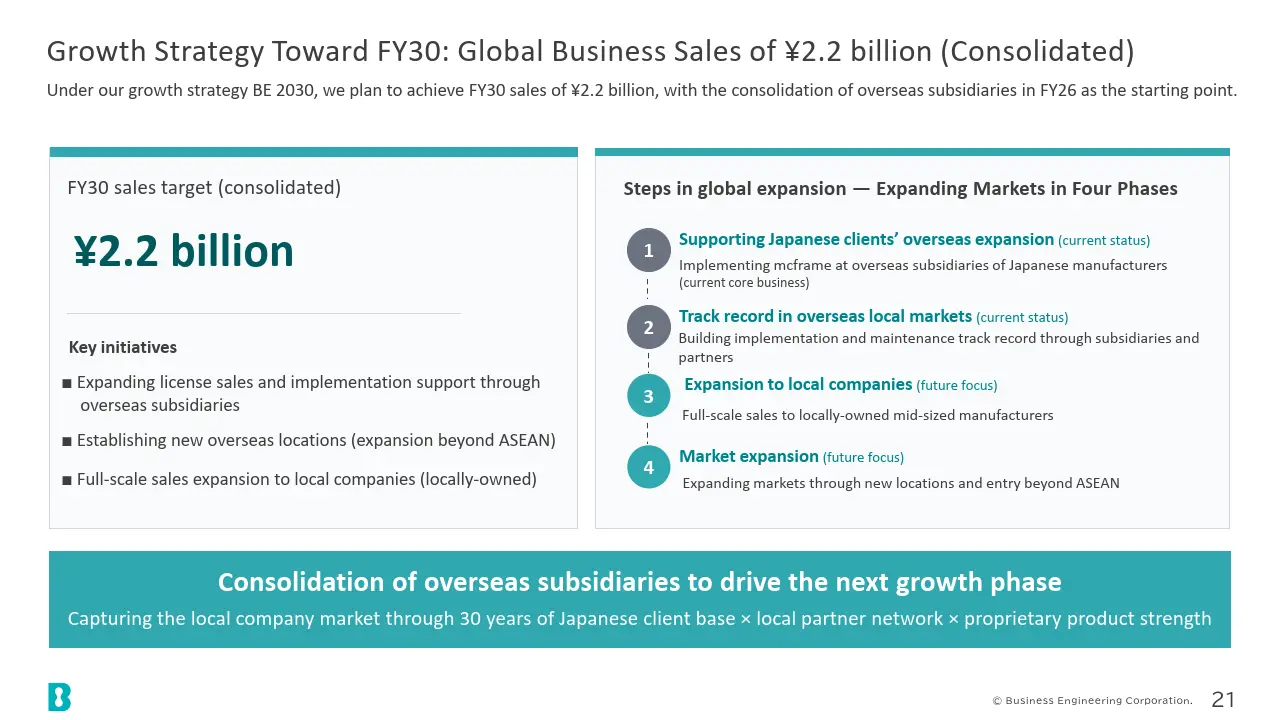
In the global business, "BE 2030" sets a target of 2.2 billion yen in sales for fiscal year 2030. In addition to the ongoing support for overseas expansion of domestic customers and maintenance support for customers' local subsidiaries, we will also explore the expansion into local companies and new markets going forward.
Global Business Model: Why B-EN-G Can Win Overseas
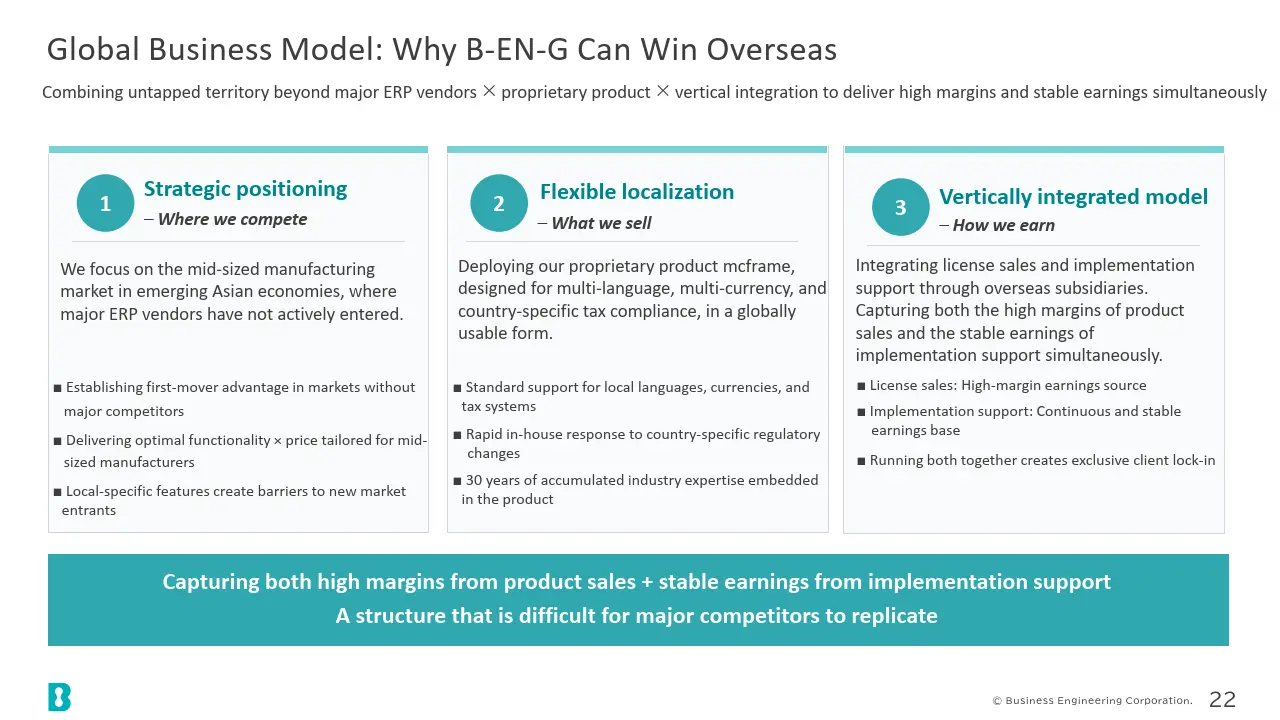
Allow me to explain the strengths of our global business. First, one of our key strengths is that we possess software products and proprietary solutions tailored for emerging Asian markets, where major overseas ERP vendors have yet to actively enter.
Additionally, through our overseas subsidiaries and partners, we are able to quickly gather information on tax systems and business practices in each country, which allows us to strengthen our products and enhance our support services--another key strength of our overseas business.
What Software Will Survive in the AI Era? | The Relationship Between AI and ERP / Business Applications
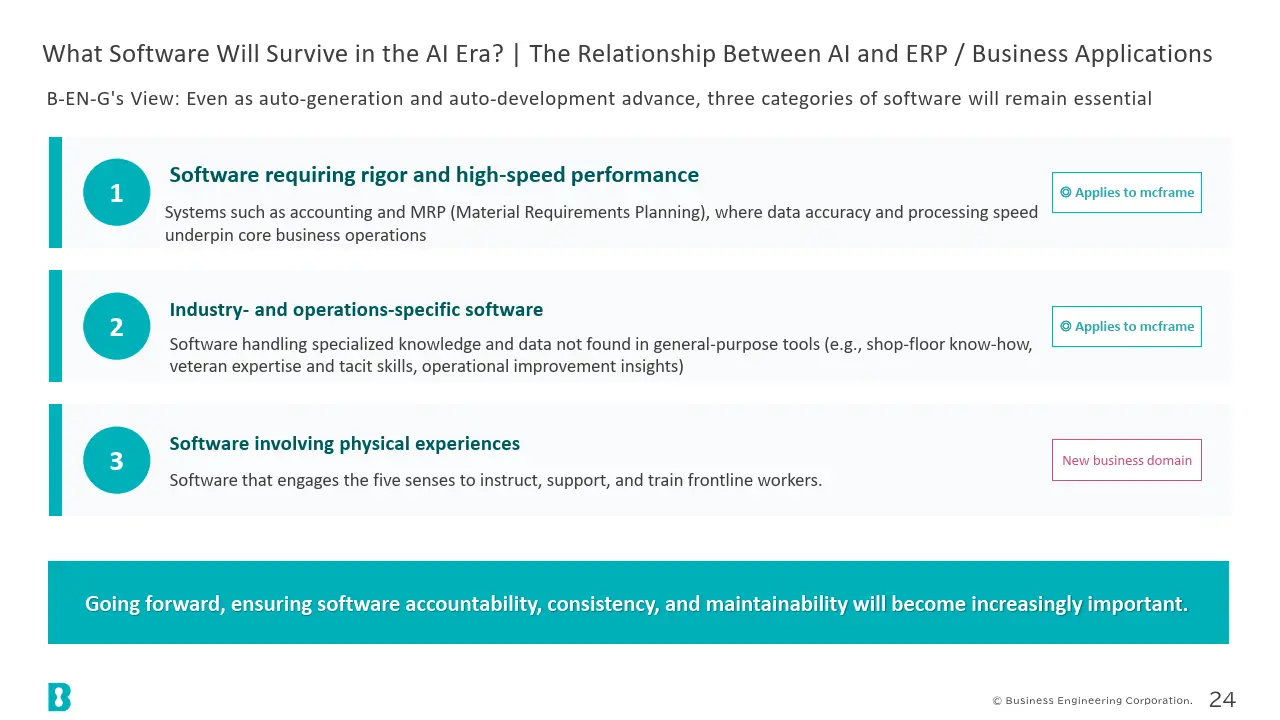
Next, I will explain our AI strategy. Since the beginning of this year, various services have been offered by AI vendors. As a result, the term 'death of SaaS' is currently being discussed in the market, but we have a different perspective.
Our view is that while a certain proportion of SaaS will be eliminated, there are software and SaaS services that will definitely survive in the AI era. This slide lists three conditions for that.
The first is the area where precision and speed are required. For example, accounting and MRP processing in production management are exactly the areas that ERP should handle.
The second is industry- and business-specific software. We believe that 'mcframe,' which covers the supply chain domain in the manufacturing industry, is exactly the type of software that can provide industry-specific knowledge and customer-specific expertise that general AI knowledge alone cannot address.
The third is software that involves physical human experiences. We believe that our new business, 'FieldDX,' falls into this category.
As a key point, we will provide software that cannot be replaced by AI, with clearly defined areas of responsibility. We also believe that maintaining consistency as software and ensuring long-term maintenance will be important challenges going forward.
What Software Will Survive in the AI Era? | The Relationship Between AI and ERP / Business Applications
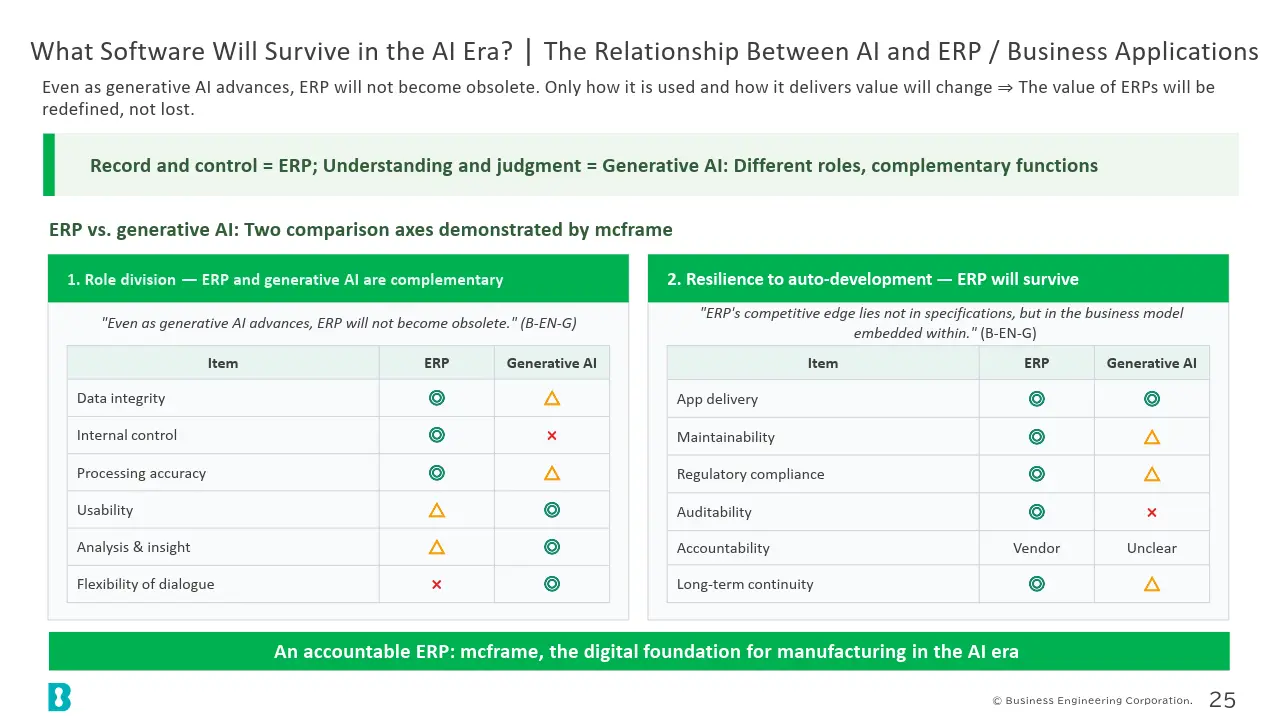
This shows the strengths and weaknesses of AI and ERP in a table format. We believe that ERP will continue to handle processes that require accuracy, speed, and are critical for internal controls. On the other hand, AI excels in usability, large-scale data analysis, and flexible interactive environments, and we expect AI utilization to advance further in the future.
In this way, we believe that the division of roles between AI-based processing and ERP-based processing will become increasingly clear going forward.
B-EN-G's Competitive Edge in the AI Era | A Partner That Understands the Operations and Implements with Accountability
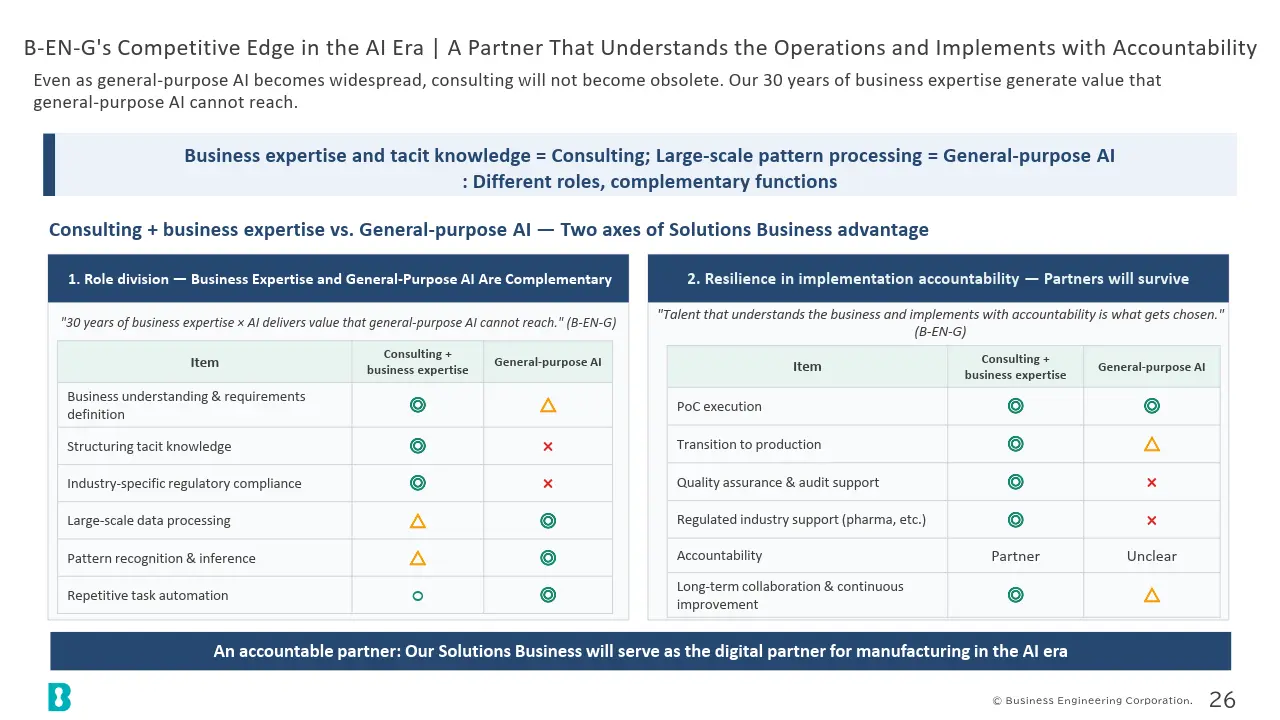
In system integration as well, we believe that the system integration services we provide will be divided into conventional critical operations and operations that will leverage AI going forward.
Our strengths--such as understanding customers' business operations, defining requirements, and structuring customers' tacit knowledge--will certainly remain as essential added value in system integration going forward. On the other hand, we expect that an increasing amount of processing related to large-scale data processing, pattern recognition, and automation of repetitive tasks will be delegated to AI.
In any case, no matter how much AI is utilized, ERP implementation will not succeed if project management is neglected. We believe this trend will continue going forward.
Product Evolution (Adopting AI) | The mcframe Evolution Story
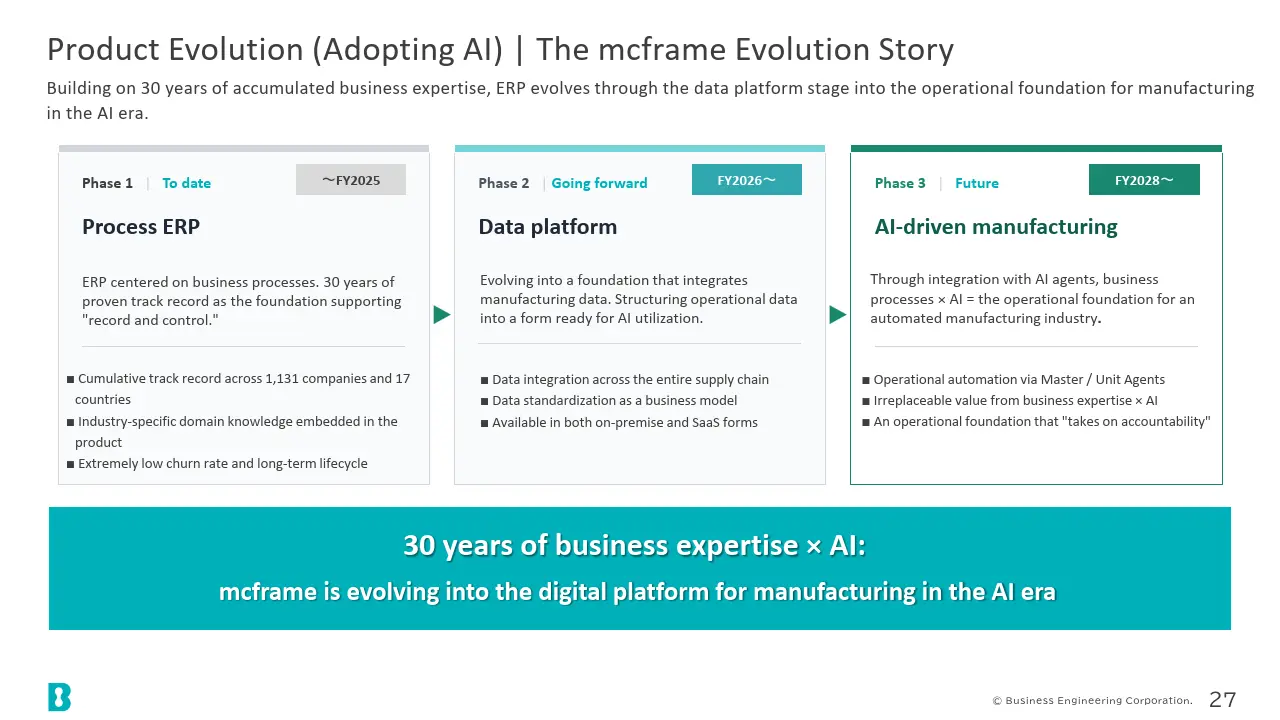
Next, I will explain the evolution of our product "mcframe" toward AI. Starting from fiscal year 2026, over a period of approximately three years, we will proceed with transforming "mcframe" itself into an AI agent, adapting it to an AI agent platform, and converting its functions into AI agents.
Furthermore, from fiscal year 2028 onwards, we are drawing a roadmap in which "mcframe" will evolve the standard knowledge in the supply chain domain and customer-specific knowledge as AI services.
The True Data Utilization Delivered by AI × Manufacturing-Specialized ERP
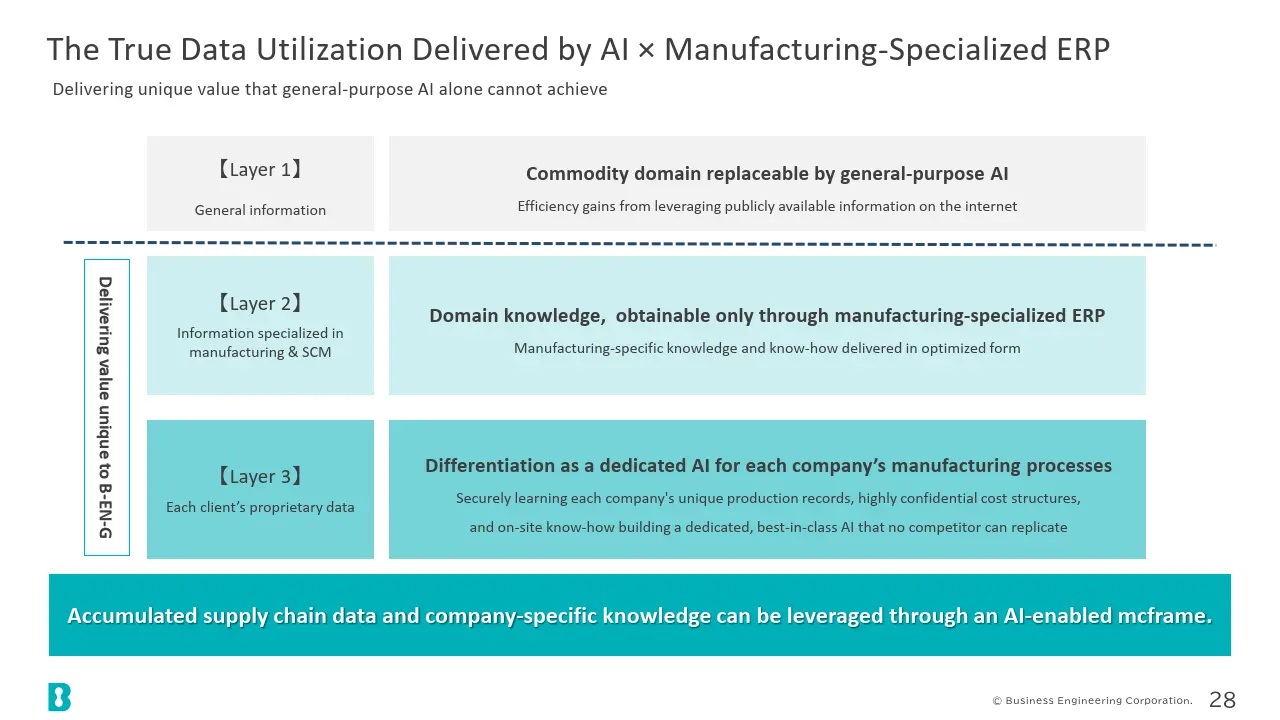
The diagram on the slide illustrates the areas handled by general-purpose AI and the areas covered by our software and services. For Layer 2 and Layer 3 at the bottom of the diagram, we plan to continue providing AI-based services through the ongoing evolution of 'mcframe'. This is how we envision our products evolving going forward.
Business Evolution | Structural Transformation in Delivery and Development (Paradigm Shift)
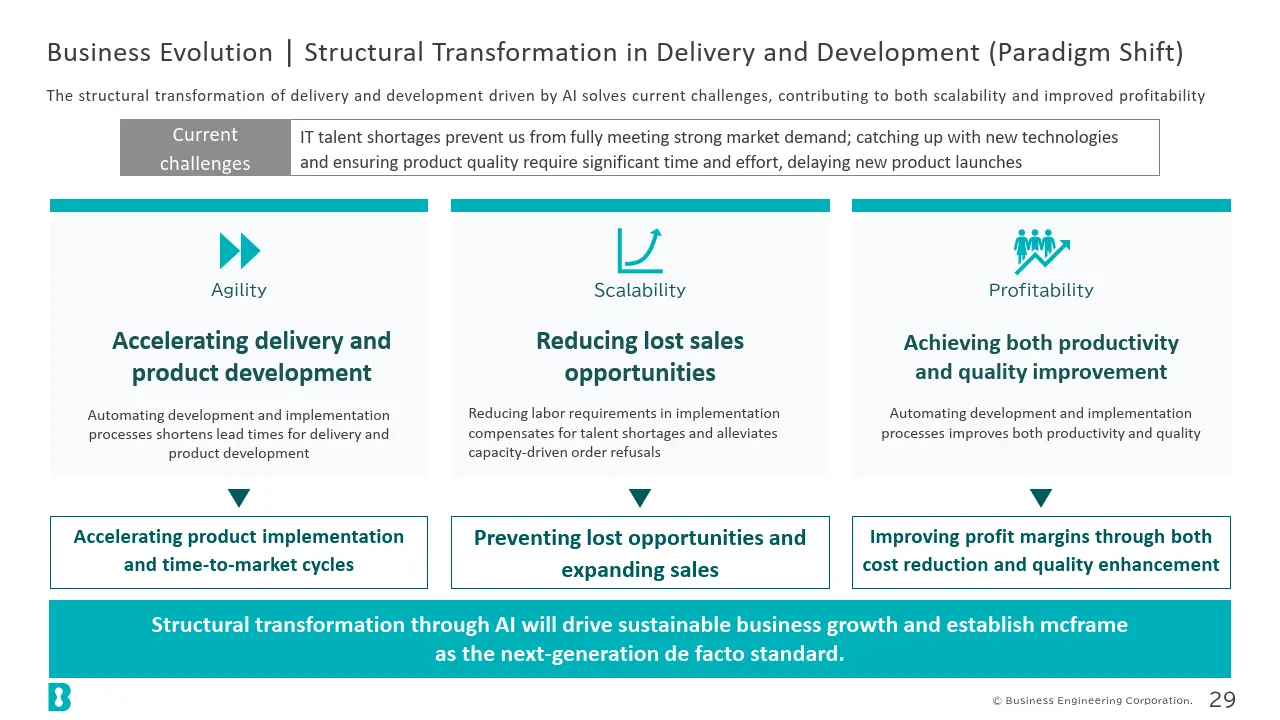
On the other hand, we believe that the use of AI can resolve the current bottlenecks in our business. We recognize that there are two major bottlenecks in our business. The first is that the shortage of IT human resources has made it difficult to fully meet customer demand.
The second is that the rapid pace of advancement in new IT technologies, represented by AI, has led to longer product lifecycles as we work to keep up with these developments and incorporate them into product enhancements. We consider these to be the current bottlenecks in our business.
By leveraging AI for this, we believe it will lead to, for example, faster product development, improved efficiency, and reduced opportunity loss in system integration orders.
AI Technology That Solves Challenges | mcframe Development Model
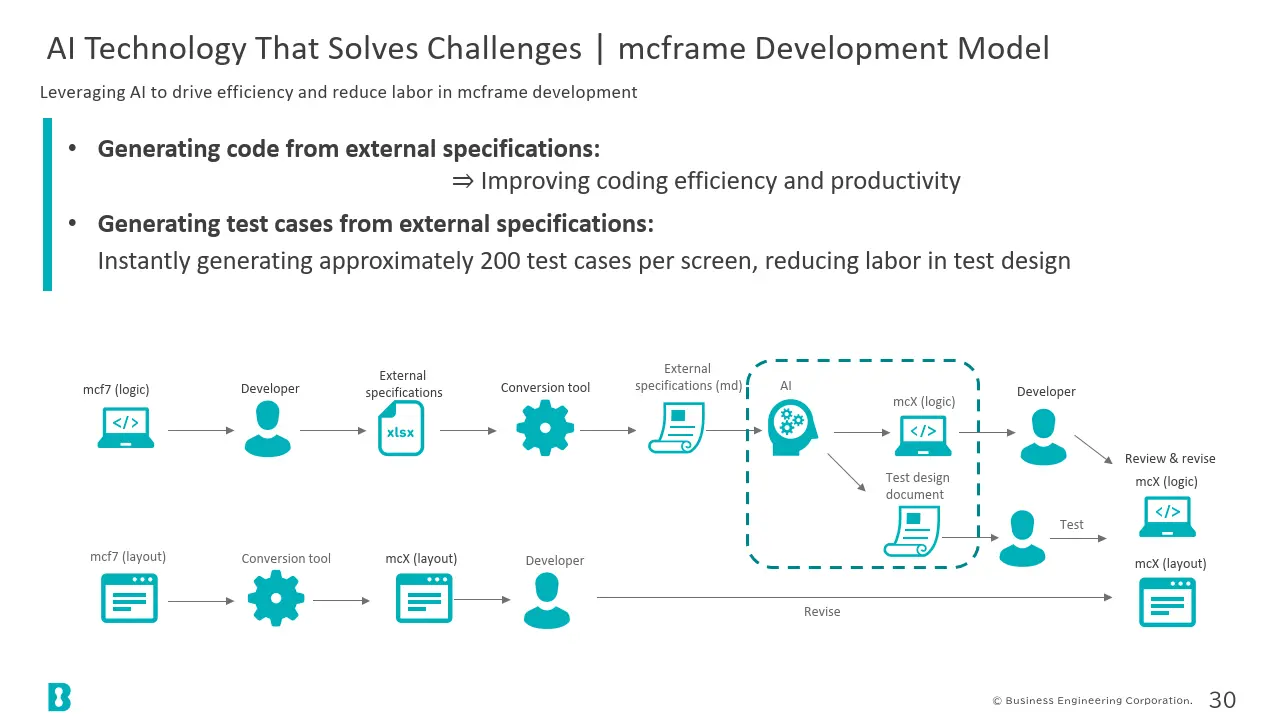
Let me explain in a bit more detail. Currently, in "mcframe," AI is already being utilized to a considerable extent in the process of generating code and test cases from specification documents. This has led to a significant improvement in development productivity.
AI Technology That Solves Challenges | Leveraging AI in the SI Business
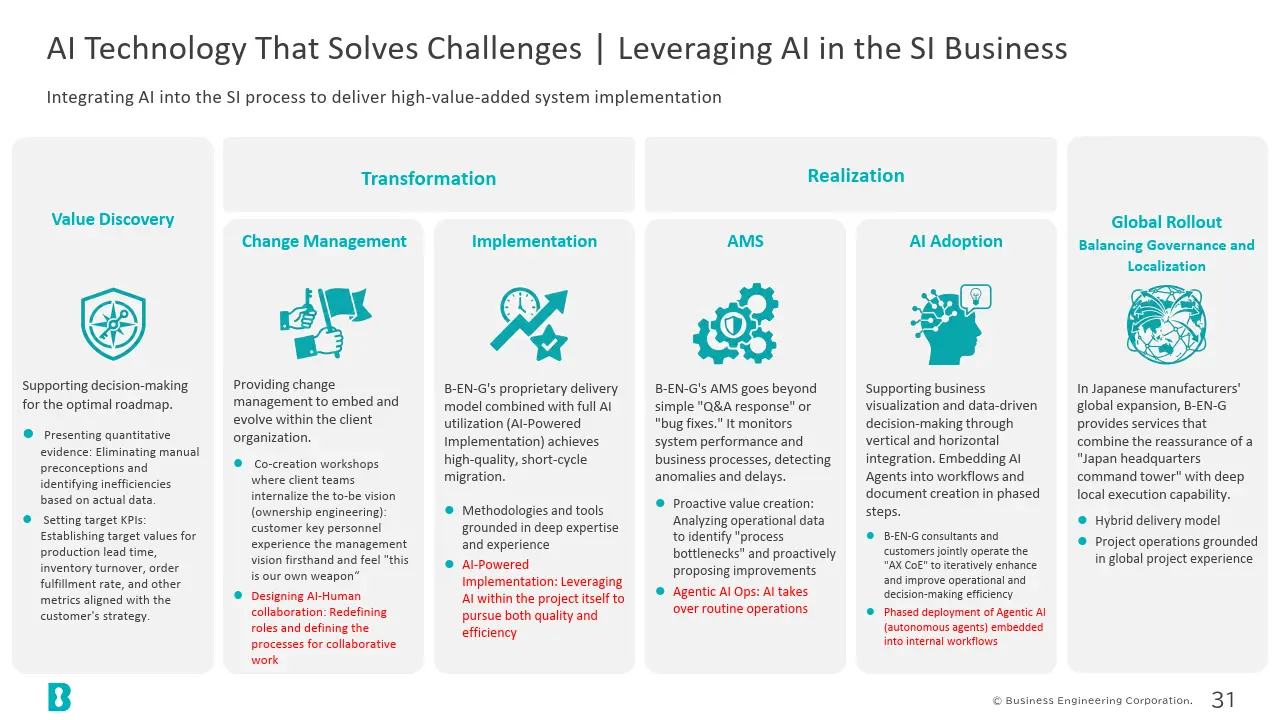
In addition, in system integration, by flexibly utilizing technologies such as "Agentic AI," it has become possible to improve the processes, production efficiency, and quality of system integration.
AI Technology That Solves Challenges | Knowledge Database-Powered Q&A Service
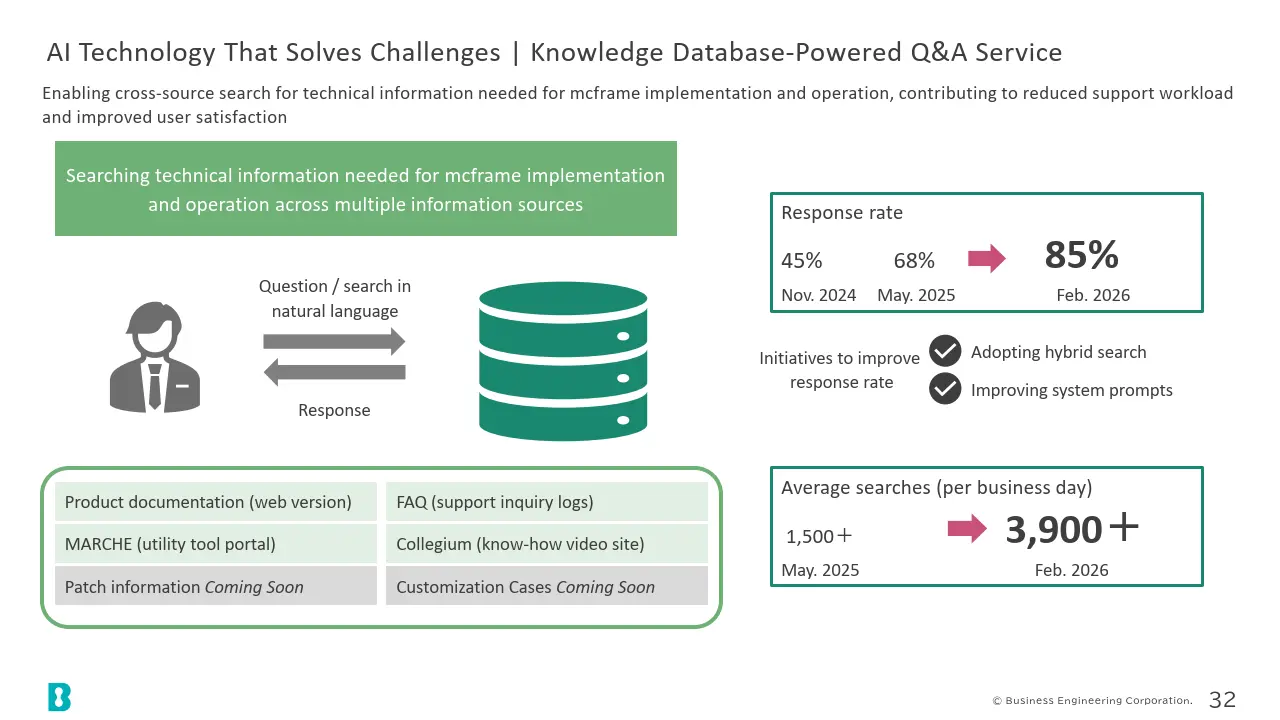
Furthermore, we have succeeded in automating more than 80% of product inquiries that were previously handled directly by developers using AI. This has already led to a shorter product development cycle.
Case Study | AI-OCR
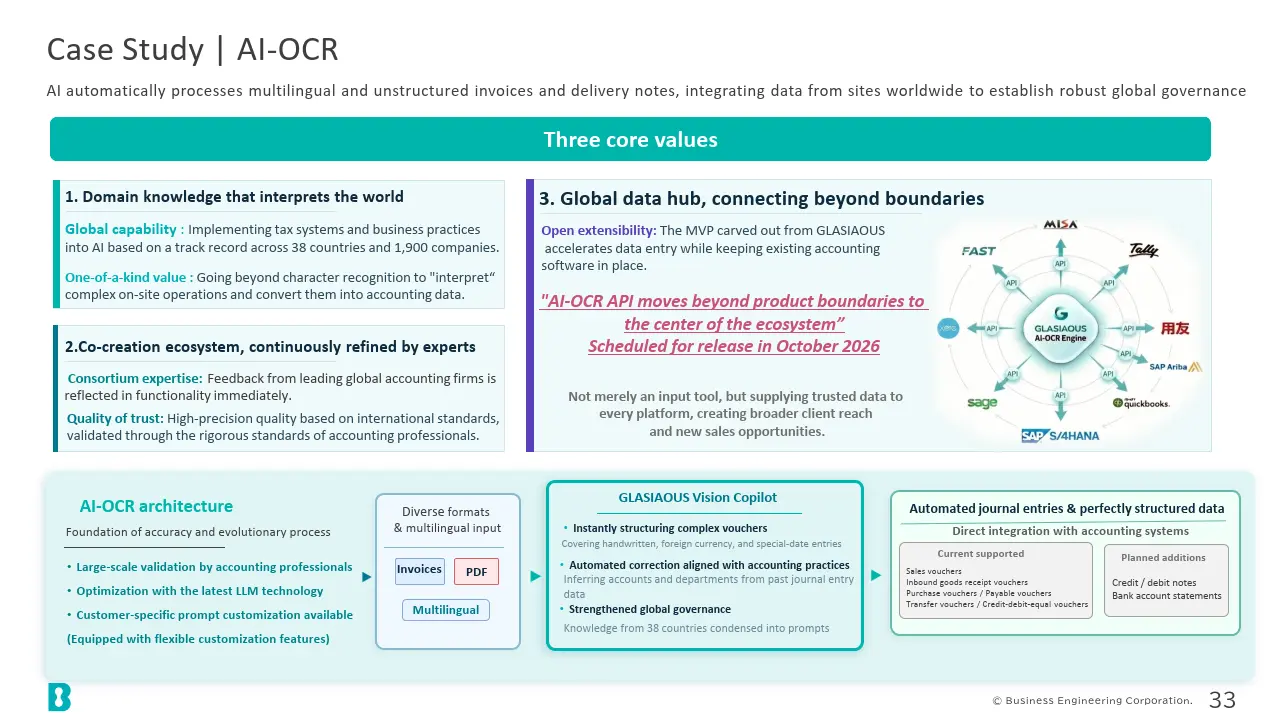
Next, we will introduce our AI products in detail. First is "AI-OCR." This service automatically reads various types of forms such as purchase orders and invoices, analyzes text in multiple languages including not only Japanese and English but also Thai, Indonesian, and others, and integrates with ERP systems. "AI-OCR" is scheduled to be released early in the current fiscal year.
Case Study | Transforming mcframe into AI Agents
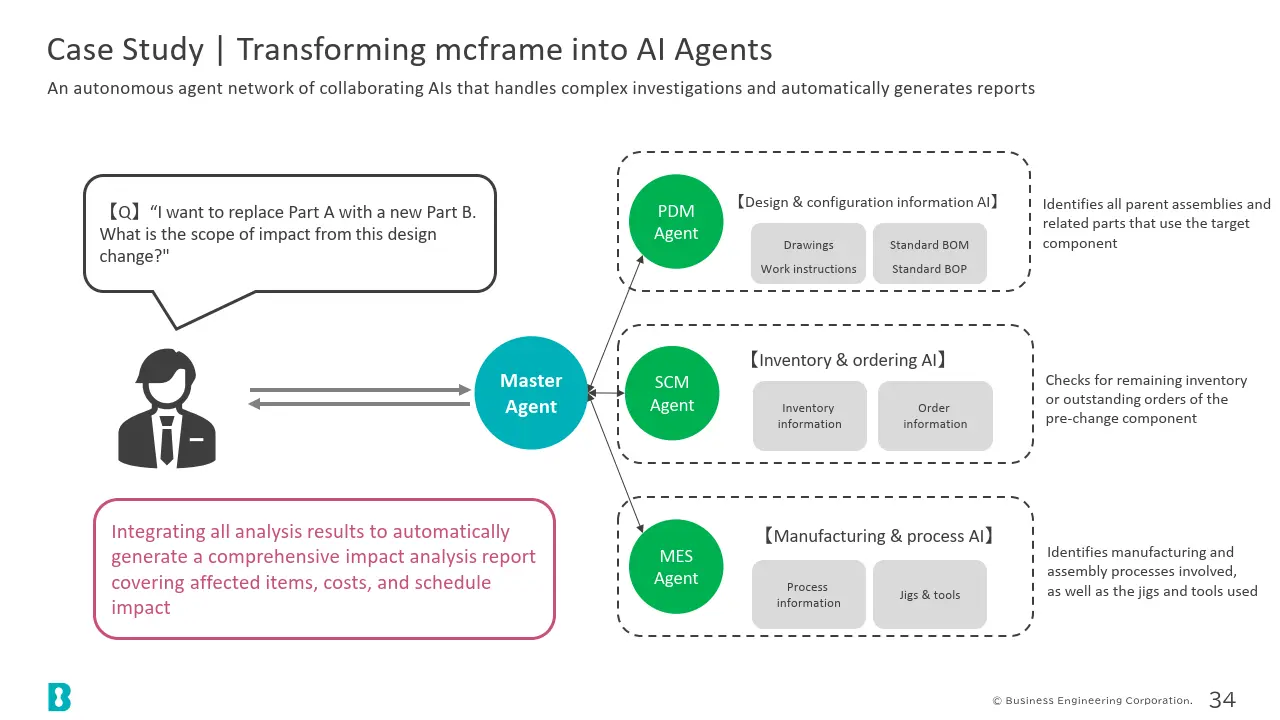
Also, as I mentioned earlier, we are currently working on making "mcframe" an AI agent. This will allow various simulation processes that were difficult to achieve with conventional standardized ERP processing to be used as services on "mcframe".
Case Study | Automatic Generation of Work Instructions by AI Agents
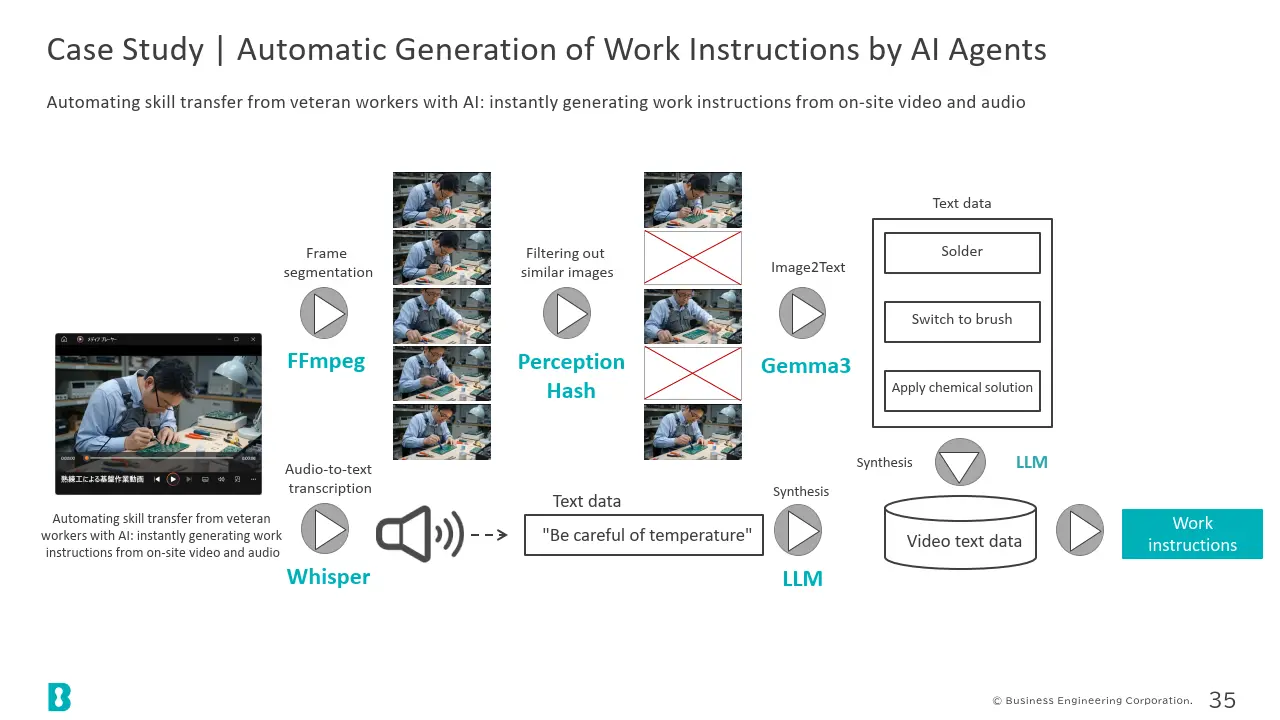
Specifically, as shown in the slide, based on data from "mcframe", it is possible to create on-site work procedure documents from, for example, videos.
Case Study | AI Agents Powering Forecasting and Simulation
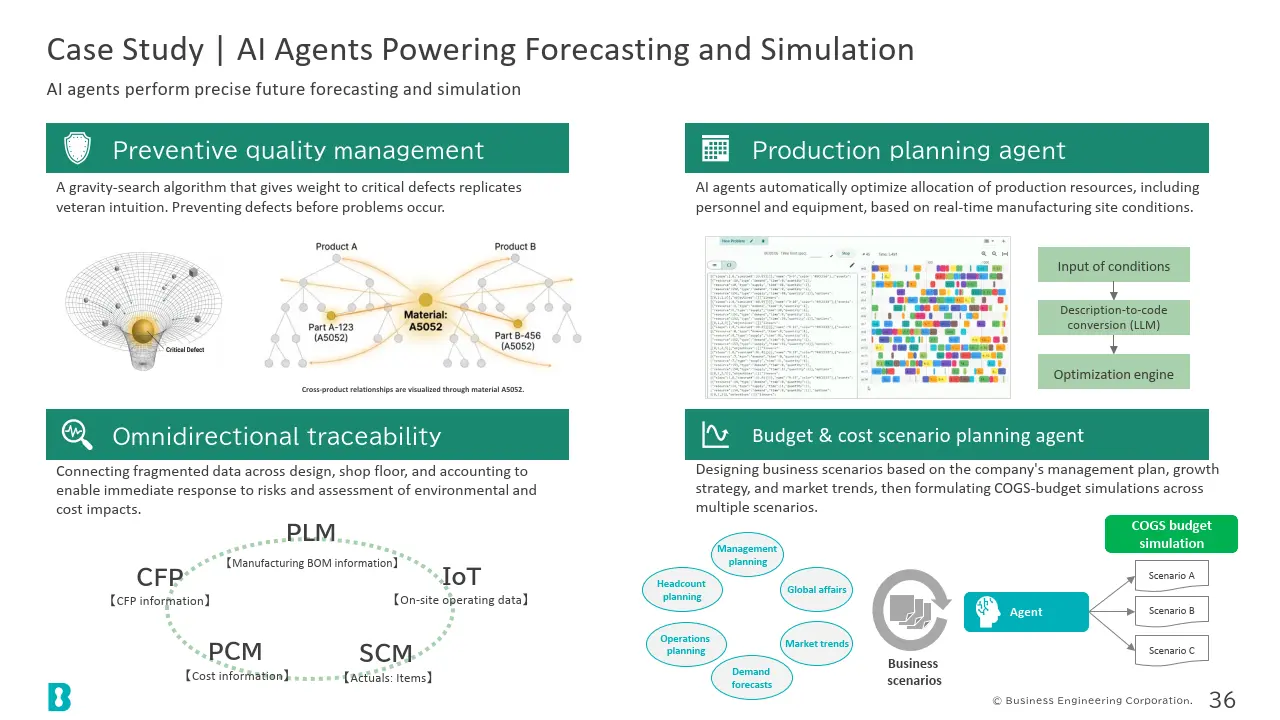
Furthermore, it becomes possible to handle functions that were difficult with conventional routine processing, such as preventive quality control, production planning scheduling, traceability of various data, and budget cost simulation.
Executive Summary of FY2026 Earnings Forecast
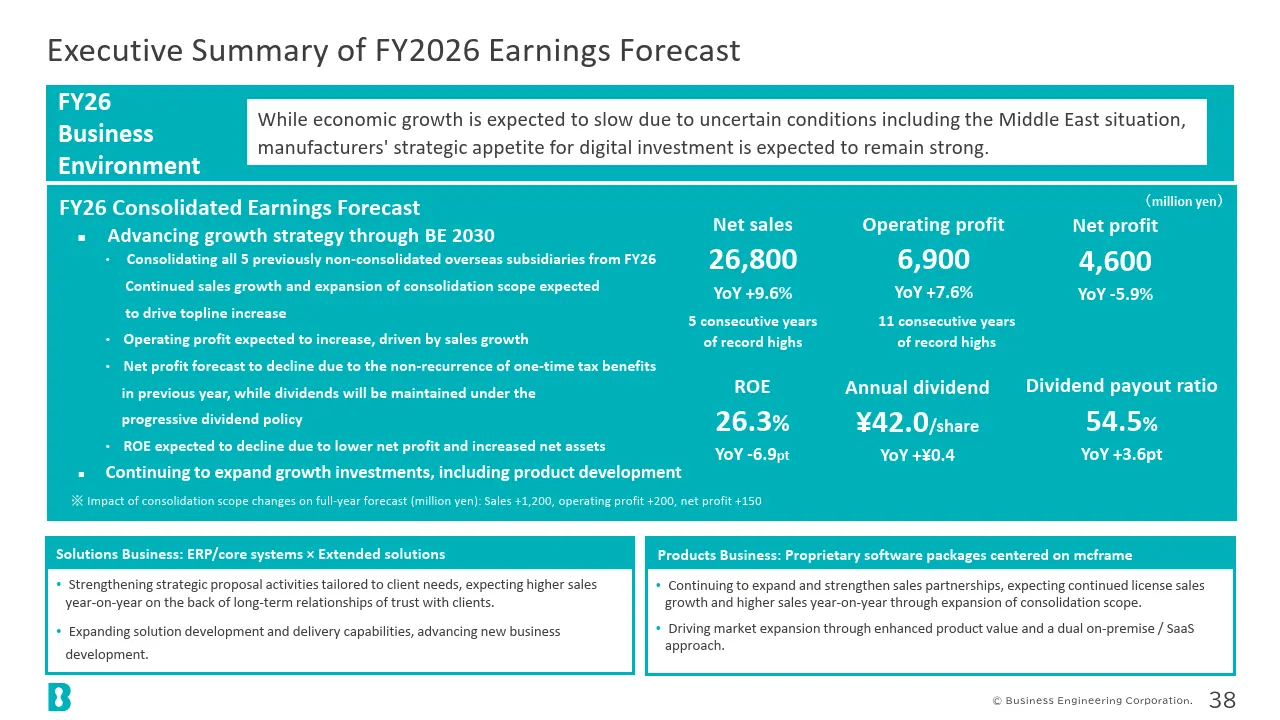
Next, I will explain the business performance outlook for the fiscal year ending March 2027. In terms of the business environment, although economic growth is expected to slow due to uncertainties such as the situation in the Middle East, we believe that the appetite for strategic digital investment in the manufacturing industry remains high.
Against this backdrop, for the current fiscal year, we expect both revenue and operating profit to reach record highs. Net profit is expected to decline due to the absence of one-time tax burden reduction measures from the previous fiscal year, but in line with our progressive dividend policy, we will continue to maintain the dividend level.
Earnings Forecast (1H/2H/FY)
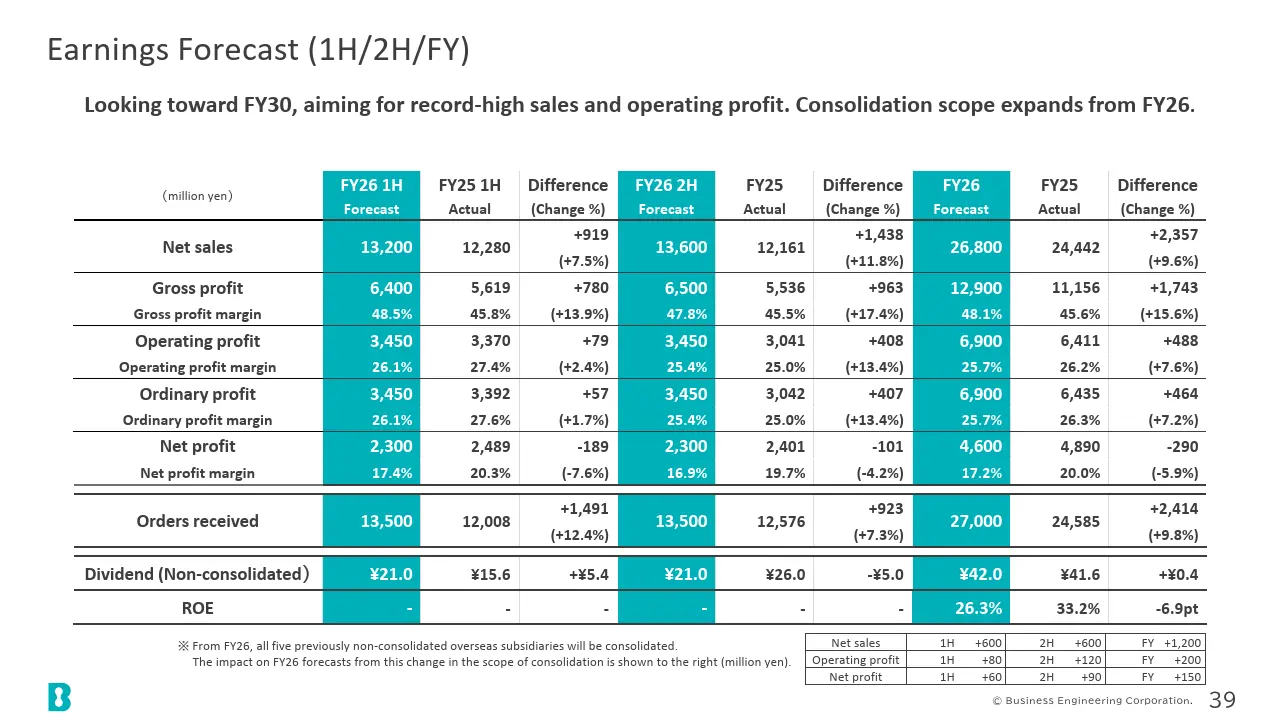
This is the full-year performance forecast. In particular, the growth rate of operating profit in the first half is limited, which is attributable to the fact that the first-half weighting was pronounced in fiscal year 2025. For the full year, both revenue and operating profit are expected to increase.
Segment & mcframe License Sales Forecasts (1H/2H/FY)
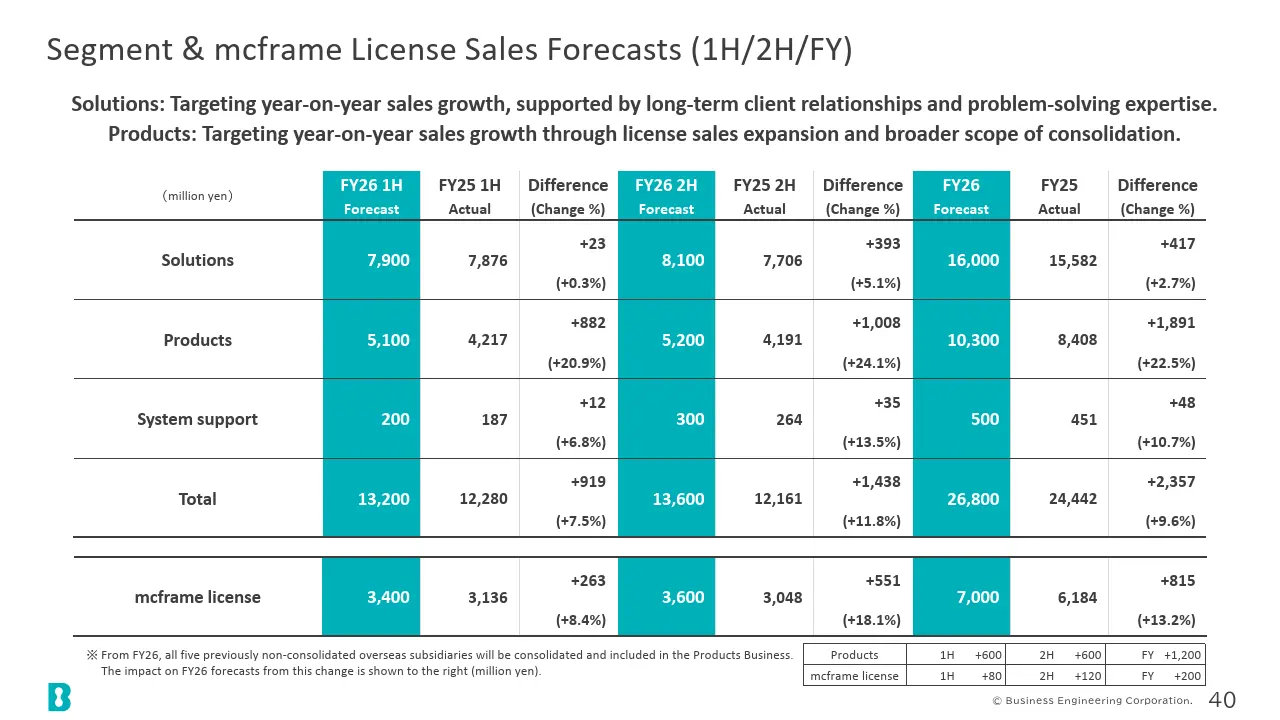
This is the sales forecast by segment and "mcframe" license sales.
Solutions Business Forecast
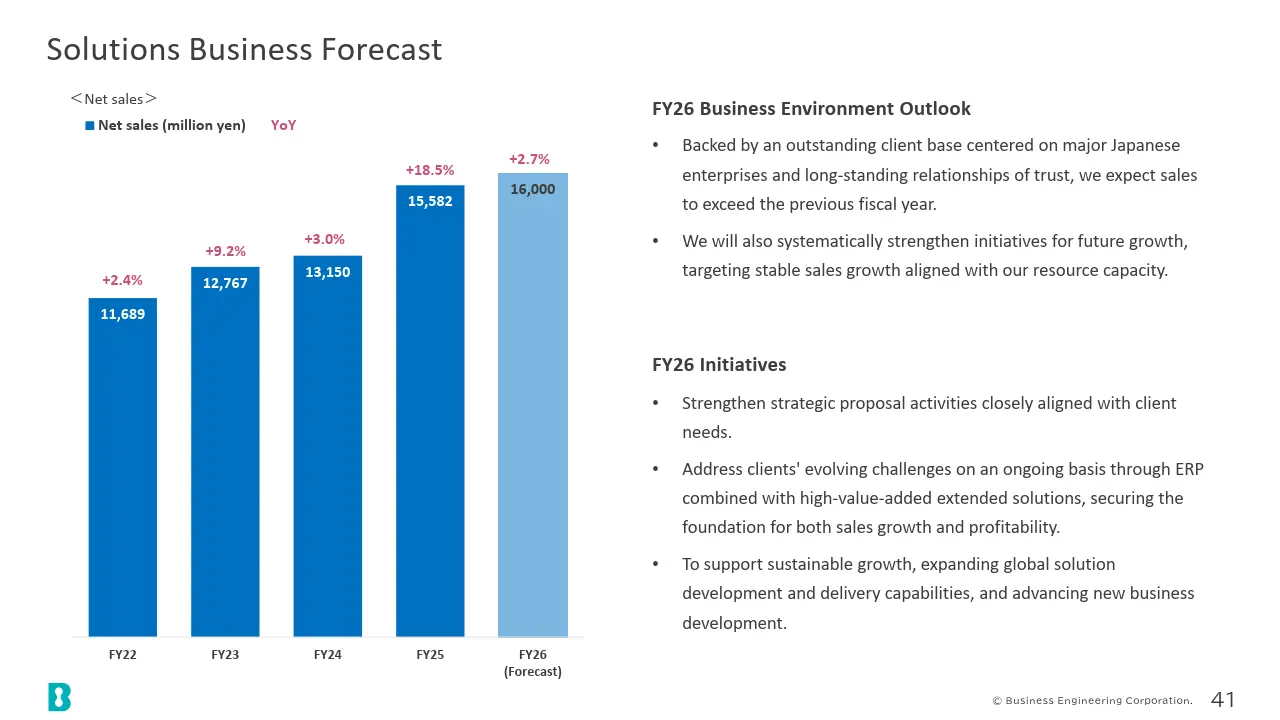
I will explain each one individually. The Solutions business shows a moderate growth rate this fiscal year due to a reaction against the significant growth in the previous fiscal year, but it is expected to steadily increase, maintaining stable revenue primarily from domestic customers.
Products Business Forecast
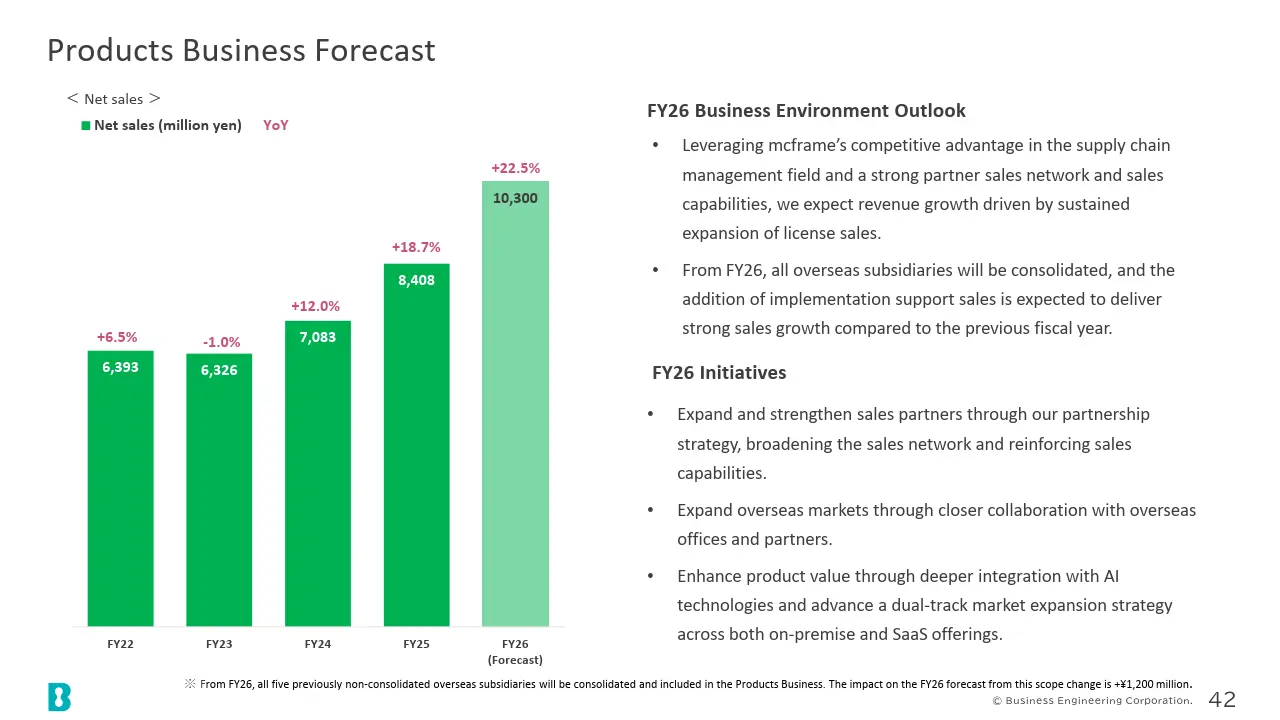
The Product business is expected to achieve significant growth, backed by the market superiority of 'mcframe'. In addition, the consolidation of overseas subsidiaries will also contribute to the increase in revenue.
Net Sales and YoY Growth
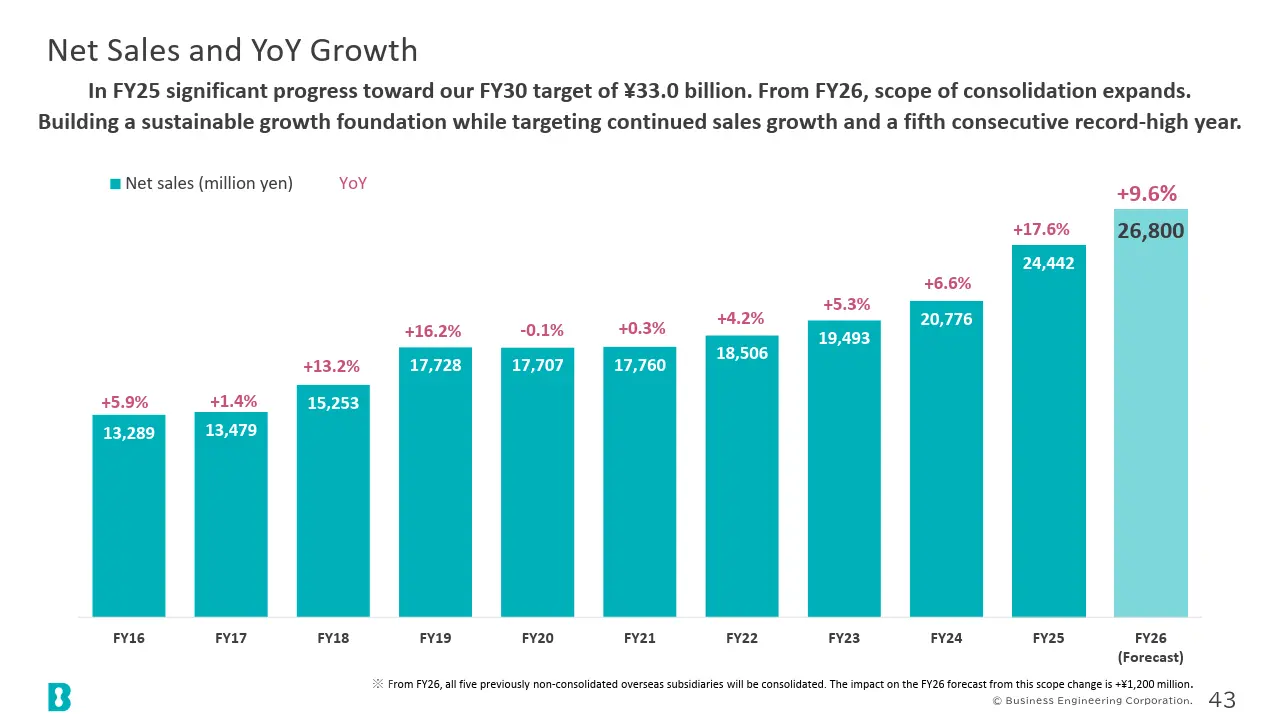
This shows the trend in revenue. We aim for continuous sales growth and record-high revenue for five consecutive fiscal years.
Operating Profit & Operating Profit Margin
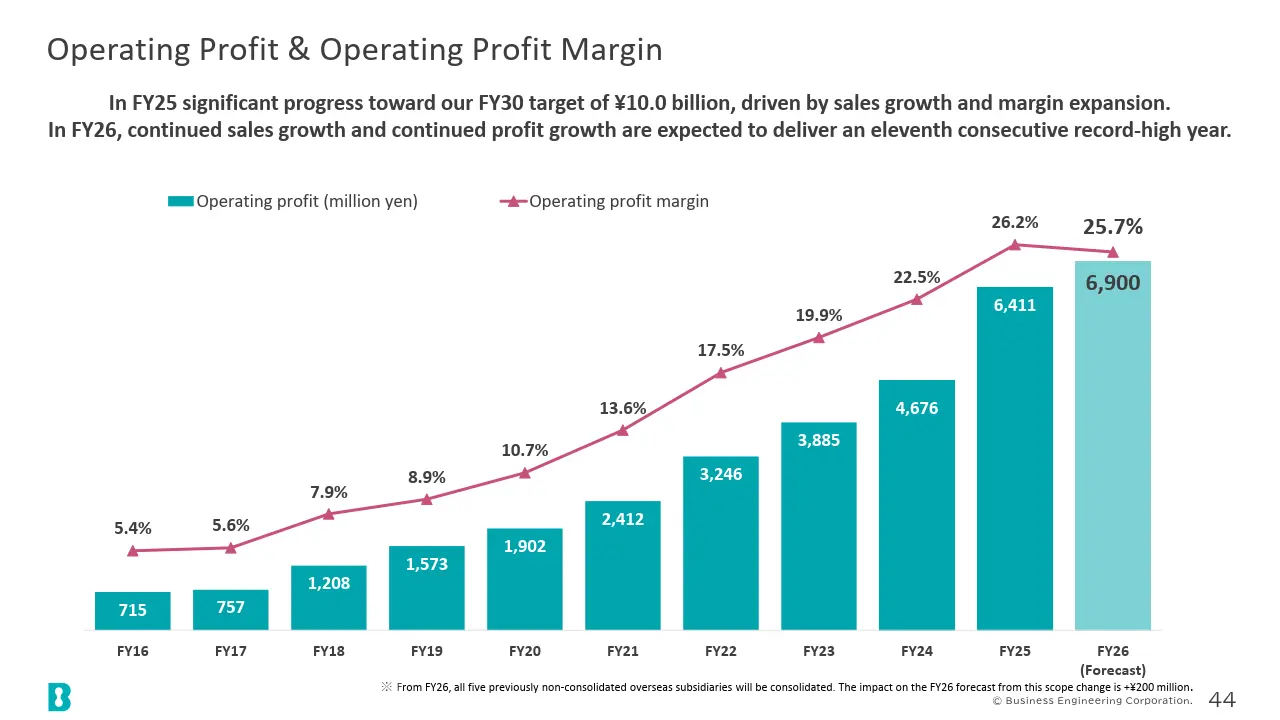
This shows the trend of operating profit and operating profit margin. Through continuous profit growth, we aim to achieve record-high operating profit for 11 consecutive fiscal years.
mcframe License Sales & YoY Growth
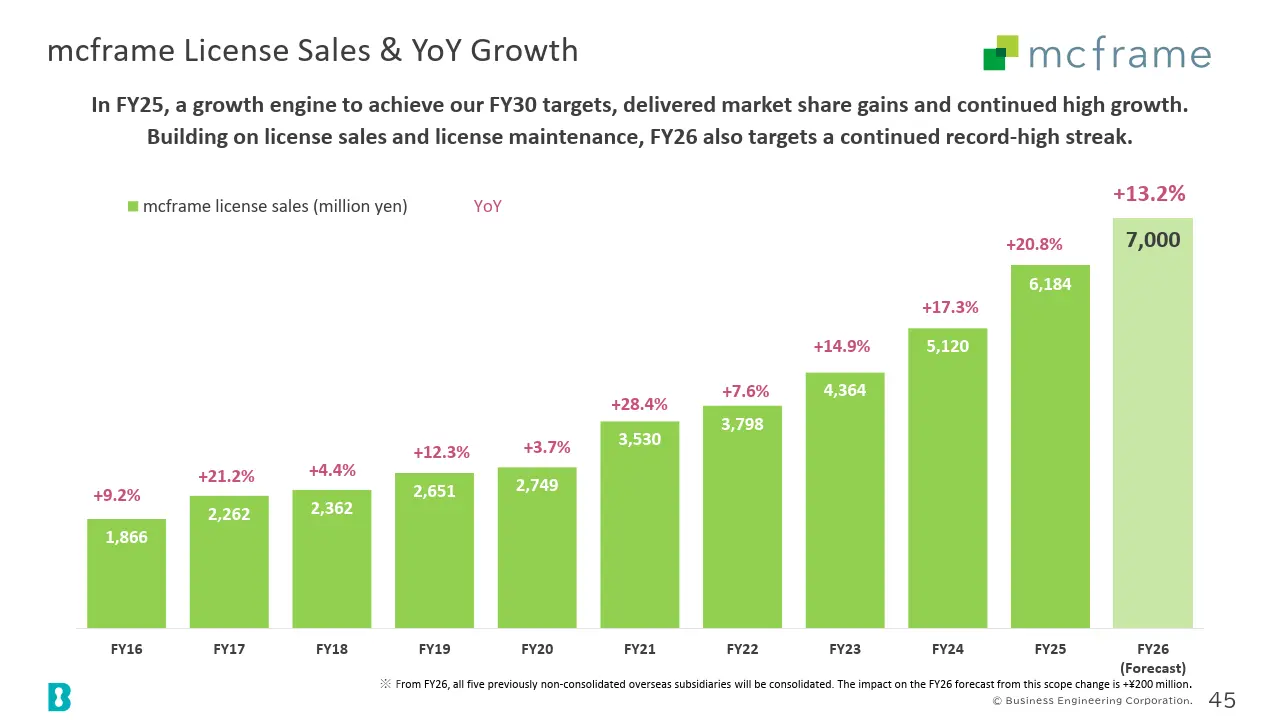
This shows the trend in "mcframe" license sales. In fiscal year 2026, we aim to achieve a high growth rate of 13.2% and continue setting new record highs.
Sales by Segment
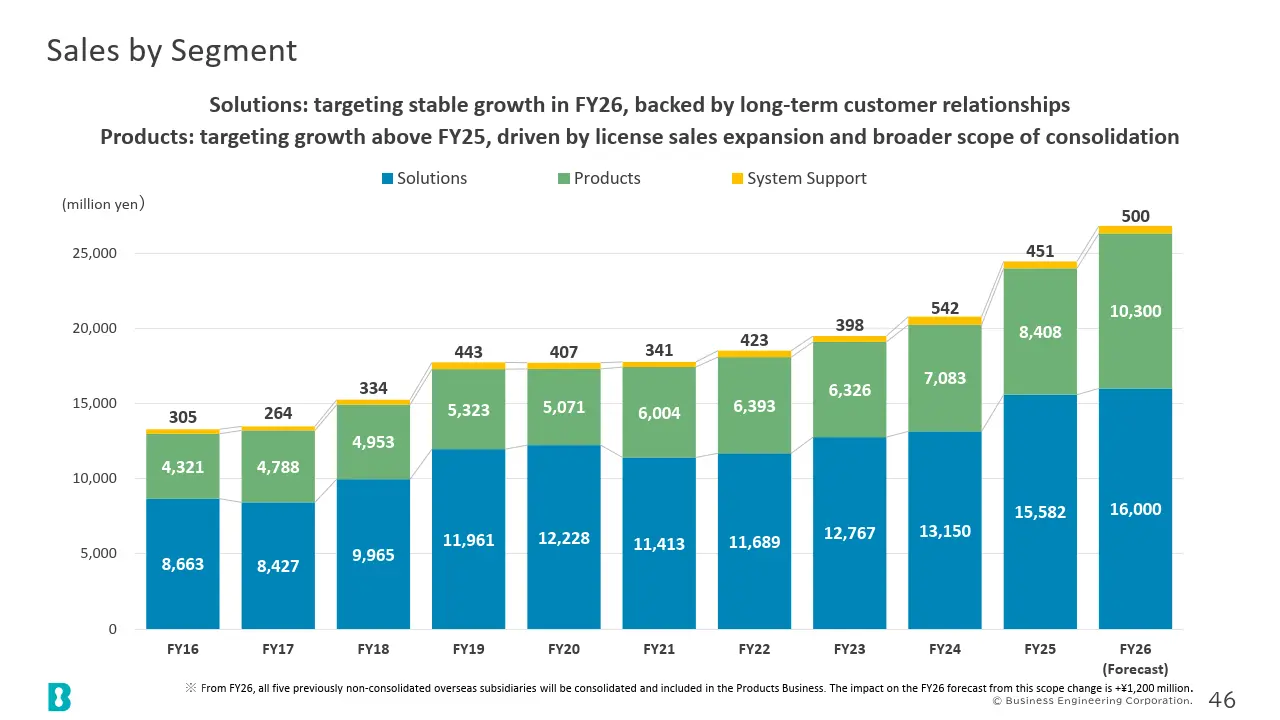
This shows the revenue trend by segment.
Dividends (Annual dividend per share)
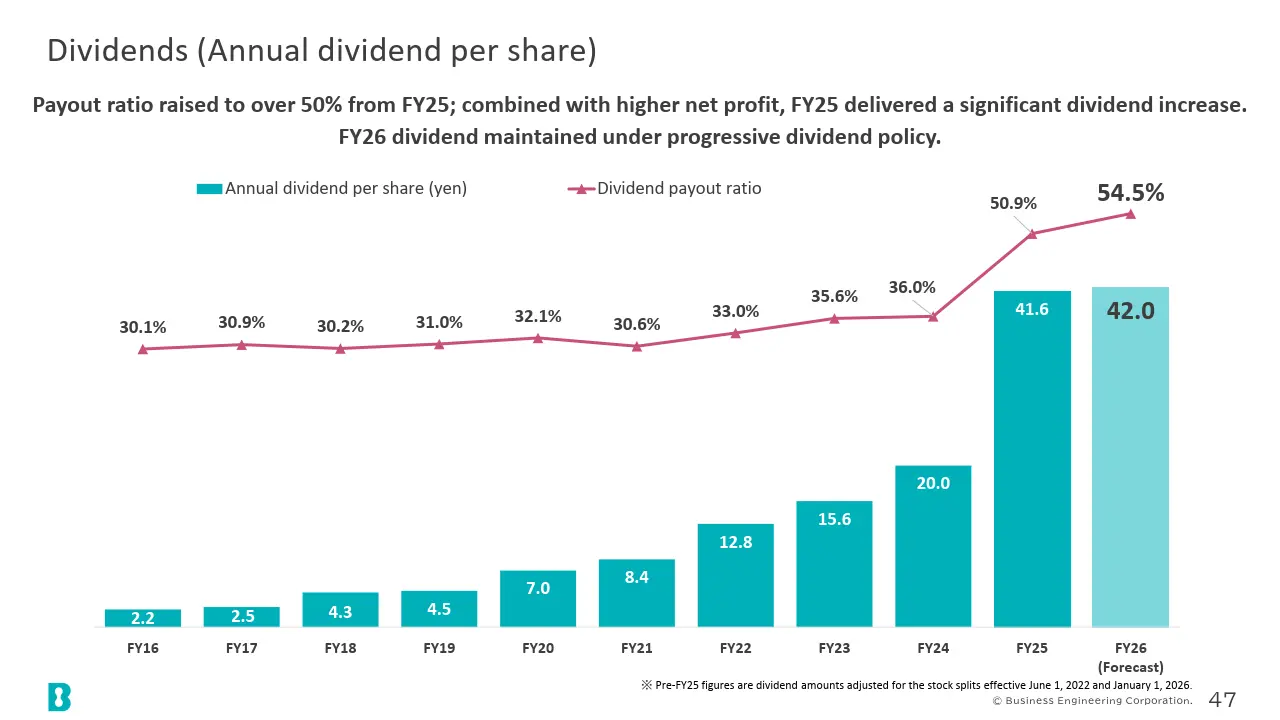
This shows the dividend trend. As mentioned earlier, we raised the dividend payout ratio to over 50% starting in fiscal year 2025. Due to an increase in net income and other factors, dividends increased significantly in fiscal year 2025. In fiscal year 2026, we will continue to maintain dividends through a progressive dividend policy.
6. Data Book
Chapter 6 is a data book, so it will be omitted here. Please refer to it later.
Integrated Report 2025
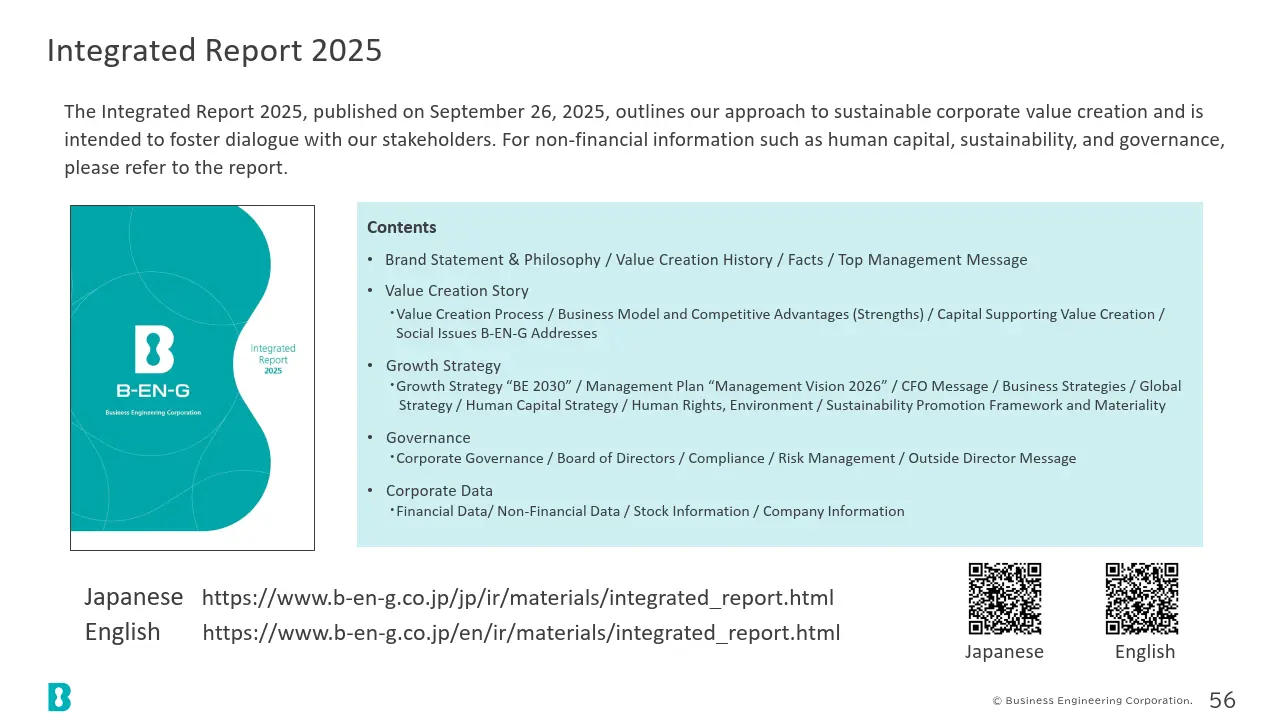
Finally, we would like to introduce our IR reference materials. The 2025 Integrated Report is available for download from our company website.
Investors Guide
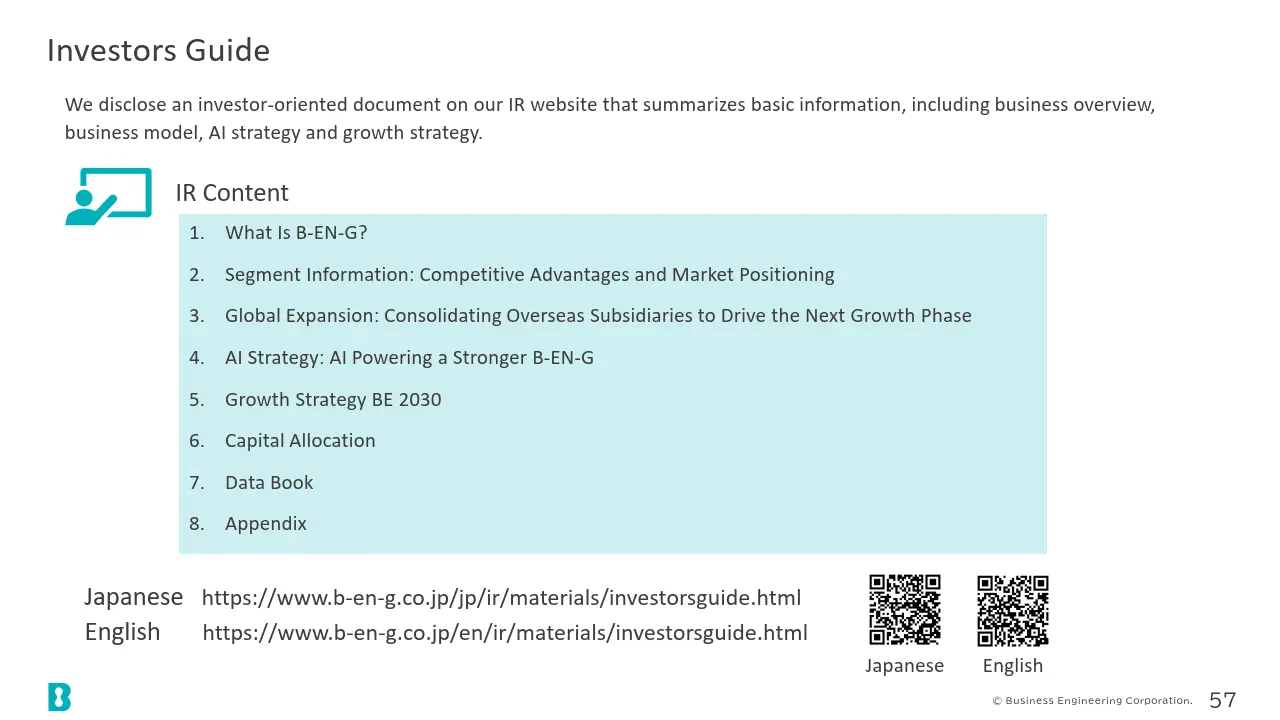
For detailed information that could not be covered today, please refer to the "Investors Guide," which is also available for download from our website.
This concludes the financial results briefing for the fiscal year ending March 2026 of Business Engineering Corporation. Thank you very much.
Q&A Summary (1)
Q: The operating profit margin for FY2026 is expected to be in line with the previous fiscal year. While the gross profit margin is projected to improve, the SG&A expense ratio is also planned to increase. Is this due to the impact of consolidating overseas subsidiaries?
A: The consolidation of overseas subsidiaries does have an aspect that puts downward pressure on the operating profit margin. Additionally, the factors behind the increase in SG&A expenses include rising personnel costs domestically (such as base salary increases) and the strengthening of sales and proposal activities aimed at further growth. It should be noted that research and development investment increases every year, and this is recorded not as SG&A expenses but as cost of sales through depreciation via intangible fixed assets; however, it is being absorbed by the effect of increased revenue.
Q&A Summary (2)
Q: The projected sales revenue for the Solutions business in FY2026 shows only a marginal increase. Could you tell us about the current status of the order pipeline and your outlook for future sales trends?
A: The Solutions business is a system integration business, and many projects span more than one year, making it prone to fluctuations in sales from year to year. In FY2025, large-scale projects went live successfully from the third to the fourth quarter, so new projects will be increasing going forward. In the first half of FY2026, the focus will be on sales activities toward the next phase of development and requirements definition, which is in the early phase of projects with smaller revenue, with the plan being to grow sales in the second half. As a result, whereas the previous fiscal year was weighted toward the first half, this fiscal year is expected to follow a "second-half-weighted" trend in which sales grow in the second half.
Q&A Summary (3)
Q: Are there any changes in the investment appetite of manufacturing customers amid an uncertain external environment, such as the situation in the Middle East? Also, are there any cases where the introduction of "mcframe" has helped companies respond to supply chain disruptions?
A: Customers' appetite for digital investment remains at a high level. Due to the impact of the Middle East situation, some customers in the chemical sector are struggling to secure raw materials, but at this point, there have been no negative impacts such as postponements or cancellations.
Regarding supply chain disruptions, we have heard that things would have been extremely difficult without digitalization. As a countermeasure against the risk of supply chain disruption during the COVID-19 pandemic, the adoption of "mcframe" increased, so we believe demand will continue to grow further going forward.
Q&A Summary (4)
Q: Please explain the main factors behind the expected decline in net profit for this fiscal year.
A: There are mainly two factors. One is that the gain on sale of policy-held shares recorded in the previous fiscal year will not occur in the current fiscal year. The other is that the one-time tax burden reduction measure under the "wage increase promotion tax system" that was applied through the previous fiscal year is no longer applicable. Excluding these one-time factors, the core earnings power of our business continues to maintain a trend of revenue and profit growth.
Q&A Summary (5)
Q: Please tell us about the status of the five overseas local subsidiaries that will be newly consolidated this fiscal year, and the changes in management structure resulting from their consolidation.
A: In particular, we expect significant contributions to sales from our bases in China and Thailand. Compared to Japan, many of these bases are still in the start-up phase of business, so their profit margins are lower than those in Japan; however, we aim to increase profits in addition to continuing to grow sales.
Additionally, taking the opportunity of consolidation, we plan to strengthen governance (grip) from headquarters not only in terms of revenue management, but also in human resources aspects such as recruitment and development, in order to further solidify our global business foundation.
Q&A Summary (6)
Q: Please tell us about the launch of the "orishia" brand for field workers and the goals of the AI-OCR product planned for release in autumn.
A: While this falls under the category of new business, one of the areas where digitalization is most lagging in the manufacturing industry is the digitalization of operations for workers at factories and logistics sites. Under the new brand "orishia", we plan to expand into areas where field workers can utilize VR-based training and pre-learning for hazardous tasks, as well as other training applications. Additionally, we will accelerate the digitalization of on-site data through collaboration with Simtops (i-Reporter). Considering use by field workers, we also anticipate changing tools from tablets to smart glasses and similar devices. In the future, we plan to consolidate this on-site information into "mcframe" and evolve it into a product that enables more advanced production management.
Regarding AI-OCR, it analyzes multilingual handwritten forms such as Thai and Indonesian with high accuracy, and by directly linking with ERP, it significantly streamlines data entry operations. This product also meets the needs of customers at our Southeast Asian bases, and we are planning to commercialize it as a standalone AI-OCR product.